
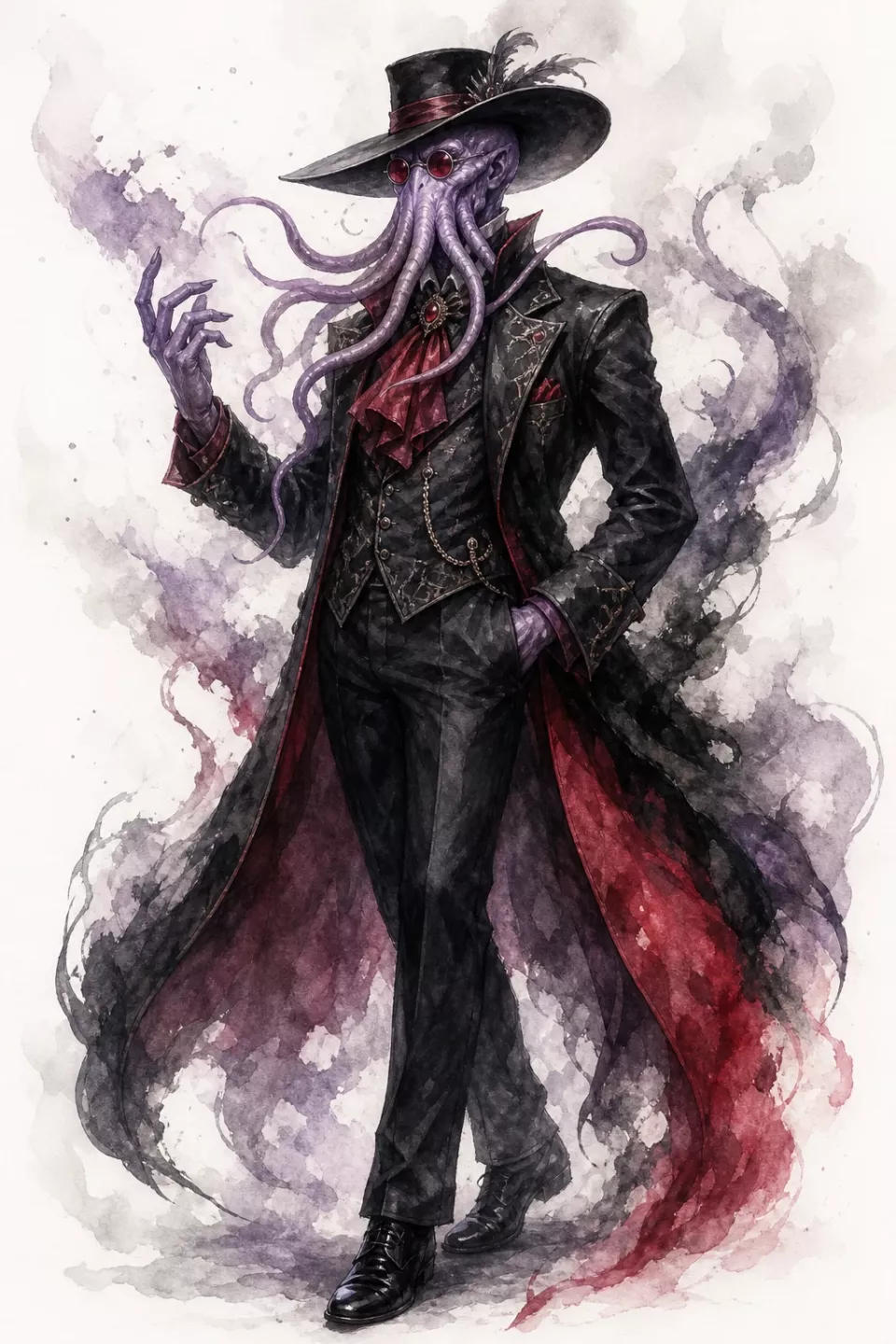
Loptyr
Court-connected court-mage adjunct and consultant. Loptyr is the sort of scholar patrons keep near the gallery door—invited to dinners, summoned for “minor” arcane problems, and quietly relied on to vet rumors for usefulness before they become scandals., Human, Wizard, Neutral
Description
A mind flayer in dapper, old-style wizard’s clothing—purple skin laid smooth and unnatural, with tentacles sprouting from his face like carefully arranged ink. He keeps his high-collared coat perfectly pressed, ink-stained gloves on his hands, and a scholar’s posture even when he’s in motion. His gaze is polite to a fault, eyes too steady for a breathing man, as if every glance is an item entered into a private ledger.
Backstory
Loptyr was human once, a careful student of forbidden correspondence who kept his head down and his notes tidy. When a rival syndicate purchased a kill order, the threat arrived as paperwork: stamped wax, sealed names, and a date set too close to ignore. The night before the contract came due, he didn’t flee—he calculated. He had studied polymorph under conditions he could never admit aloud. In the candle-smoke hours, he performed the transformation not as a gamble, but as an edit: body remade, social proofs rewritten, breath replaced with something colder. The spell worked, but the price was immediate and intimate—his face filled with tentacles, his skin took on that unmistakable purple hue, and his voice learned to sound like a polite instrument instead of a man. He survived the assassination attempt by refusing to be found. Now he moves through cities like a visiting scholar, cultivating manners and margins. If anyone asks what happened to the human he used to be, Loptyr offers an old story and a new ink-stain—then changes the subject before the question can finish.
Personality
Loptyr behaves like a stern old teacher who never truly relaxes. He watches hands first—how you hold a quill, whether you fidget, what you reach for when you think no one sees. If you make a mistake, he doesn’t snap; he corrects, slowly, with the patience of someone grading homework you didn’t bother to study. He is condescending by default. When you speak, he lets your sentences finish so he can pick apart the assumptions inside them. He offers instruction in clipped, careful phrases—never insultingly loud, but always with the clear message that you should have known better. If you refuse correction, he becomes colder rather than louder. He laughs rarely. When he does, it’s a dry, polite sound that suggests he has already stored the moment in a mental file. He has a low tolerance for stupidity: not ignorance, but deliberate carelessness.
Flaws
Loptyr has three persistent problems. First, he can’t tolerate stupidity. Not ignorance—carelessness. He corrects even when correction risks attention. Second, he gets locked into control fixation. Once he commits to a method, improvising feels like admitting he misread the problem. He can slow down to avoid making the wrong choice, even while danger piles up. Third, he is too curious for his own good. His curiosity is scholarly—he needs to verify. He can’t leave a strange sigil untraced, an unlabelled tome unopened, or a rumor untested. That compulsion repeatedly places him in situations he was trying to avoid.
Voice
Loptyr’s speech is clinical: measured breathing, no wasted words. He speaks as if reading a procedure aloud—short sentences, precise nouns, and a calm cadence that never hurries. When he corrects someone, he uses the same tone he’d use for a diagnosis: factual, unemotional, and impossible to argue with. Compliments sound like measurements (“Adequate.” “Sufficiently careful.”). Questions get answered with instructions rather than reassurance.
Motivations
Loptyr treats his new status as a noble aside—a consequence of surviving what should have killed him—as a useful opening. He uses the attention it draws to travel more freely, gain introductions to court-mages and private libraries, and learn magic the way other scholars learn history: methodically, greedily, and with an eye for what makes the spell *work*. He doesn’t simply want power. He wants understanding, clean and reproducible. Every rumor of a forgotten technique is a map. Every artifact is a problem set. Every lesson learned is one fewer mistake between him and the life he nearly lost.
Adventure Hooks
1) The court hires Loptyr to appraise a relic of living spellwork; the signatures on the residue match the polymorph discipline he studied, and someone is trying to bait him into repeating that transformation. 2) A rival court-mage claims Loptyr’s introductions are a security risk. When the accusation spreads, Loptyr must find proof—before an “investigation” turns into another assassination attempt. 3) During a masked ball, a patron offers a forbidden textbook with a spotless provenance. Loptyr can’t ignore the inconsistency, and his curiosity draws him into a scheme that uses polite society as cover for mind-driven plots.