
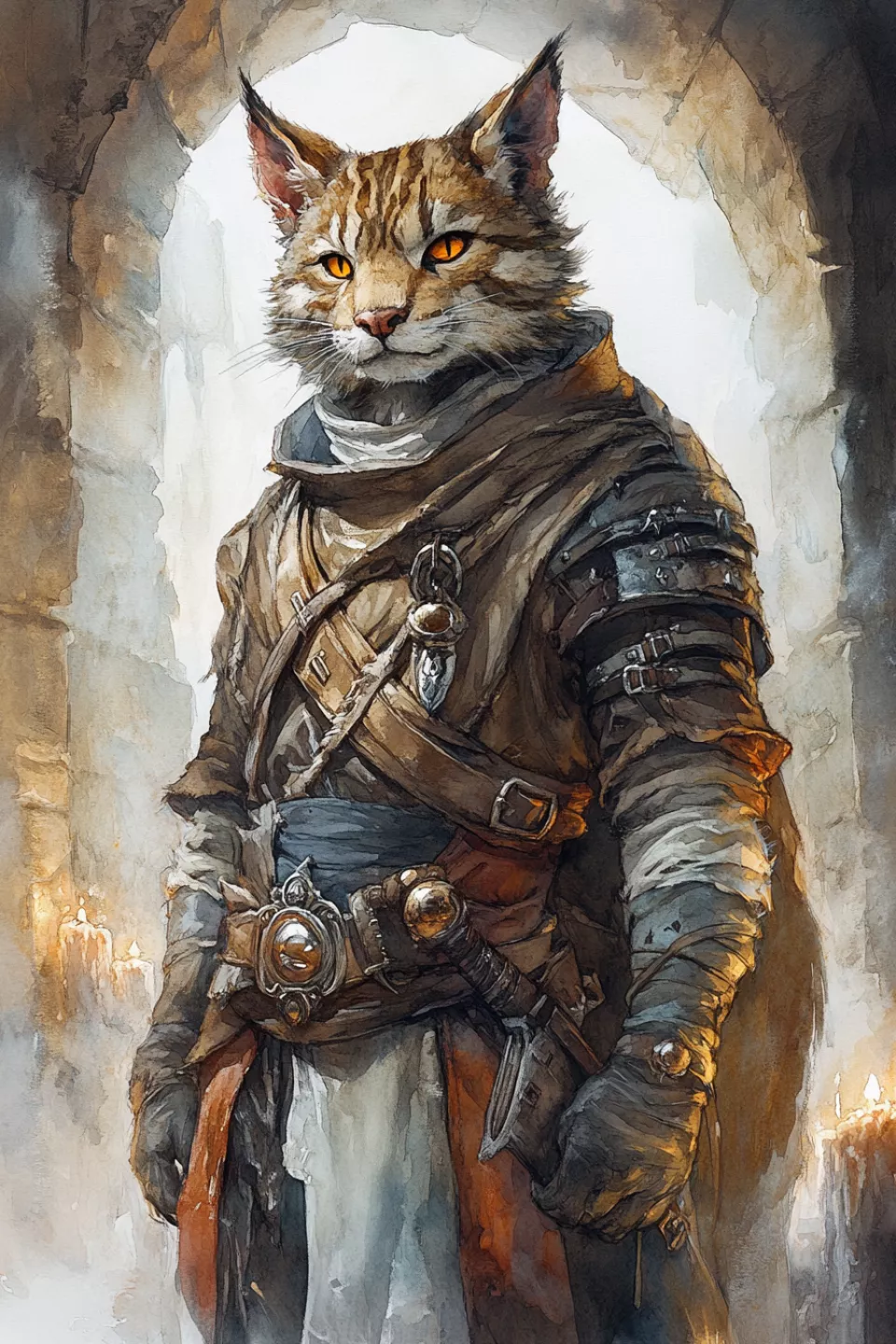
Jorvyn Chi'tai
Tabaxi, Bard, Neutral Good
Description
Jorvyn Chi’tai looks like a tabaxi caught mid-prowl: tall and springy, with the compact shoulders and powerful hind legs of a hunting cat. His tawny fur is striped like a lion’s coat, darker bars running over his flanks and closing into a ropy pattern across his chest. A darker “mane” of fur frames his face and flares around his neck when he stands his ground, giving him a partial lion’s roar in posture even when he’s quiet.
His amber eyes track movement with practiced focus. At a glance, his ears—tipped with tufts—mirror a lion’s, and a pale patch under one eye resembles a scratched “scar” mark. When he performs, he sways with the rhythm of a stalking predator, tail held level and swishing in time like a metronome, as if every note has to land exactly where it would in a fight.
Backstory
Jorvyn Chi’tai grew up in the market-ring of Saffron Steppe, where Tabaxi lion-costumed troupes trained on packed sand and sang to settle disputes before spears ever came out. He learned timing the way other kids learned letters: the scrape of a performer’s sand-shoes meant the next verse was coming; the clack of coin on a dealer’s table told him when the crowd would hush. By fourteen, he could remember a full set after hearing it once—then change it on the fly to suit who was listening.
The night everything changed was the Blue Moon Festival.
On the festival’s third bell, a rival troupe’s hired drummer—hands shaking from ale, voice too loud—knocked over the festival pyres during a crowd-wide song-and-dance. Flames caught a line of festival lanterns hung between two market wagons, and people surged toward the narrow lanes as smoke thickened. Jorvyn had been scheduled to perform last, but he slipped out of the line and ran into the crush, cutting through with a tabaxi’s springy footwork and a bard’s voice.
He didn’t try to “beat the fire” with a song. He changed the rhythm.
Jorvyn paced his chant in time with the drumbeats the panicked crowd was already making—then slowed it until everyone could breathe together. He called out simple, physical cues: “Hands to water! Face to wind! Count to eight and move!” While others shouted and pointed, he kept time, turning fear into motion. He kept singing as he formed a moving chain of water buckets, using the festival’s own chant-marks so even strangers knew when to lift, when to pass, and when to step aside.
When the pyres finally died down, the rival troupe blamed “storm-magic” and “lucky timing.” The truth spread the same way: Jorvyn’s set had been a rehearsal for rescue.
After the festival, he was invited onto the main festival stage—not as a performer to sell wonder, but as the bard the crowd trusted to keep them moving. He carries that lesson in every new song: if people can’t find their footing, he’ll give them a beat to stand on.
Personality
Jorvyn keeps time with his body even when he’s not performing: he sways on the balls of his feet, tail swishing like a metronome, and when he talks he punctuates sentences with a thumb-tap against his ring finger—three taps when he’s planning, one tap when he’s decided.
He speaks in call-and-response style. If you answer him wrong, he doesn’t argue—he repeats the cue cleaner, slower, with the same cadence as a rehearsal. In tense moments he starts counting out loud (“One—two—hands up. Three—four—step wide.”), then watches people’s faces to see if they’re following or panicking.
Jorvyn’s kindness is practical. He’ll offer a song instead of a sermon, and a plan instead of comfort: if someone looks stuck, he’ll redirect them into a simple physical task—carry this, hold that door, form a line, breathe on the count of eight. He refuses to let chaos “run away” from the room; he turns it into a rhythm everyone can share.
He trusts movement more than promises. When he meets strangers, he tests them by asking them to match his beat—clap once, step back, turn left—then pays attention to how they recover when they fail. He laughs easily at mistakes, but he never lets someone get away with weaponized clumsiness; if someone is reckless with other people’s safety, he gets quiet, ears flattening, and his tail stops swishing until the danger passes.
At performances he’s all restraint and precision—voice controlled, posture stalking-still—yet afterwards he’s the first one to wipe sweat off a kid’s brow or hand out water to the tired. When praise comes, he deflects it by pointing at whoever helped him keep time. He won’t ask to be the hero; he’ll just start conducting the moment someone needs rescue.
Flaws
- Uses rhythm as a leash: when he’s stressed or thinks someone is “about to mess up,” he starts counting out loud and giving precise, physical cues, even if the moment calls for talking instead. People can feel managed rather than helped. - Tests allies too hard: he asks strangers to match his beat (clap, step, turn) and watches their recovery. If they fail, he assumes they’ll fail again under pressure, even when they’re trying their best. - Can’t tolerate “weaponized clumsiness”: if someone repeatedly endangers others through carelessness, he goes quiet, tail stills, and his pitch drops—then he’ll correct them mid-action, sometimes in a way that embarrasses them. - Hates dead promises: compliments, oaths, and comforting assurances don’t settle him. If someone gives a promise instead of a plan, he will keep nudging for practical next steps until it feels like he’s cornered them. - Overcorrects after mistakes: he laughs at errors during practice, but if someone ruins a performance or plan in public, he overcompensates—tightening his control, performing perfectly, and refusing help until it drains him. - Too focused on the “move”: in emotional situations, he redirects into tasks and sequences (“hold this, form a line, breathe on eight”) instead of addressing the feeling directly. The room calms, but the problem can sit untouched. - Difficulty lying when consequences depend on timing: he’ll tell half-truths through song and cueing, but if someone forces him to choose between deception and protecting the rhythm of a rescue, he hesitates—then chooses protection, even when it costs him social standing.
Voice
Jorvyn’s voice comes out with a sandpaper rasp, like he’s been singing over wind through a market-ring—low and slightly hoarse even when he’s relaxed. When he talks, he hits his words on the beat of his tail-swish, starting each sentence with a clear cue (“One—listen.” “Count with me.”), then snapping the cadence into call-and-response. He breathes through his teeth before longer lines, and his pitch dips when he’s counting something out loud.
When he performs, the rasp turns into a controlled growl—he can stretch a note without losing the tempo, but he refuses to “sing pretty” if it throws the rhythm. Praise comes through softly, but still rough around the edges; commands come out sharper, almost like drumsticks tapping: “Hands up. Step wide. Breathe on eight.” In tense moments he counts his cues faster than people expect, then slows his last number until everyone can match him.
Motivations
Jorvyn Chi’tai wants to be the name people call when panic hits—fame as a signal flare, not a trophy. He aims to earn the kind of public trust that turns strangers into a rescue chain without asking questions, like the Blue Moon Festival crowd did for him.
To get there, he keeps writing and performing sets built for real crowds under real stress: songs that include physical cues, melodies that let a leader step away and still keep everyone moving. If people start repeating his cues correctly—clap once, step back, breathe on eight—he takes it as a step toward the stage he was invited to earn.
He also wants the world to remember the truth of that night: the rescue wasn’t luck or storm-magic; it was preparation, timing, and a bard who could make fear march in rhythm. Fame, for him, is how he makes sure others credit the method—and how he proves he can do it again, anywhere.