
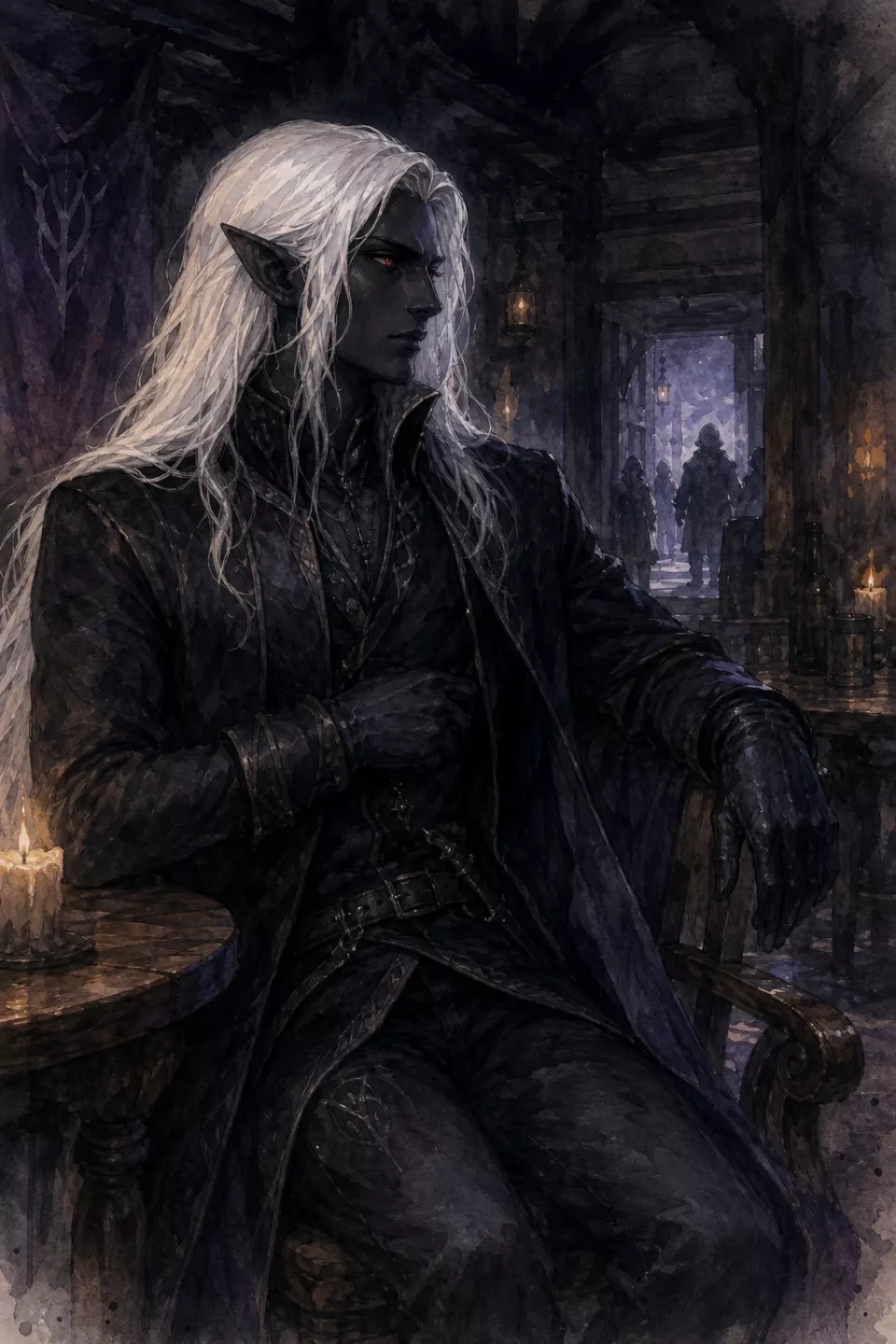
Veldarr Xiltyn
Drow, Warlock, Neutral
Description
Veldarr Xiltyn is a drow man with waist-length white hair, usually worn loose down his back, and piercing red eyes that track every movement in the room. Relatively young for a drow, he is only just reaching his 120th year. His composed face and quiet, watchful presence reveal nothing about his pact. He dresses in dark, practical layers that conceal his arcane focus and other signs of eldritch power. He chooses seats with a view of every entrance, keeps one hand near his concealed casting focus, and notices changes in a room before anyone else reacts. His red eyes seem capable of piercing straight through a person’s soul, lingering just long enough to make even hardened company look away. Almost no emotion reaches his face; only the occasional slow, unsettling smile betrays something cruel beneath his calm.
Backstory
Veldarr was six when the high elves came to the Xiltyn household beneath the old mushroom forest. They wore polished mail and white cloaks, claiming to purge a nest of raiders. His father reached for a blade; his mother pushed Veldarr behind a water cask. Neither survived the first minute. The soldiers killed his brothers in the corridor, then dragged his mother into the lamplight so Veldarr would watch her die.
Veldarr had a twin brother, Xevryn, born minutes before him and seldom more than an arm’s reach away. They slept beneath the same blanket, hunted pale cave crickets together, and learned to read one another’s plans from a twitch of the fingers. When the soldiers entered, Xevryn shoved Veldarr toward the water cask and ran into the corridor to draw them away. Veldarr saw the white flash of a sword before the falling corpse hid him from view. He never learned whether Xevryn died first or last. In the burial chamber, the voice found a boy who had survived his own half—and Veldarr has treated every bond since as a weakness someone will eventually exploit.
He lived because one corpse fell across him. Beneath his father’s body, breathing through blood and spilled lamp oil, Veldarr listened to the elves search the rooms. Before dawn, he crawled into a drainage fissure and followed it until the tunnels opened into a forgotten burial chamber.
For three days he drank condensation from the stones and chewed fungus scraped from the walls. A voice found him there in the dark—not kind, but patient—and offered power enough to ensure no one would ever decide his life was worthless again.
Veldarr emerged changed. He trusts no uniform, no oath, and no smile sharpened by privilege. High elves receive his silence, his scrutiny, and nothing freely given. He does not seek indiscriminate revenge; he wants names, proof, and the moment each killer realizes the child they spared has come to collect.
Years later, while searching a collapsed shrine beneath the old mushroom forest, Veldarr found an ancient book sealed in black hide and dusted with bone ash. Its pages recorded pacts, vanished covens, and warlocks who had traded years, names, or blood for power. He read by stolen candlelight until the wax drowned the table, drawn less by promises of strength than by the proof that others had survived such bargains. From then on, he studied arcane power with the same patience he gave to vengeance.
The place had been called a shrine by the few maps that marked it, though the word proved generous. Veldaar found no carved god waiting above an altar, no worn relief of a saint or demon, no alcove where offerings had once gathered beneath the watch of a deity. The deeper he went, the less the ruin resembled any place built for worship.
It was a temple, perhaps, but built for a purpose no living tradition remembered.
Half-collapsed corridors twisted beneath the old mushroom forest, their ceilings broken where roots and pale fungal shelves had forced their way through the stone. Dust lay thick across the floor, undisturbed except for the marks of Veldaar’s boots. Some passages ended in sunken rooms where the floor had dropped several feet below the threshold. Others narrowed until he had to turn his shoulders and pass between walls slick with black moisture. The air smelled of wet stone, old ash, and something metallic buried beneath both.
He found no internal shrines. No statues. No names.
In one chamber, nearly bare save for a row of ancient stone bunks, he paused beneath a ceiling split by a jagged seam. The bunks had been carved directly from the walls, each one shallow and narrow, their surfaces worn smooth by bodies long vanished. There were no blankets, chains, vessels, or tools to explain who had slept there. Only shallow grooves scored the stone near the head of each bed, as though generations of restless hands had clawed at it.
At the next intersection, Veldaar stopped.
The passage ahead ran straight. The passage to the left descended toward a flooded darkness. The passage to the right was choked with fallen blocks.
Something inside his thoughts turned him toward the right.
It was not a voice. It carried no sound, no words, and no feeling he could name. It was simply an inexplicable certainty that the blocked passage was the one he needed. Veldaar studied the rubble, found a narrow gap, and crawled through.
Beyond it waited a large stone door without a handle, hinge, or visible seam. A symbol had been carved into its face: a four-pointed star unlike any mark in his memory. Just inside each point sat a single carved eye. Beneath the shape ran a straight horizontal line.
Veldaar traced the symbol without touching it. The stone held no magic he recognized, yet the air around it pressed against his skin like the hush before a spell.
He placed both hands against the door and pushed.
Nothing happened.
The thought returned.
This time, it carried a demand.
An offering.
Veldaar drew his dagger. He opened his left palm with one clean cut and pressed the bleeding hand against the symbol. His blood ran along the carved lines. Before it could drip to the floor, it lifted from his skin and filled the four-pointed star, the eyes, and the line beneath them. The entire mark turned blood red.
The wound in his palm vanished.
The door opened with a horrible grinding of stone. The sound rolled through the temple, waking echoes in rooms Veldaar had never seen. Dust poured from the ceiling as the ancient slab dragged inward.
Inside waited a medium-sized chamber, bare except for a singular altar at its center. Four torches stood in the corners. They ignited as Veldaar crossed the threshold, each flame burning a dim purple that gave no warmth.
A black book rested upon the altar.
Its cover was darker than the surrounding shadows, sealed in hide with no title, clasp, or ornament. Beside it stood a shadowy humanoid figure, still as a statue.
Veldaar approached with one hand near his dagger. Purple light touched the figure’s outline, then its shoulders and arms. The shape resolved into an orc—fairly muscular, broad through the chest, and watching him from beneath a lowered brow.
The orc sat cross-legged beside the altar, his hands resting on his knees as though he had been meditating in the darkness for hours. He opened his eyes and studied Veldarr without surprise.
“My name is Groknar,” he said. His voice was low and rough. “A mutual party has been watching you, Veldarr.”
Veldarr’s hand remained near his dagger. “Then they have poor taste in entertainment.”
Groknar’s mouth twitched, though it did not quite become a smile. He reached toward the altar and lifted the black book.
“They believe you are ready.”
He held it out. Veldarr did not take it at once. The book gave off no visible aura, yet the purple flames bent toward it, their light thinning around its edges. At last, curiosity overcame caution. His fingers brushed the cover.
A voice rasped through his mind.
Blood remembers. Blood binds. Blood opens the way.
The chamber vanished.
Veldarr stood in a realm without ground or sky, surrounded by darkness so complete it seemed to press against his eyes. Far ahead floated a four-pointed star, each point marked by a single eye. A straight line ran beneath it, exactly as it had on the temple door. The symbol turned slowly in the void while something vast shifted behind it.
The ancient voice spoke again, dry as dead leaves dragged across stone.
Power for release. Strength for service. Bind yourself, and I will place a portion of myself within you. In time, you will free me. Until then, you will answer when called and perform the favors I set before you.
Veldarr looked into the four eyes. “And if I refuse?”
You return to the dark with nothing.
He thought of the white cloaks beneath the mushroom forest. He thought of Xevryn’s hand shoving him toward safety, and the sword flashing in the corridor. Then he extended his wounded palm.
Blood rose from the cut and hung before him in a red, trembling thread. It shaped itself into letters Veldarr could not read, yet understood. He pressed his hand against the unseen contract. The blood spread across it, sealing the pact.
Pain burned through his arm. The four-pointed star flared crimson, and the darkness broke apart.
Veldarr returned to the chamber on one knee, his palm clenched against the stone floor. The book lay open on the altar. Its cover now bore the four-pointed star, engraved so deeply that no light reached the bottom of its cuts. The four carved eyes seemed to follow him.
Groknar watched in silence until Veldarr rose.
“What did you bind yourself to?” the orc asked.
“Something that expects to be obeyed.”
“That is not an answer.”
“It is the one you have earned.”
Groknar considered him, then reached into a fold of his dark clothing and produced a smooth stone the size of a small egg. The same four-pointed star had been carved into its surface, complete with four eyes and the line beneath them. He placed it in Veldarr’s hand.
“Keep it close,” Groknar said. “When the time is right, I’ll call you.”
The purple flames went out.
For one breath, Veldarr saw Groknar standing in the darkness. Then the orc was gone, leaving only the black book, the marked stone, and the faint smell of blood.
Personality
Veldarr speaks in an even, authoritative voice that seldom rises above conversation yet leaves little room for argument. He studies doorways, reflections, hands, and exits while appearing to listen without concern. He lets others reveal their intentions first, answering questions with careful half-truths rather than direct lies. Sudden movement earns a quiet glance, never an obvious flinch. He keeps most people at a measured distance, offering neither familiarity nor confidence without cause. Those who earn his trust discover a fiercely loyal friend who remembers every kindness, stands beside them without hesitation, and answers betrayal with finality.
Motivations
Veldarr pursues knowledge with a hunger that no discovery can satisfy. He studies forbidden grimoires, dissects old pacts, and questions survivors long after their answers have become painful, believing every secret might reveal how power can be taken from those who wield it. Beneath that pursuit burns his hatred for the high elves who slaughtered his family and left Xevryn’s death uncertain. He refuses reckless violence; he gathers names, witnesses, relics, and proof, waiting until each target can understand why death has found them. Every alliance is measured by what it teaches him and whether it brings him closer to the white-cloaked killers he has never forgiven.
Flaws
The sight of a high elf—especially one wearing white clothing or the crest of the soldiers who slaughtered his family—can shatter Veldarr’s practiced composure. Anger floods him with the memory of Xevryn’s last stand, and bloodlust drowns out caution, evidence, and orders. In that moment, he may expose his pact, abandon a careful plan, or attack before learning whether the elf had any part in the massacre.