
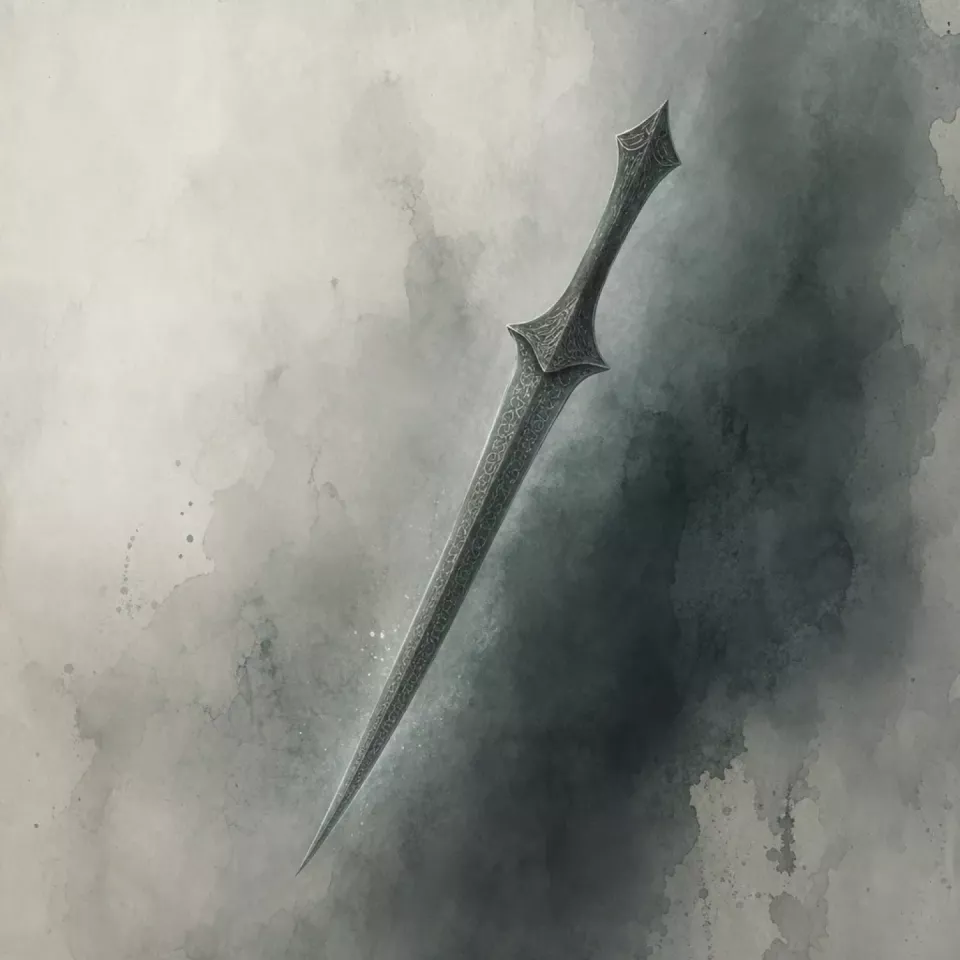
Boop
Tool, Very Rare, Requires Attunement
Forged at the kitchen-table height of grief, the katana is the color of rainwater trapped in smoke—dark steel that never quite settles on one shade. When the wielder brings it close to a lantern, the surface drinks the light and gives it back as a thin, oily shimmer, like a blade slick with shadow; the edge hums with a low, breathy pressure that makes teeth ache. The maker’s ritual left no “aura” the way bards describe magic—only a sense that the metal remembers heat and then refuses it, as if it learned what burning does. The demon-spirit inside does not roar; it leaks. A cold taste rides the back of the tongue when the sword is drawn, and for a heartbeat the air smells of wet stone and ash. Its curse is personal: every time it’s lifted with anger, the katana draws up a flood of the father’s last tears—cold, salt-crusted, unstoppable—until the wielder’s hands want to tremble the way they did the day it was made.
Description: Tetsusaiga is a broad-bladed katana sized for a medium creature, its profile a little heavier near the guard than a typical sword. The steel is dark iron with a wet-looking sheen, as if it were carved from riverstone; when it catches lanternlight, the reflection breaks into thin, overlapping ripples along the fuller. Near the base of the blade, the metal shows a faint, crescent-shaped grain that looks like breath fog on cold glass—most noticeable when you exhale over it. The hilt is wrapped in black cord tightened so evenly it gives the grip a faint ridged texture under the thumb. A simple handguard frames the blade in a crescent pattern, and the scabbard is the color of old lacquer, scarred with shallow gouges that never quite deepen. The weapon’s weight sits where your forearm expects it—fast to draw, harder to disarm.
Significance: In the hands of its first wielder, Tetsusaiga ended threats that couldn’t be stabbed through—only resisted, worn down, and turned aside. People who have seen it describe the same moment: the air thickens, the world seems to measure distance in heartbeats, and then the blade and its wearer become a single, deliberate target. Tales agree on one detail no one argues about: the sword does not “transform” by accident. When the wielder is desperate, it chooses the kind of protection required—wind for arrows, steel for claws, and a hard refusal for things that try to borrow the body. Superstitious companions swear that the sword dislikes careless promises; it tightens the grip in the hand the moment someone lies about what they’ll do.
Special Powers or Traits:
Transforming Retort (Special, Protective): When you are hit by an attack you can see, Tetsusaiga flares with a brief, audible snap like a drumskin under strain. Until the start of your next turn, you gain a protective ward against that strike’s source and its follow-through. While the ward is active, you have resistance to the triggering damage type, and you can reduce the triggering damage by an amount equal to your proficiency bonus (minimum reduction 1). If the attack was made with a weapon, the ward’s snap ripples along the blade’s edge and creates a small “deflecting arc” that also imposes disadvantage on the next melee attack roll made against you before the start of your next turn.
Guard of the Iron Crescent (Defensive Trait): When you take the Dodge action, you may choose to mark one creature you can see within reach. Until the start of your next turn, attacks from that marked creature that deal melee damage have their damage reduced by an amount equal to your proficiency bonus (minimum reduction 1). The marked creature feels it as a tug at the wrist—its swings feel fractionally late—until it disengages.
Fighting Temper (Weapon Trait): Tetsusaiga’s edge stays unnaturally responsive. While you are holding it, you ignore the first level of exhaustion you would normally gain during combat (you still gain exhaustion normally, but the first step doesn’t take hold until after you’re safe).
Truthsteel (Oathlike Condition): When you speak a vow—whether sworn to an ally, to a kingdom, or to yourself—Tetsusaiga’s metal cools, and the blade’s crescent grain turns sharply defined. For 1 minute, you have advantage on saving throws against being charmed, frightened, or compelled to move against your will. The vow can’t be about hurting innocents or breaking your own stated limits; the sword won’t hold up a lie meant to turn cruelty into permission.
Scabbard Silence: Drawing Tetsusaiga from its scabbard doesn’t create sound. Its motion is fast, but quiet enough that most sentries only notice the shift in wind. If the scabbard is used to sheath the sword as part of ending combat, the sword’s presence quiets further—DC 13 Wisdom (Perception) to notice you’re armed, even for creatures already looking in your direction.
Lore (optional to read at the table): The Thornwood didn’t just feed blades; it taught them. Tetsusaiga was forged after a hollow vow—someone promised safety to a village, then walked away to survive. The forest remembered the missing protection and made the sword remember it back. Since then, the blade rewards commitment and punishes careless choices the same way: it turns force into steadiness when you truly mean to stand.
Description
A katana that looks almost ordinary until it’s in motion. The steel is the color of old rainwater, dark when still and brighter along the edge when the light catches it—only at the very line where it would cut. The wrap is tight black cord, salt-rough in places where hands have sweated through it, and the guard is a simple iron tsuba punched with repeating half-moons that never align the same way twice.
The blade’s sharpness isn’t just high-quality tempering. It hums the moment you draw it—quiet, not audible so much as felt in the teeth and fingertips. The edge slices air with a sound like silk tearing, a whisper too fast to track. When you set the katana down, the metal doesn’t ring; it drinks the noise, leaving the room too still for a heartbeat after impact.
What makes this katana overpowering is the way the edge behaves. Ordinary katanas want to meet resistance. Boop wants to remove it. Strikes land with a certainty that doesn’t come from technique alone: the cut opens a path that the target’s armor and sinew can’t fully agree on. Cloth parts cleanly as if it were paper. Leather stretches, then tears in a straight line. Chain rings stay linked a moment longer than they should, then abruptly decide to come apart—links separating along the cut as though the blade suggested the outcome.
A look along the spine reveals the second feature. Near the base, a shallow groove runs the length of the katana, but it isn’t forged into the metal. It’s filled with faint, smoked-gold script that smears when you stare too hard. The ink-like pattern doesn’t sit on the surface; it seems to sink a fraction deeper the longer you hold the grip. When combat begins, that groove warms from dull to hot, and each swing draws a thin line of heat through the air—visible only to you and only when you’re moving with purpose.
Boop also overpowers the wielder, not just the target.
In combat, you fight faster than your body expects. Your first step comes before you decide on it. Your guard rises a fraction early. The katana “helps” by nudging your timing toward angles that guarantee clean separation. Enemies feel this as bad luck: every block looks solid for half a second, then fails in the last instant.
The blade makes bad decisions feel impossible. If you hesitate, the katana seems heavier than it was a moment before, as if it’s disappointed in your indecision. If you commit—if you commit fully—the weapon gets lighter and the world narrows to reach, edge, and follow-through.
The sharpness reads intent. A feint that’s meant to mislead becomes a threat the instant steel touches air. If you swing to wound instead of to finish, Boop still cuts like it believes the wound should be final.
After the fight, your fingers remember the cut even when there’s no blood. The cord wrap leaves faint pressure marks on your palm hours later, and the groove’s smoked-gold script cools slowly, as though it’s still tallying what it removed.
Most ordinary katanas are tools: they require skill, fatigue, and upkeep. Boop is a verdict in steel. It makes every exchange feel one-sided, not because your enemies are weaker, but because the blade insists that resistance is optional. Once it’s drawn, you don’t just threaten the battlefield—you change the rules of what the battlefield is allowed to keep.
Lore
The wardens of the Thornwood carried nine such blades, forged — the stories say — from the tooth of something the forest kept asleep. Eight burned with the heartwood groves. The ninth rides at the hip of Kaelen Thornwood, who took it from his captain's body and has carried it toward The Marrowmaw ever since.
The blade grows cold in the creature's presence — which makes it the finest compass in the world for exactly one destination.
Properties
Keen. You gain a +1 bonus to attack and damage rolls made with this magic weapon.
Soundless. While holding Whisperfang, you have Advantage on Dexterity (Stealth) checks made to move silently.
Tooth remembers. Within one mile of the creature whose tooth forged it, the blade is painfully cold to the touch.