
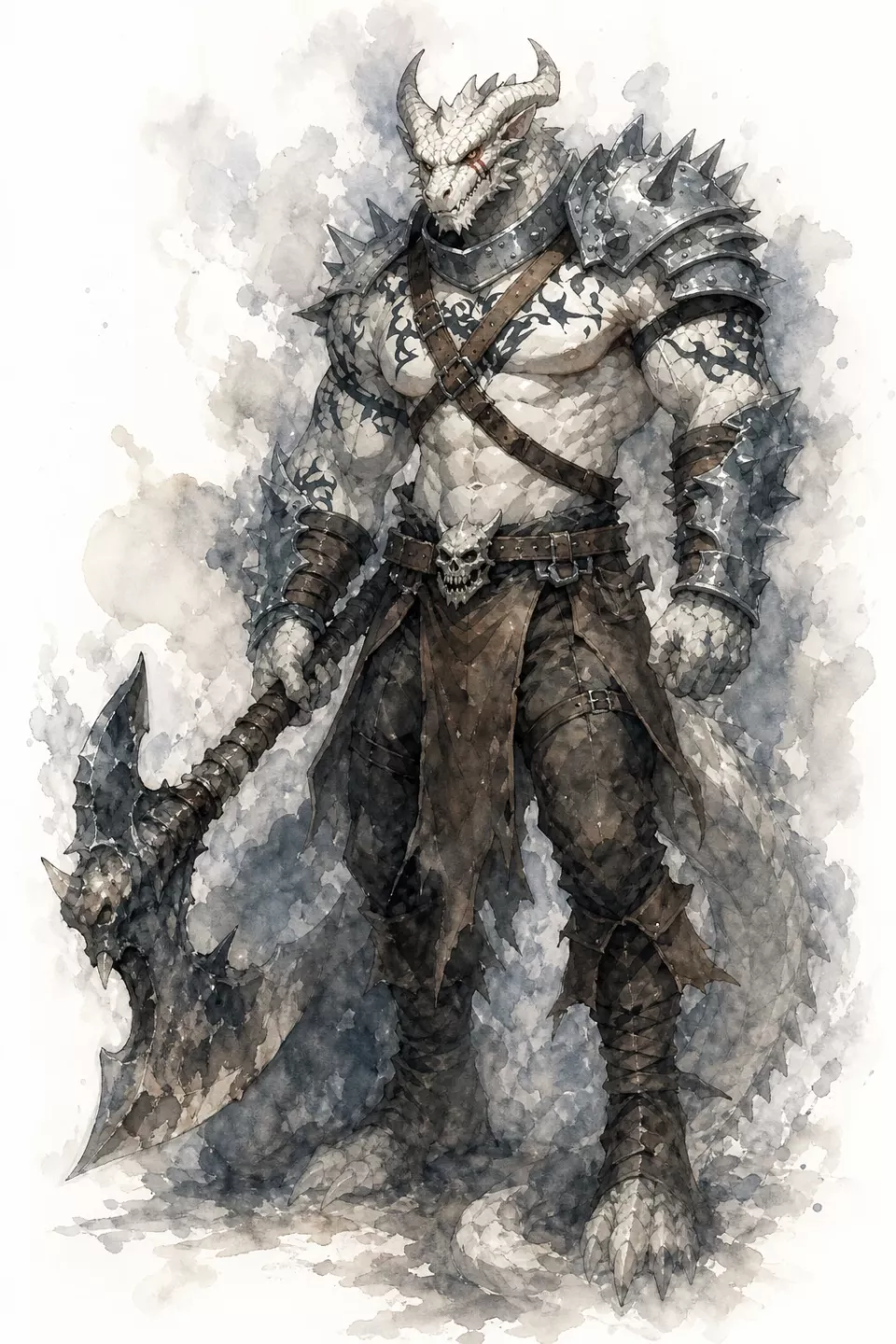
Caligula
Dragonborn, Barbarian, Chaotic Evil
Description
Caligula stands like a walking siege engine—hulking, broad in the shoulders, and built for impact. His skin is scaled a hard, weathered brick-red along the ribs and arms, with darker ridges running in blunt lines down his torso. When he moves, his bulk shifts with weight, not grace: heavy steps that make the floor complain, shoulders rolling as if he’s carrying invisible armor even when he isn’t.
His eyes are a hot, red glare—too bright to look away from. One of them sits under a ruin of scars and damage: a gash slashes through his right eye socket, the cut splitting the brow and browbone like a smashed helm. Dried blood and healed tissue catch the light in thin, uneven bands, and the right eye always looks slightly “off,” as if his gaze lingers at the edge of the world rather than at you.
Two large horns jut from his skull, white and chalky in color, thick at the base and curling outward with jagged tips. They’re scarred and nicked along the edges, as though they’ve been struck by weapons or stone more than once. His face is all spikes and angles—cheek ridges that taper into blunt points, a heavy brow that crowds forward, and a muzzle marked by rough scaling that makes his expression feel like it’s always ready to snarl.
On his left shoulder, a spiked metal pauldron guards the joint like a crude battering ram. The metal is dented and darkened, its spikes uneven in length, some bent slightly, some sharp enough to catch fabric and skin. It sits over his armor plates with rough, functional fastenings rather than elegance—bolts and straps that look meant to survive being hit, not to impress.
Around his muscular body is a large metal neck guard, thick enough to deflect a glancing blow. It wraps his throat and upper chest, secured with a leather belt drawn tight at the sides. The leather is scuffed and oil-dark, worn where it bends with him, its edge frayed from heat, sweat, and hard living. Under the metal, his chest and arms bulge with corded strength—muscle that doesn’t look trained so much as earned through repeated violence.
His hands wear metal gauntlets, heavy and blunt with reinforced knuckles. The plates are scratched and dulled, as if they’ve been dragged through sand or pounded against armor. Between the fingers, gaps of dark grime show where the metal meets skin and where blood has dried and been cleaned and dried again.
His legs are wrapped in ragged leather pants that hang tough but battered—stained at the knees, wrinkled at the hips, and torn along the outer seams like they’ve survived more than one close call. A belt cinches them at the waist, fitted with a demon’s skull as a buckle: bone-white with cracked, carved ridges, its empty eye sockets catching light when he turns. The skull sits forward, heavy and unmistakable, as if it’s meant to announce what he believes in—or what he’s done.
Most of the time, Caligula carries a massive battle axe in both hands or slung within reach. The weapon is crude rather than refined: the head is thick and heavy, edges battered into an irregular bite, with tool marks still visible where it was forged and re-forged. The haft is scarred and wrapped where grip is needed—leather strips and frayed cord that look replaced mid-crisis. When he shifts, the axe head bumps his leg with a dull metal thud, always ready, always present.
Caligula’s presence is a loud thing even before he speaks. The moment he crosses a threshold, conversations drag to a stop and then start again—quieter, tighter—like people have learned what his footsteps sound like. His heavy steps land with a complaint in the floorboards, and he takes up space the way a brawl takes up a room: shoulders squared, chin pushed forward, grin too fast to be polite. He doesn’t look around so much as measure exits and weak spots, eyes flicking to hands, to coins on tables, to anyone who looks like they might throw the first insult.
He talks like he’s already winning. Every sentence comes with a mockery, a boast, or a dare tucked into the end of it, delivered with a hearty, boisterous laugh that makes it hard to tell whether he’s joking or only pretending. When someone refuses him, his smile doesn’t soften—it sharpens, like he’s thinking of the quickest way to change their mind. He claps people on the back a second too long, then watches their face when he lets his knuckles sit against bruises that aren’t his. If a barmaid flinches, he leans in and grins wider, as if discomfort is just another kind of invitation.
Caligula is all momentum and noise. He drums his gauntleted fingers in the rhythm of punches, rolling his left shoulder as if stretching for the first hit, and he’s always balancing a threat on the edge of laughter. When he’s pleased, he gets louder; when he’s annoyed, he gets louder faster. He’ll tell you his story in chunks between challenges—how he survived last time, how he ruined someone worse, how the next time will be bigger. He rarely waits for an opening; he makes one, often with broken furniture and a grin that says he’d rather be in the middle of the mess than standing safely on the edges.
The thrill of fighting runs through him like a second heartbeat. Caligula is frequently involved in tavern brawls, barging into arguments that aren’t his and turning them into spectacle—knocking over dice tables, yanking men by their collars to “settle it properly,” then cheering when blood starts painting the floor. He’s the kind of customer who never just watches; he pushes for the next round, drags strangers into side bets, and boasts about how he’ll do the other fighter’s work for him—cheaper, messier, and with more noise. When he hears about gladiator contests, he’s there early enough to talk trash before the banners even settle, trading insults like coin and trying to bully the match into becoming his stage. If a master won’t hire him, he’ll find the mercenary captain who will—then show up at the camp the way a storm arrives: loud, hungry, and ready to swing first and explain later.
Even when he’s “calm,” his body argues with the air. His right eye always seems fractionally off-center, giving his glare a constant, predatory focus that doesn’t drift politely to your face and then away. His axe feels like an extra limb—when the weapon shifts, the thud on his leg sounds like a decision being made. People learn quickly that with Caligula in the room, trouble isn’t coming; trouble is already picking out where it will land.