
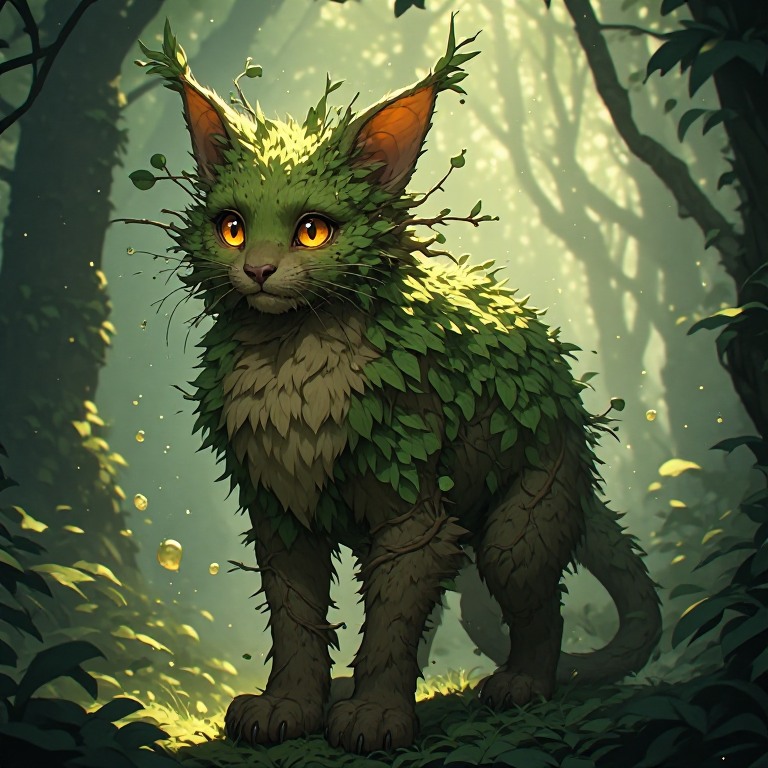
Moss Kitten
Fey
Description
Moss kitten fits in the crook of a cloister wall or at the foot of a kitchen stool—no taller than a house cat’s shoulders, with a compact body built for slipping through hedges and roots. Its fur looks like damp felt at a glance, but on closer inspection it’s threaded with living moss. The strands clump around its legs in soft, uneven mats, and tiny beads of water cling to the pile as if the creature has been sleeping in shade.
Where its face should be all whiskers and alert ears, the forest has begun to write its own script. From the mossy fur sprout tufts that resemble miniature ferns, and its whiskers—dark, wiry lines—trail from the muzzle like roots searching for soil. The kitten’s ears are real cartilage beneath the green, but their edges are scalloped with moss growth that overhangs slightly, giving the head a rounded “leaf bud” look. Its eyes are bright, warm, and wrong for a cat: pale amber irises with faint rings of darker green at the rim, like a seed seen from too close.
As the moss kitten grows older, the change becomes unmistakable. Along its back, shoulders, and the ridges of its spine, pale stems push up from beneath the moss-fur in tidy rows. At first they’re no thicker than sewing thread, but they thicken as they rise, lifting the fur like a garden bed disturbed by new shoots. When the stems bloom, the flowers open in a handful of colors that seem to break sunlight into bands—candy-pink petals, thin bands of blue and violet, gold at the center—like a stained-glass window collapsed into a paw-sized creature. The blooms scent the air lightly: wet stone, crushed herbs, and a hint of sweet sap.
Its paws press with the weightless confidence of something used to living carpets. The pads are slightly darker than the rest of its fur, slick with moss sheen, and the claws are short and clean, barely visible beneath the greenery. Small dark smudges—almost like pawprint stains—mark its forelegs and the base of its tail, spots that never fully fade and never spread.
They don't wear clothing, but they carries their own adornment: bits of leaf and dried seed fluff snag in its fur at the edges, as if it often squeezes through brambles and always returns with something gathered. When it walks, the moss shifts in slow waves, and the rainbow blooms tremble at the slightest breeze, casting brief, colored flashes across the ground beneath it—enough to make the creature feel like a living garden fragment that learned how to purr.
Lore
Playful in the way a thrown acorn is playful—quick, purposeful, and never entirely accidental—moss kittens move through the dryad groves as if the trees are their shared toy. They sprawl in forks of branches and drape themselves along bark ridges, paws tucked under ribbed green fur that looks soft until the light catches it and you notice it’s dotted with living specks of moss. When the day warms, they lounge closer together, forming little clustered wreaths like sun-baked nests, and they spend long minutes watching swaying leaves rather than anything farther away. Their mischief is patient: a moss kitten will steal a ribbon left on a branch, shove it into a hollow behind a knot of wood, and then sit upright as though it’s pleased with the theft, tail flicking once every few breaths.
A dryad’s tree is the common landmark for where they belong. Moss kittens favor trunks that hold shallow hollows and branches that stay dry even in mist, because their fur holds dew like a sponge. At sunrise they rub their faces along bark the way cats do, leaving behind a faint green scent—plant-sap and crushed herb—then they roll in leaf litter until their bodies are mottled with safe camouflage. They’re usually quiet, but when a nest turns playful the forest fills with soft, purring chirps and the bright click of tiny claws on wood. If danger approaches, their behavior changes instantly: they stop batting at loose twigs and start pressing to the same limb, close enough that a stranger’s glance can miss them entirely.
Their homes can be found in two forms. Many nests live inside hollow tree trunks, where the interior is lined with softened moss and a mat of vine fibers strong enough to spring back when kittens tumble over it. Those hollows have a habit of staying dry even during heavy rain, as if the bark itself knows to seal and vent at the right times. Other nests are built rather than occupied: with quick fey magic, the kittens coax grass, vine strands, and curled leaves into a basket beneath the treetop, a shallow cup that sits just above a safe drop. The “construction” looks like a natural knot of roots at first glance, until the vines tighten with deliberate tension when kittens move in. The magic is subtle and local—no fireworks, no towering spell—just the feeling that the tree is suddenly willing to become furniture.
A nest has telltales that seasoned woodsfolk learn to read. Look up, and you may find blooms in the wrong season—small, stubborn flowers tucked into bark creases that shouldn’t survive the weather. Follow them down the trunk and you might see fruit ripening early or staying green longer than it should, clustered where kittens can reach it from a favorite limb. Sometimes the leaves near the nest are slightly more vibrant, as if the tree is spending extra energy to keep a promise. If you find those out-of-season blooms and the nearby hollow always feels faintly warm to the touch, you’re likely watching a moss kitten home—whether the kittens are visible or not.
Moss kittens hunt in a low, opportunistic way. Small birds are their most frequent prey, snatched from careless perches or coaxed into striking distance by a single kitten’s exaggerated, harmless “skitter” motion. One pretends to chase its own tail, another slips along the underside of a branch where the bird can’t see it, and the group waits until the flock’s attention narrows to the nearest movement. They also take fruits and nuts—fallen hazelnuts, crabapples, berries that cling too stubbornly to their branches—but the amounts they consume never seem to match their activity. Hunters who’ve tracked a nest swear they return to their favorite hollow and find only a few scraps: a shell half-cracked, a bite-marked fig skin, a feather or two. The kittens do not appear to overeat. Instead, they soak in sunlight and warmth with a hunger that behaves like plants. After a clear afternoon, their fur looks newly thick and springy, as though it grew more moss in the sun’s last hour. At dusk they stop scrambling and settle into the brightest patch of tree-light they can find, bodies relaxing as if the forest itself is feeding them.
They are communal by nature. A single moss kitten is rarely seen alone for long; it either returns to others or vanishes into the canopy where it will be joined. Most nests hold six to ten kittens, sometimes more in old groves where many trees stand close enough for easy jumping. These “nests” have rules the forest understands. The group claims a cluster of branches and a particular hollow trunk, and kittens take turns patrolling the perimeter limb-by-limb, never all at once. While one pair watches the air for birds, two keep an eye on the ground for passing squirrels, and the rest lie in a warm arc, trading small games—tapping each other’s paws, nudging acorns down shafts, or rolling a fallen seed just far enough to make a sibling chase it. The nest’s scent is a telltale sign: a mix of sap, crushed greens, and the faint musky sweetness of fruit.
Dryads, pixies, and other woodland fey often encourage moss kittens to live near their own places. A dryad might carve a small hollow into her boundary tree, leaving a pocket just big enough for a nest, and invite the kittens with a scent of crushed herbs and leaf-mist. Pixies sometimes trade trinkets—tiny shells, bright seeds, bits of ribbon—encouraging the kittens’ mischief toward targets that benefit the grove rather than harm it. The woodland fey tolerate their theft and “games” because moss kittens pull their weight in quiet ways: their presence discourages certain pests, their strengthening magic keeps shelter intact, and their nest becomes a reliable marker of safe canopy routes.
For all their good-natured nuisance, moss kittens are not foolish. When they play, they watch. When they lounge, they remember footfalls. If an intruder approaches the wrong tree at the wrong hour, the kittens don’t just scatter like frightened cats—they reposition, using the canopy like a map. One group may feign distraction by bouncing a fruit from branch to branch, leading attention away from a hollow entrance where others wait. Their communal instincts make them hard to pick off individually, and their sunlight-feeding strength means they can recover quickly after a brief disturbance—settling into warm patches, pressing foreheads to bark, and letting their moss-furred bodies drink the day back into themselves.
Tactics
Moss kittens fight like small fey with a gardener’s patience: they don’t rush; they reposition. Treat them as a perimeter predator that uses concealment first, damage second, and retreat last. In most encounters, the kittens work in a loose ring around a target, climbing where they can keep the target’s gaze spread across multiple angles.
Preferred “weapons” are their bodies and environment. Their short claws and vine-slick paws excel at gripping bark, mantling along branches, and swatting from ambush positions. They favor soft target-choice—younglings and isolated guards, then anything that hesitates or turns away. When they do bite, it’s quick: a muzzle press into flesh, a snap, then immediate motion to another limb.
Tactics by scenario:
Open ground: kittens bunch at the edges of cover (bush lines, low stones, fallen logs). One or two perform exaggerated “skitter” motions—darting sideways, feinting a pounce, then stopping just out of reach—to pull attention while others slip through roots and rise up behind.
Narrow interior spaces (caves, cloisters, ruins): they treat walls and ledges as hunting lanes. One kitten “holds” a position above or along the ceiling line while the others funnel movement, forcing prey to choose between forward pressure and flanking claws.
Against a climbing or ranged threat: they spread vertically—one climbs higher, one stays mid-level on a trunk ridge, another drops to line up a bite as the target reaches. They rarely all engage at once; instead they trade turns to keep the target guessing.
Against heavy melee: kittens go for distraction and repositioning. They bat loose twigs, shake fruit, and knock pebbles from bark seams to break footing. Once the front line stumbles or reorients, the kittens dart for ankles and hands, then retreat into a nearby hollow or behind a thicker trunk.
Special maneuvers:
The “branch-to-hollow misdirection”: a pair bounces acorns or fruits from limb to limb, drawing eyes toward the movement while the rest funnel toward the trunk hollow entrance. The visible kittens don’t fully commit—only until the target’s stance shifts.
Dew-and-camouflage reset: if a kitten is damaged or exposed, it immediately presses to bark and lets moss fur dull its outline, then crawls a few inches along the trunk to a new silhouette. The group repeats this pattern rather than fighting to the death.
Sun patch recovery: after a brief clash, surviving kittens disengage and regroup into the brightest available tree-light, purring and settling into warm arcs. They stay motionless long enough for players to think the threat ended, then reappear from the same angles when attention relaxes.
In general, a moss kitten group aims to separate a target from the safer line—pulling them toward a tree hollow, a bramble edge, or a drop—then punishing the moment that target reaches, stumbles, or looks away. If the party remains coordinated and watches multiple angles, the kittens shift to harassment only: small bites, feints, fruit thrown for distraction, and rapid climbs until the group can choose a better opening.