
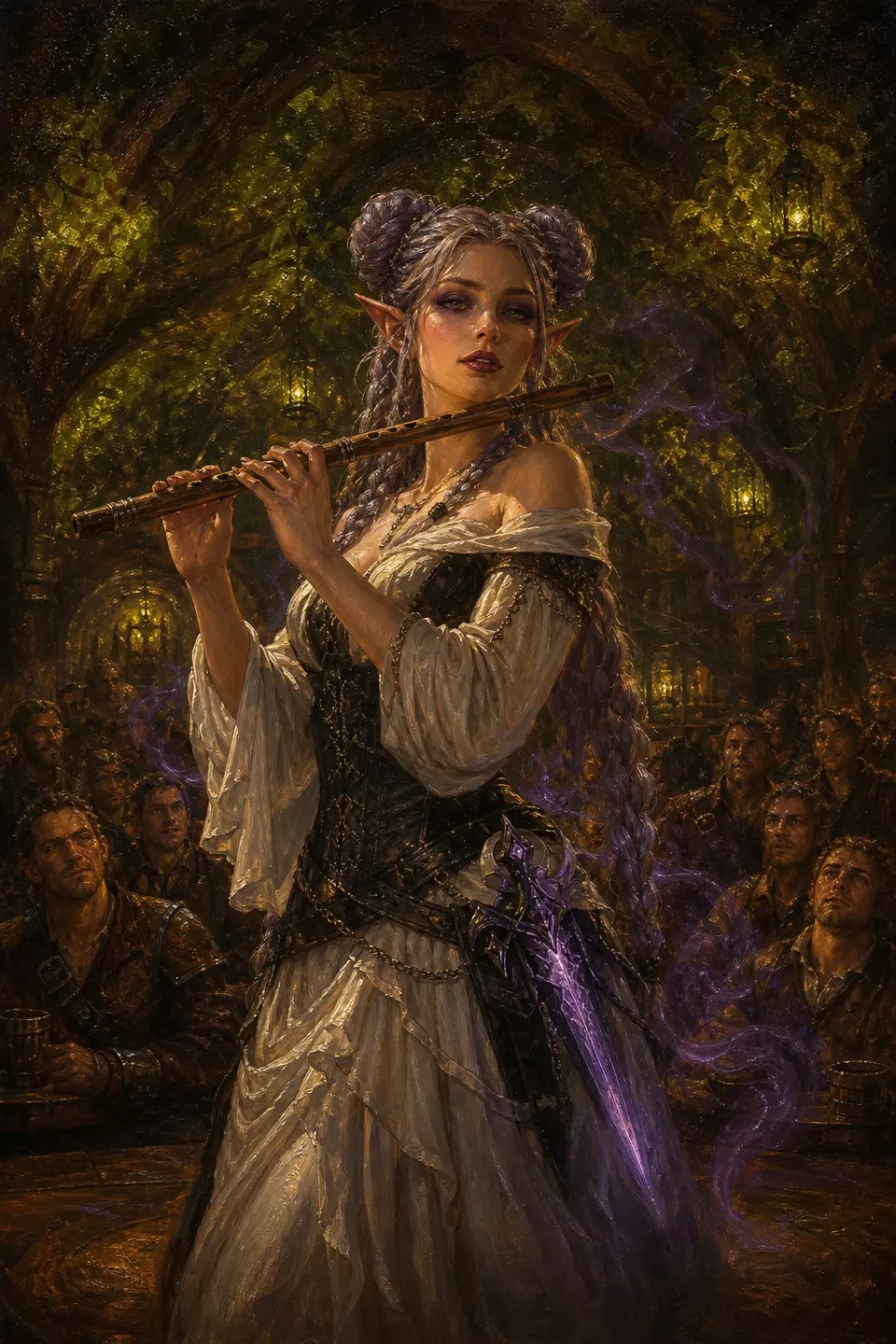
Morrigan Corsicus
Wood Elf, Bard, Chaotic Good
Description
Around twenty-five years old, Morgan is of average height with a lean, lithe build. Her light purple-grey hair is arranged in two braided buns high on her head, with two long braids flowing down her back. She has soft purple eyes framed by dark purple smoky eyeshadow and berry-red lips. She wears light, flowing black armor that moves like layered cloth while protecting the vital points beneath it. A shadow blade rests in her hand, its dark edge suited to the quiet precision of her bardic fighting style.
Backstory
Morrigan grew up above her family’s tavern in the city, surrounded by spilled ale, roasting meat, and rain-soaked cloaks. As a child, she slipped from her chambers after dark and hid near the common-room stairs, listening to travelers sing of faraway lands and heroes who had survived brutal battles. She learned the shape of the world through those songs before she ever saw it herself.
She grew close to Rildor, an old, blind halfling who played the flute beneath his companions’ stories. Morrigan begged him to teach her how he played—how to build a tale from nothing but breath, rhythm, and melody. He taught her more than music. Through quiet lessons, he revealed the truth of the war spreading across the lands and the evil power advancing toward the city.
Rildor had fought that same power many years before. His songs and tavern tales were a cover for his real talents: he was a wielder of shadow blades and a formidable fighter. The enemy always underestimated him because he looked weak and lame. They never understood that he spent his nights gathering information from soldiers whose tongues loosened after too much ale.
Morrigan learned to listen for more than stories. She learned to read a room, blend into darkness, and turn shadow into a weapon. Beneath Rildor’s guidance, music became her craft and shadow became her blade.
When the war reached the city, the crown family was overthrown and the enemy seized the palace. The new rulers issued a decree: every citizen would bow and publicly swear fealty to the regime. Anyone who refused—or was found defying it—would be hunted down and executed.
Morrigan’s father, Theron, and her mother, Enthira, kept the tavern open and acted as devoted supporters whenever the occupying soldiers came to drink and seek paid company. After midnight, when the soldiers had grown careless or stumbled back toward the palace, the family unlocked tunnels hidden behind the tavern and beneath the basement storeroom. Loyalists slipped through the darkness and gathered among the barrels, maps, and supply crates. Plans for rebellion took shape beneath the feet of the very soldiers who believed the tavern served them.
Morrigan was sixteen when her parents began hiding the rebellion from her. Theron and Enthira feared that involving their daughter would put her in danger and expose them all. They did not realize what she had learned from Rildor. Morrigan could move through the storeroom without disturbing a hanging lantern or shifting a floorboard. Night after night, she slipped from her room and hid among the shadows, listening as rebel leaders traded names, routes, warnings, and plans. She learned the rebellion’s secrets while her parents believed she was safely unaware.
The rebellion began with small skirmishes across the city, each aimed at removing a key figure from the regime’s inner circle. On the nights when Theron and Enthira left to conduct an operation, they told Morrigan only that she must perform for the tavern’s patrons and help keep the bar running. They thought the work would keep her occupied and far from danger.
Rildor played the flute while Morrigan sang and danced among the tables. Her voice carried over the clatter of mugs, and her movements drew every eye in the room. Soldiers drank more deeply, talked more freely, and failed to notice which companions slipped out through the back or which messages passed beneath the bar. Morrigan’s beauty and music became another kind of cover—one she understood perfectly, even while her parents believed she was merely entertaining the occupiers.
This routine continued for two years. By the time Morrigan turned eighteen, the nightly performances and secret observations had begun to feel like a cage. Restless and angry, she confronted Theron and Enthira on her birthday. She told them she knew about the rebellion beneath the tavern and demanded the chance to help.
Her parents admitted they had kept her out of the plans not because they distrusted her, but because they wanted to keep her alive. She was their only daughter, and they would not watch her die for a cause that, in their eyes, should never have belonged to the elves of her generation. If Morrigan insisted on helping, they told her, she could continue performing and serving as a distraction.
Morrigan went to Rildor, furious that they saw her as nothing more than a pretty diversion. “I am more useful than that,” she told him.
He cut her off before she could say more. “Perform. Pretend. Let them underestimate you. That was one of your first lessons. Now you are given a chance to use the skills you have been taught. Use them well, and to the shadows the enemy will fall.”
Morrigan continued to play the part her family had given her. Drunken soldiers proved easy to spy on once the ale loosened their tongues. While her voice held their attention and her beauty kept their eyes fixed on the performance, she listened for whispers about army movements, supply routes, planned raids, and the new king’s whereabouts. The men never suspected that the singer smiling at their tables was weighing every careless word. By dawn, Morrigan carried their secrets into the tunnels beneath the tavern, where the rebellion turned rumor into action.
At first, being the keeper of whispers and the rebellion’s unassuming spy exhilarated her. She soon grew restless again. Listening was useful, but Morrigan wanted to remove the enemy herself. Without telling her parents or Rildor, she began choosing soldiers who seemed careless and easy to isolate. During her performances, she caught their eyes, returned their flirtations, and let them believe they had won her interest.
At the end of the night, she led them from the tavern and out of the upper city toward the Moon Woods. There, beside a star-reflecting pond, stood a long-abandoned stone cottage Morrigan had discovered as a child. Over the years, she had stocked it with supplies, a table and chairs, a sleeping cot, warm furs, and pillows. She offered each soldier a drink and spun a tale about wine stolen from the old royal family’s merchants when the army first entered the city. She claimed that a soldier had caught her, found her too beautiful to punish, and allowed her to keep stealing until she had amassed a private collection.
The wine was poisoned with nightshade. The soldiers never suspected the drink, the cottage, or the woman who had led them there. Once the poison took effect, Morrigan hid their remains in a nearby cave, where the forest’s owlbears and wolves would erase the evidence. She burned their discarded clothing in the cottage fireplace until nothing remained but ash. Each killing left her with the bitter knowledge that she had kissed men who served the power that destroyed her city. She accepted that cost as the price of taking another soldier from the new king’s army.
One night, Morrigan returned to the tavern and found Rildor waiting in the shadows of the darkened common room. He had watched her for weeks as soldiers followed her out and vanished. He warned her that she was becoming too confident, and that confidence could smother intelligence. Rumors had begun spreading through the city: soldiers were disappearing, and some hidden rebel faction must be hunting them.
Rildor ordered Morrigan to stop for several weeks and let the whispers die down. Until then, she was to remember her training—observe before acting, leave no pattern for an enemy to follow, and never mistake a successful deception for proof that she could not be deceived.
Morrigan obeyed. For several weeks she returned to the tavern stage and played the harmless performer while the rumors thinned. When boredom began gnawing at her again, Rildor asked her to leave the city with him for a few days to visit an old friend. He told her to pack clothes, food, supplies, and two daggers for protection. He had already asked Theron and Enthira for permission to take her beyond the city walls, but insisted that she say goodbye before they left.
Her parents each embraced her. Theron’s stern face revealed nothing, but Enthira’s brow furrowed and her lip trembled as she said farewell. Morrigan noticed. Suspicion followed her as she left the city beside Rildor.
At the final gates, the clamor of armor rose behind them. A hundred soldiers were running into the city toward her home. Morrigan demanded that Rildor turn back, but he forbade it and pushed her through the gates. When she asked what was happening, he told her to hurry. This was not the time to talk; they needed to get as far from the city as possible.
Morrigan realized he knew more than he had said. She refused to continue unless he told her what was happening. Rildor promised to explain at the last inn atop the hill, where an acquaintance waited with horses. They had to reach him on time.
At the inn, Rildor and his acquaintance spoke in low voices while Morrigan fastened her pack to a saddle. Before they could mount, three young men came running up the road with news from the city. Soldiers had found the dead men in a cave in the Moon Woods and discovered the cottage nearby. Evidence in the cottage had revealed the killer’s connection to the husband and wife who owned the tavern in the upper city.
The soldiers had ransacked the tavern and uncovered the hidden tunnel leading to the storeroom where the resistance held its meetings. The king ordered the tavern burned and every civilian inside executed in the street. The soldiers were asking for the couple’s daughter—the songstress from the tavern—because they had not found her during the raid. Homes across the city were being searched, and a reward was offered for anyone who turned her in.
Rildor gave Morrigan a black cloak and urged her onto the horse. They had to leave at once. He promised to explain everything when they were safely beyond the city’s reach.
Once they were far enough from the city, Rildor and Morrigan stopped for lunch. He explained that he had heard whispers about the bodies being discovered and that soldiers had found the wine used to poison them. An older soldier, an important member of the king’s guard, recognized the bottles from the old merchants’ store. He remembered the beautiful girl he had once caught stealing—the one with purple eyes.
When the soldiers mentioned those eyes, others recalled the songstress at the tavern, daughter of the older couple who had lived quietly in the city for years. For several nights, they watched the family’s movements and found discarded wine bottles behind the tavern. They brought the evidence to the king, who ordered the soldiers to destroy the tavern and investigate the premises.
Rildor had spoken with Theron and Enthira before the raid. He told them what Morrigan had been doing in the shadows and offered to take them out of the city. Friends in other cities could shelter them, he said, and the regime would never find them. Her parents refused. They would confess to the killings and claim that Morrigan knew nothing about them.
They ordered Rildor to take their daughter and keep her safe. He agreed, then contacted friends inside the city to arrange the food, clothing, horses, and supplies needed for their escape. On the morning of their departure, Theron and Enthira gave Rildor a letter for Morrigan, to be delivered only after they were safely beyond the city.
Rildor handed it to her at the roadside inn. In it, her parents apologized for keeping her away from the rebellion, explaining that they had hidden the truth because they wanted to protect her. They wrote that they were proud of her, that they loved her, and that she must not return to the city. They would do anything to keep her safe—even die for it, if that was the price demanded of them.
For months, Morrigan and Rildor crossed the lands, performing in taverns to earn coin. Between performances, she trained harder than ever in the art of wielding shadow, promising herself that one day she would avenge her family by bringing down the king who had destroyed them.
Near the end of their journey, Rildor fell ill. Cold weather, long roads, and nights spent sleeping in the woods had weakened his old body. At the safe house, Morrigan tended him while they waited for his contact, but his condition worsened.
One night, as she wiped a warm, wet cloth across his brow, Rildor beckoned her to sit. He raised himself slowly and told her that he would not live until morning. His bones, he said, knew that the end had come.
He asked her to take his pack and open it. Inside was a book, a locket, and a bundle wrapped in cloth. The book was his journal, filled with everything he had learned about shadows. He told Morrigan to study it, train with it, and master what it contained.
The bundle held two silver daggers with obsidian hilts—the weapons Rildor had carried during the war of his youth. Once Morrigan mastered the shadows, he said, she would be able to imbue the daggers with their power and summon them in battle.
The locket had belonged to her mother. Enthira had given it to Rildor before their departure and asked him to place it in Morrigan’s hands on her twenty-first birthday, as her mother had done before her.
Morrigan thanked him and urged him to rest. His friend was due to arrive the next morning, and with a healer’s help, she insisted, he might yet recover. When she awoke, Rildor was dead. His skin was cold, and his pale eyes were closed as if he were still asleep.
Morrigan sat beside his bed in silence until his friend arrived. Together, they buried the halfling in the garden among the flowers.
Afterward, Morrigan laced her boots and gathered her pack, Rildor’s belongings secured inside. As she scanned the room one last time, she saw his flute on the table beside the door. She considered carrying it to the grave and burying it with him. Then she hesitated.
She could not leave it behind. The flute had begun everything: the music that drew her from her childhood room, the songs that taught her to listen, and the lessons that carried her into the shadows. Morrigan slung it across her back as an archer might carry a bow, lifted her pack, and walked into the moonlight.
She mounted her horse and rode through the night. The darkness seemed to close around her, carrying the weight of everything she had lost. Morrigan vowed to return to the city she called home and avenge Theron, Enthira, and Rildor. One day, the king would face the end of his reign at the edge of her shadowed daggers.