
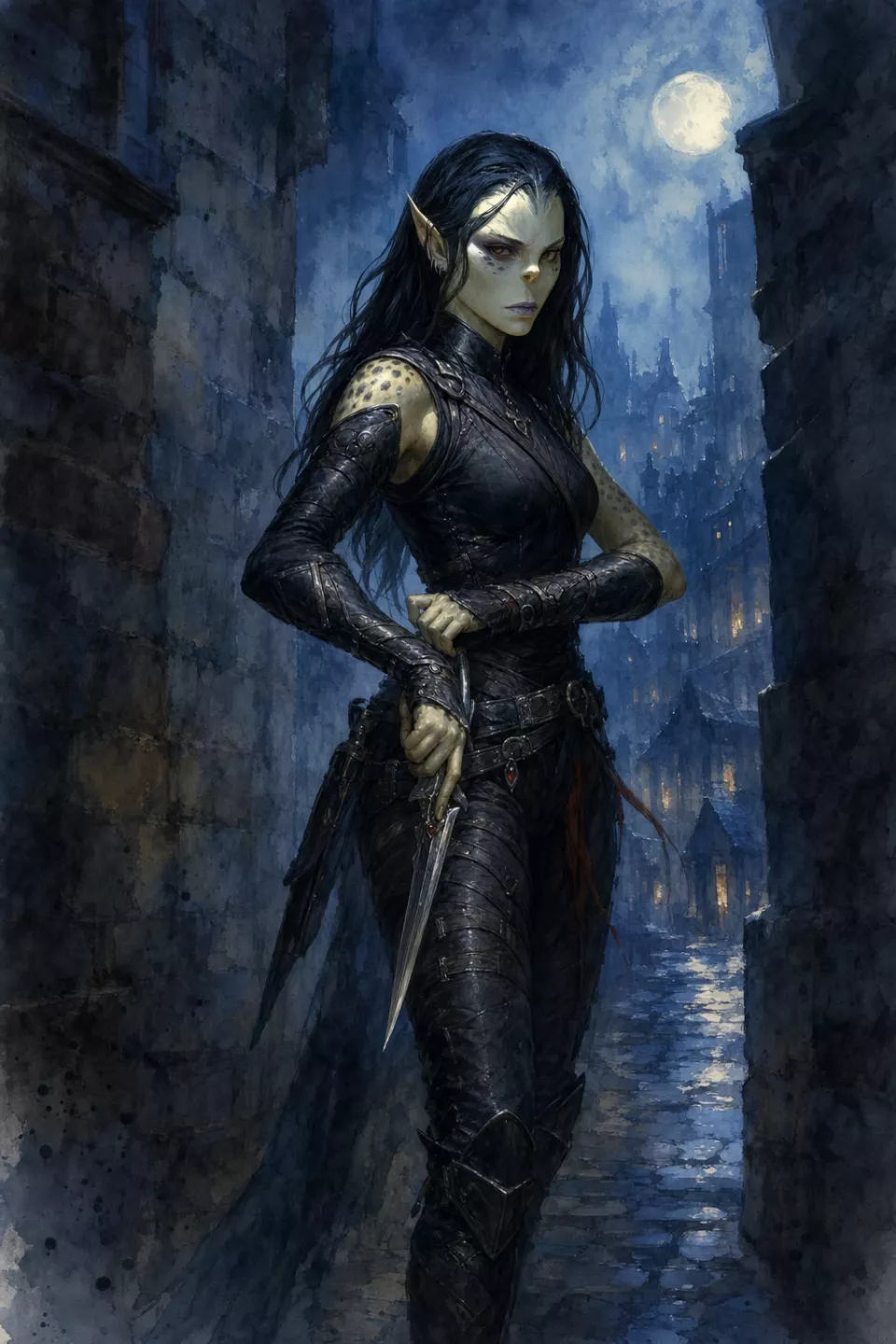
Elyndra Jaxith
Githyanki, Rogue, Chaotic Neutral
Description
Elyndra Jaxith is a lean githyanki rogue with long, black hair drawn back from her face in a tight, practical fall. Her pale, angular features are sharp enough to read as carved—high cheekbones, a narrow mouth set in quiet restraint, and half-lidded eyes that never stop measuring distance. She wears close-fitting black leather armor stitched for stealth: overlapping panels that flex when she moves, a low collar that swallows sound at the throat, and reinforced bracers along her forearms. Narrow belts cross her waist, each one snug and functional, holding small tools and throwing gear in marked, reachable loops. Concealed sheaths ride along her thighs and inner forearms, their edges hidden beneath dark wraps. When she stands, she keeps her weight on the balls of her feet, shoulders squared but loose, chin slightly lowered—ready to spring, listening through every pause.
Backstory
Elyndra Jaxith was born aboard the githyanki warship Vengeance of Ash, where the corridors smelled of hot metal, weapon oil, and the sharp dust of the Astral Plane. Her first lessons were not letters or songs, but silence, balance, and the proper angle for a blade between the ribs. She learned to climb the ship’s rigging without a sound and to cross a barracks while sleeping soldiers breathed around her. The officers called her disciplined. Her mother, Vezra, called her watchful—and warned her that watchful children survived longer than obedient ones.
At fourteen, Elyndra was assigned to a creche on a conquered world, where young githyanki trained beneath red banners and the gaze of a silver swordmaster named Kharza Vonn. Kharza saw talent in her quick hands and quicker judgment. She taught Elyndra to open locks with a sliver of bone, read a guard’s intent from the position of his feet, and lie without changing her breathing. For three years, Kharza was the closest thing Elyndra had to family.
That ended during a raid against a mind flayer outpost. Kharza ordered Elyndra to retrieve a captive scout from a sealed chamber. Inside, Elyndra found not a prisoner but a cache of stolen memories—crystalline records taken from githyanki soldiers before their deaths. Among them was a memory of Kharza kneeling before an illithid, trading the location of a warship for her own life. Kharza had not been captured. She had sold them out.
Elyndra returned with the records and said nothing. That night, she cut the command seals from Kharza’s armor and left them on her pillow. By dawn, three officers were dead, the ship’s navigation core was missing, and Elyndra had vanished through a maintenance hatch with a stolen astral skiff.
She has spent the years since selling her blade to whoever pays in coin, secrets, or passage. She refuses contracts involving children, prisoners, or mind flayers, though she will not explain why. She keeps Kharza’s old bone lockpick in a sheath beneath her left bracer and uses it only when the risk is worth remembering.
Now Elyndra carries a fragment of the stolen navigation core, its markings pointing toward a hidden illithid vault somewhere in the Material Plane. The githyanki want it destroyed. Kharza wants it recovered. Elyndra wants the memories inside—not to expose her former mentor, but to learn whether her mother’s name appears among the dead. Until she knows, every alliance is temporary, every locked door is a question, and no one gets close enough to stand behind her.
Personality
Elyndra speaks in short, level sentences, leaving silence where other people would offer reassurance. She watches hands more than faces and chooses seats with a wall at her back, a clear view of the exits, and no one close enough to reach her unseen. In conversation, she asks precise questions, remembers the answers, and gives away little unless a fact can buy information, passage, or leverage.
She distrusts vows, uniforms, and anyone who calls obedience a virtue. Her loyalty must be earned through repeated action: keeping a promise when profit says otherwise, protecting the helpless without witnesses, or admitting a mistake before it becomes someone else’s wound. She has a dry, almost invisible sense of humor, usually delivered as a quiet observation at the worst possible moment.
Elyndra does not comfort people with words. She repairs a broken strap, leaves food beside a sleepless companion, or takes the first watch. Children and prisoners draw a guarded protectiveness she tries to disguise as efficiency.
Under pressure, she becomes colder and more exact. Her breathing slows, her hands stop fidgeting, and she reduces every problem to exits, leverage, and the person most likely to betray the group. If cornered, she will lie, flee, or strike first—but never abandon someone helpless to save herself.