
Vortak Rhyver
Simic Hybrid, Artificer, Chaotic Good
Description
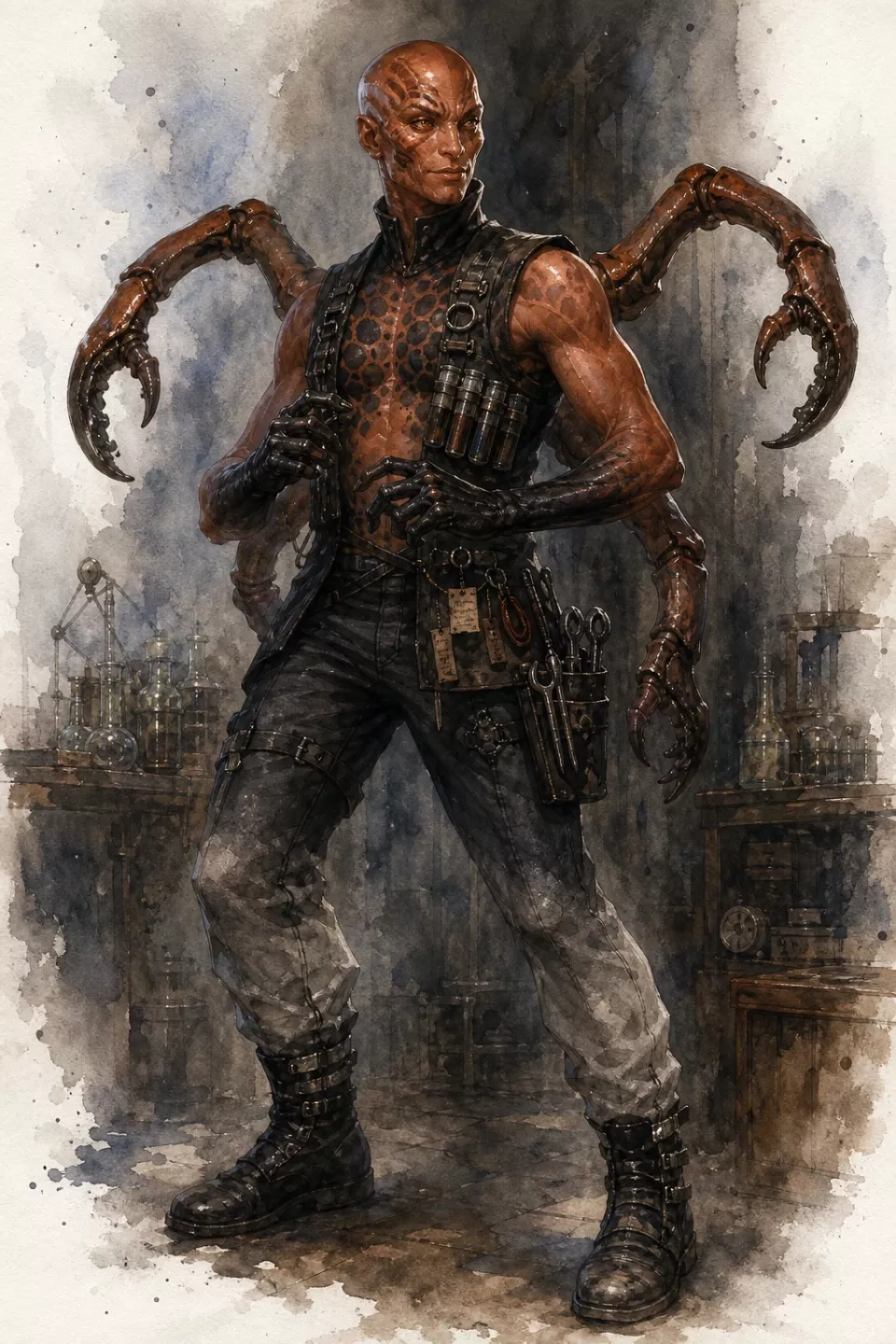
Vortak Rhyver stands with a creature-compact build, all angles and purposeful movement, as if his body is built for quick work rather than long stillness. His Simic Hybrid skin is Vedalken in texture and tone—cool to the eye, slightly translucent at the edges of his cheekbones and knuckles—colored an auburn that catches warm light like old copper. Black spots cluster across his chest in a deliberate pattern: a set of irregular blotches centered over his sternum, fading at the edges where the auburn skin smooths back into dominance. The spots don’t spread down his arms; they stop at the upper rib line, making his torso look like it was inked and then sealed.
His four arms give him a practical, awkward-to-ignore silhouette. The first pair of arms function like normal arms, starting in darker black at the hands and forearms, then fading steadily into auburn as they reach the shoulder. He holds those arms close when he’s thinking, fingers slightly curled as though he’s ready to grip tools at a moment’s notice. The second pair are crab-like: jointed, thicker at the base, with segmented knuckles and a hooked silhouette to the hands. When he moves, those crab arms don’t swing—they scuttle into position, forelimbs lifting and lowering with tight control, claws flexing open and shut at measured intervals, leaving faint clicks in the air when the shell-like ridges catch.
His face reads Vedalken-calm at first glance, but his expression is pure motion. His jaw and mouth sit on a defined, plated ridgework around the cheeks, and his eyes track everything nearby—people, exits, the nearest workbench—before he commits to speech. Thin lines along his brow and the sides of his nose resemble faint growth channels, dark and subtle against the auburn skin. When he smiles, it’s quick and functional, as if he’s already decided how to fix the situation.
He has a vest in a matte, dark fabric fitted tight across the torso. The vest is crowded with attachments: rows of small metal rings for hanging keys and parts, a cluster of capped vials along one side, and a folded tool bracket at the opposite hip. His gadgets sit where they can be reached without hunting. The vest’s pockets aren’t neat; they’re arranged for speed, with labels and wrapped cords visible at a glance.
His pants transition like a gradient of grime and ash: dark grey at the thigh and knee, fading to a lighter grey that thins out toward the ankle. Near his feet, he wears boots that are practical and heavily grounded: black, nearly featureless from a distance, with thick soles and scuffed toe caps. Where the boots meet the lighter grey fabric, narrow straps and small metal fasteners show, suggesting quick removals and field repairs.
Overall, Vortak’s body reads like a walking workshop—four arms set up for tasking, dark-to-auburn contrast guiding the eye to where he grabs and where he clamps, and gear placed exactly where a tool would be used mid-action. When he shifts stance, the crab-like arms twitch first, then the normal arms follow, as if his hands are waking up in sequence to start the next fix.
Backstory
Vortak Rhyver was nine when the nets went over him.
He’d been picking mushrooms along the flooded outskirts of Gravenhollow with a scavenger’s knife his foster mother had taught him to keep sharp—thin steel, careful hands, don’t trust anything that shines in the muck. That night the river fog thickened until the lantern light couldn’t punch through. Then came the knock: not on a door, but on the water itself. Ropes hissed, something heavy dragged across the weeds, and a pale team in sealed masks lifted him bodily as if he were no more than a sack.
Vortak woke with his wrists locked in brass cuffs bolted to a glass-and-steel platform. The air tasted of antiseptic and brine. A dim pool of pale light swam over his skin, making his stomach roll even before he understood what had been done to him. He heard voices through a wall of sound-dampening foam—calm, measured, pleased with themselves. They argued over his “adaptability” and “behavior under stimulus,” as if he were a tool that responded correctly to a test rig.
A week—maybe longer; time blurred under bright lights—later, the first procedure took. His bones ached as if someone had stacked stones inside his chest. Surge clamps opened along his ribs, and tubing threaded into him with a wet, practiced certainty. When the restraints came off, his arms didn’t move the way they used to. They were longer by a handspan, jointed in strange ways, with pale finlike membranes that flexed under pressure. The skin along the new limbs was patterned with faint raised lines, like maps drawn by someone who only knew how to measure in living tissue.
The staff called him “V-0,” then “specimen,” then “failed integration,” each title like a lid being pushed down over a jar.
They fed him carefully timed meals and taught him nothing except fear. They monitored him with dials that clicked and whirred, with glass screens that showed his heart rate and muscle response. When he reacted too strongly to a sound, they praised it. When he resisted, they marked it wrong. One of them—an organizer with a coat stained at the cuffs from constant lab work—leaned in close and told him the outcome like a sentence already passed.
“You were stolen for the ultimate hybrid. You’re not it. You’re a flaw.”
The lie wasn’t meant to comfort him; it was meant to break him. Vortak learned to stay quiet, to keep his breathing shallow, to look down at the platform as if he didn’t notice how many days there were between “mismatch” and “end.”
He did notice.
Guards rotated in and out on schedules printed in thick black ink on clipboards outside the lab. He watched through the gaps under the door when their boots crossed the hall. He memorized the smell of each uniform—oiled leather, cold metal, sour sweat—and the sound their key rings made, sharp and predictable. He started counting the time by the hum of machines and the cadence of distant pumps moving water through the facility’s underchannels.
Then came the night of the “cleanup.”
The doors thudded open hard enough to shake dust from the seams. Cold air rolled in with a set of boots that didn’t belong to his usual rotation. Vortak heard the organizer’s voice, sharper than before, speaking to someone off to the side.
“Last chance at a usable hybrid core. If it won’t take, we remove it. Keep it contained.”
Remove it.
Vortak’s thoughts moved fast, because if he froze he would die. He listened to their tools: metal scraping, a latch clicked shut, a faint hiss as pressure released. One guard stepped into the lab, then another. Their footsteps came right to the platform.
The cuffs on his wrists weren’t locked as tight as usual. The failure label had made them careless; they assumed the specimen would never matter again.
When the first guard leaned over to check the readings, Vortak’s fingers flexed—slow at first, then faster, like a marionette being yanked into motion. His new arms responded in ways that his old ones never would. The fin-membranes along his forearms spread, catching moisture in the air, and the joints within them clicked with a strength that surprised him even as he used it.
He didn’t lunge like a monster. He moved like someone who had studied what guards did to keep control.
The first guard’s head dipped. Vortak twisted his wrists against the remaining restraint, then drove his longer arms up and through the guard’s guard—palmed against the collarbone, levering with a joint designed for gripping, not punching. There was a wet snap when the guard’s neck met the wrong angle. The guard fell without a sound beyond a startled exhale.
The second guard drew his weapon too late. Vortak’s finlike membranes flared, catching the blade’s edge and shifting it off line, as if his body knew how to redirect pressure. He grabbed the guard’s wrist with both new hands and yanked—bones protesting, muscles screaming—until the guard’s grip failed. The weapon clattered across the glass floor and skidded toward the platform.
Vortak didn’t stop to look at the blood. He kicked the platform clamps free, using the extra reach of his arms to hammer the release points. Brass tore away from bolts with a scream of metal. The shock of it made his vision swim, but he kept moving.
The alarms didn’t sound right away. The facility was built for controlled environments; it expected measured outcomes. By the time the first siren started wailing, Vortak was already hauling himself toward the underchannel doorway, half-running, half-dragging his body through a narrow corridor that smelled of wet stone and coolant.
He went where the facility’s own systems wanted to keep him.
The drains weren’t meant to be exits, but they were paths. Vortak followed the sound of moving water and the vibrations underfoot, slipping between grates and conduit housings. His new arms made climbing easier—each grip different, each hold tested—turning narrow metal into something like a ladder. When he reached a maintenance ladder that dropped into a flooded service tunnel, he didn’t hesitate. He hit the water and sank, using the membrane-lined limbs to swim through currents too narrow for a human body.
He surfaced coughing, tasting river muck and copper, and kept going.
Behind him the facility’s lights flickered as power rerouted to containment. Through grating and distance he heard angry voices and shouted orders that didn’t include mercy. He didn’t return fire. He didn’t try to be a hero. He just stayed one step ahead of the people who believed he was disposable.
He fled for three days without sleeping, because every time he closed his eyes he saw the platform lights and heard the organizer’s words. On the fourth day, exhausted, he found a derelict workshop on the edge of an aqueduct—half collapsed, but dry enough to make a shelter. He tore apart old devices scavenged from the shelves: cracked tools, broken gauges, a rusted brass monocle full of condenser lenses. His arms—new, awkward, stronger than he expected—made him clumsy at first, but he adjusted quickly the way a creature adjusts to a new body.
He didn’t call himself an artificer at first. He called it survival.
Vortak learned to build because he needed to undo what had been done to him. He fitted scavenged parts to his new limbs, testing what responded: coils that tightened and released, gel-pads that cushioned pressure, counterweights that balanced his extended reach. He crafted simple rigs to aid climbing, to strengthen grips, to redirect fluid. He studied the way Simic experiments worked—forms and functions, stimulus and response—without ever trusting the people who had used him as their proving ground.
His mind stayed sharp because he had to. He grew used to looking over his shoulder in tavern doorways, used to counting exits, used to listening for footsteps that didn’t match the rhythm of the room. When people asked about his arms, Vortak gave answers that weren’t lies but weren’t full truths either—“parts replaced,” “a workshop mishap,” “river surgery.” He avoided specialists, avoided officials, avoided anyone who spoke like they had a ledger for him.
He kept moving through cities and towns along the riverways, taking odd jobs that didn’t require a stable past: repairing watch mechanisms for dockworkers, building waterproof charms for fishmongers, tuning arcane trinkets for apprentices who didn’t ask questions about where he’d learned. He made friends the way other people made armor—carefully, with seams reinforced by caution. When someone treated him like a weapon instead of a person, he walked away. When someone treated him like a problem to solve, he listened until they turned their back.
Then, chaotic good in action: he stole back from cruel owners, returned goods to families who’d been cheated, and sabotaged experiments that smelled too much like his own.
Vortak Rhyver never forgot the night he escaped.
He didn’t tell it as a horror story. He told it as proof that his body had its own plan, and his life could be his decision. The failure they promised became fuel; the killing they threatened became the lesson that guards don’t expect resistance from the ones they brand broken.
Years later, the promise of that past flickers back into the world.
People in a riverside bar—one with plank floors that creak like old ships and ale that smells faintly of smoke—tell stories about a Simic-shaped stranger who keeps to the corner near the door. He sits with a small case of tools that he never opens all the way in public. His new arms rest relaxed, fin-membranes folded close, but every so often he flexes them—testing nothing, showing everything. When someone stares, he meets their gaze and simply smiles, as if daring them to ask the wrong question.
A regular swears he’s heard Vortak laugh once, quick and low, after a patron tried to start a fight and ended up with a broken knuckle and a lesson learned. Another says he paid for the whole table with coins that looked newly minted, then vanished before anyone could ask where he got them.
The bar never gets an answer.
Just the lingering sense that the person there—quiet, repaired, resilient—remembers the platform lights, remembers the word “remove,” and chose, even then, not to die quietly.
Personality
Quiet
Honest
Reserved
Slightly crazy but in a good way when he's making stuff