
Kraaz’ Ghul
Tiefling, Paladin, Chaotic Neutral
Description
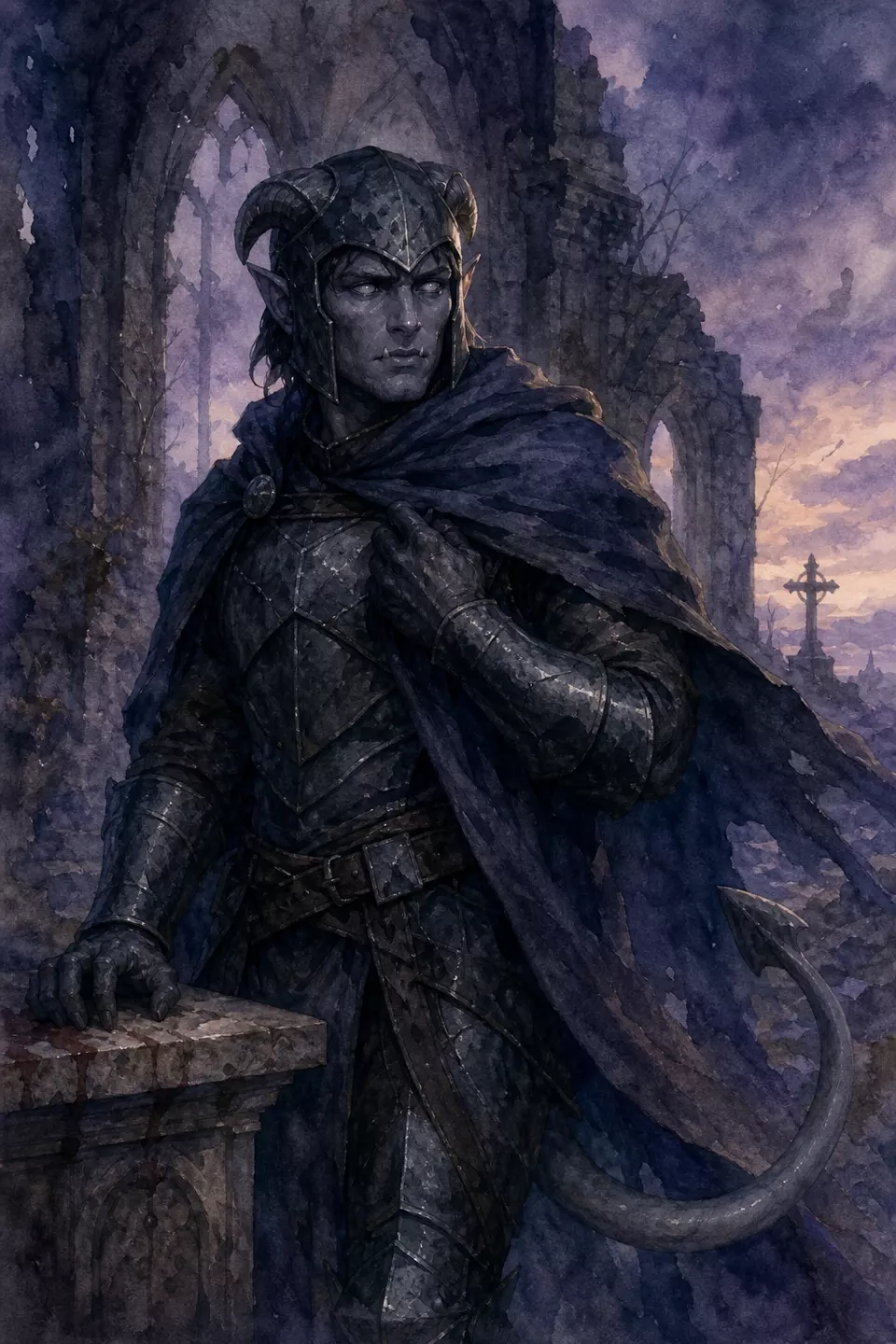
A grey-skinned tiefling paladin in dark, battle-worn armor. Their short horns curve close to the skull, leaving the face unobstructed beneath a shadowed helm. The armor is practical rather than ornate, scarred by old blows and kept meticulously clean. A dark cloak hangs from the shoulders, and a holy symbol is worn beneath the breastplate, hidden from casual view.
A grey-skinned tiefling paladin in dark, battle-worn armor. Their short horns curve close to the skull, leaving the face unobstructed beneath a shadowed helm. The armor is practical rather than ornate, scarred by old blows and kept meticulously clean. A dark cloak hangs from the shoulders, and a holy symbol is worn beneath the breastplate, hidden from casual view. His skin has a cool, ash-grey cast, darkening around the knuckles and along the angular cheekbones. His eyes are muted amber, set beneath heavy brows and narrowed by the helm’s rim. A thin black braid hangs behind one ear, threaded with an iron bead. His gauntlets leave the fingertips exposed, revealing blunt, dark claws. The cloak is fastened with a tarnished clasp shaped like a broken wing, its hem brushing mud-splashed riding boots. He stands squarely, shoulders level, with one hand near his sword hilt. At rest, he rolls a shoulder slowly and taps a claw against his breastplate.
Backstory
He grew up in a wasteland, where survival forged him from hatred. After losing someone very close to him, he abandoned that path and took a holy oath. Now he serves the forces of good while hiding the darkness of the life he lived before.
Kraaz’ Ghul was raised among the slag fields beyond a dead mining town, where black dust settled on the tongue and every pool of water carried a film of oil. His people lived beneath overturned wagons and sheets of hammered metal, trading scavenged weapons for grain. He learned early that a full belly belonged to whoever reached the carcass first. By thirteen, he could strip a fallen raider of boots, buckles, and teeth before the body cooled.
The one person who kept him from becoming another wasteland predator was Sava, an old human salvager with one eye and a laugh like a cracked bell. She taught him to mend armor, read old road markers, and leave enough behind for the next starving traveler. When Kraaz returned from a raid with blood on his hands, Sava made him scrub the armor until he could see his horns reflected in it. “If you must become a monster,” she told him, “at least know what you are becoming.”
He ignored her until the Red Knives came for the settlement. Kraaz had been riding with them for months, guiding their attacks through dry gullies and abandoned watchtowers. He believed fear was the only law that held. Sava proved him wrong when she hid three children beneath her salvage cart and refused to give them up. Kraaz watched the gang’s captain kill her for that refusal, then stood aside while the settlement burned around them. The children survived. Sava did not.
He hunted the Red Knives for six months, not out of justice but because vengeance gave his grief a direction. At the end of the trail, he found their captain dying beneath a collapsed shrine, clutching a rusted holy emblem. The dying man begged for water. Kraaz nearly left him to the dust, then remembered Sava cleaning blood from a child’s face with the hem of her own coat. He gave the captain his canteen, listened to his last breath, and carried the emblem to the shrine.
There, among cracked stone and windblown ash, Kraaz swore that no helpless voice would be silenced while he still had a weapon in hand. The oath did not erase the years spent serving raiders, nor did it make mercy easy. It gave his violence a boundary. He now travels from settlement to settlement, taking guard work, breaking sieges, and putting tyrants on their knees when gentler methods fail. He keeps Sava’s dented cooking cup beside his bedroll and wears the stolen holy emblem beneath his breastplate. Every life he saves pays a little of what he owes; he has never accepted that the debt can be paid in full.
Personality
He wins people over with an easy smile, a polished voice, and sarcasm sharp enough to make an insult sound like a compliment. Beneath the charm, he is steadfast; once he gives his word, pain and fear do not move him from it. He does not openly worship or preach. Instead, he follows a private path of penance, treating every act of protection as payment toward a debt he believes can never be fully settled.
Kraaz keeps conversations moving before anyone can ask where he learned to fight or why his holy symbol stays hidden. He remembers names, preferred drinks, and the small complaints people make when they think no one is listening. With strangers, he offers dry jokes and harmless wagers; with authority, he becomes agreeable in tone and disobedient in practice. He dislikes being thanked and will redirect praise toward the task, the weapon, or sheer luck. He is gentler with frightened people than with the powerful, often kneeling to speak at their level while keeping one hand free.
He treats anger as a tool that must be kept sharp but sheathed. Insults aimed at him earn a grin, yet cruelty toward prisoners, animals, or the helpless makes the humor vanish from his face. He rarely speaks about Sava unless drunk, exhausted, or tending a wounded stranger; then her sayings emerge in a rough imitation of her cracked laugh. Before sleeping, he checks the camp’s perimeter, cleans his blade, and sets the dented cooking cup where he can touch it without looking.
Under stress, Kraaz grows quieter rather than louder. He counts exits, water skins, and living bodies, then starts issuing short orders in the same polished voice he uses for banter. If someone breaks faith with him, he gives one warning and makes the next consequence unmistakable. After violence, he scrubs blood from his gauntlets until the metal shines, even when the blood is not his. He accepts wounds without complaint but reacts sharply when an ally hides an injury, as though concealment were a personal betrayal. четвер