
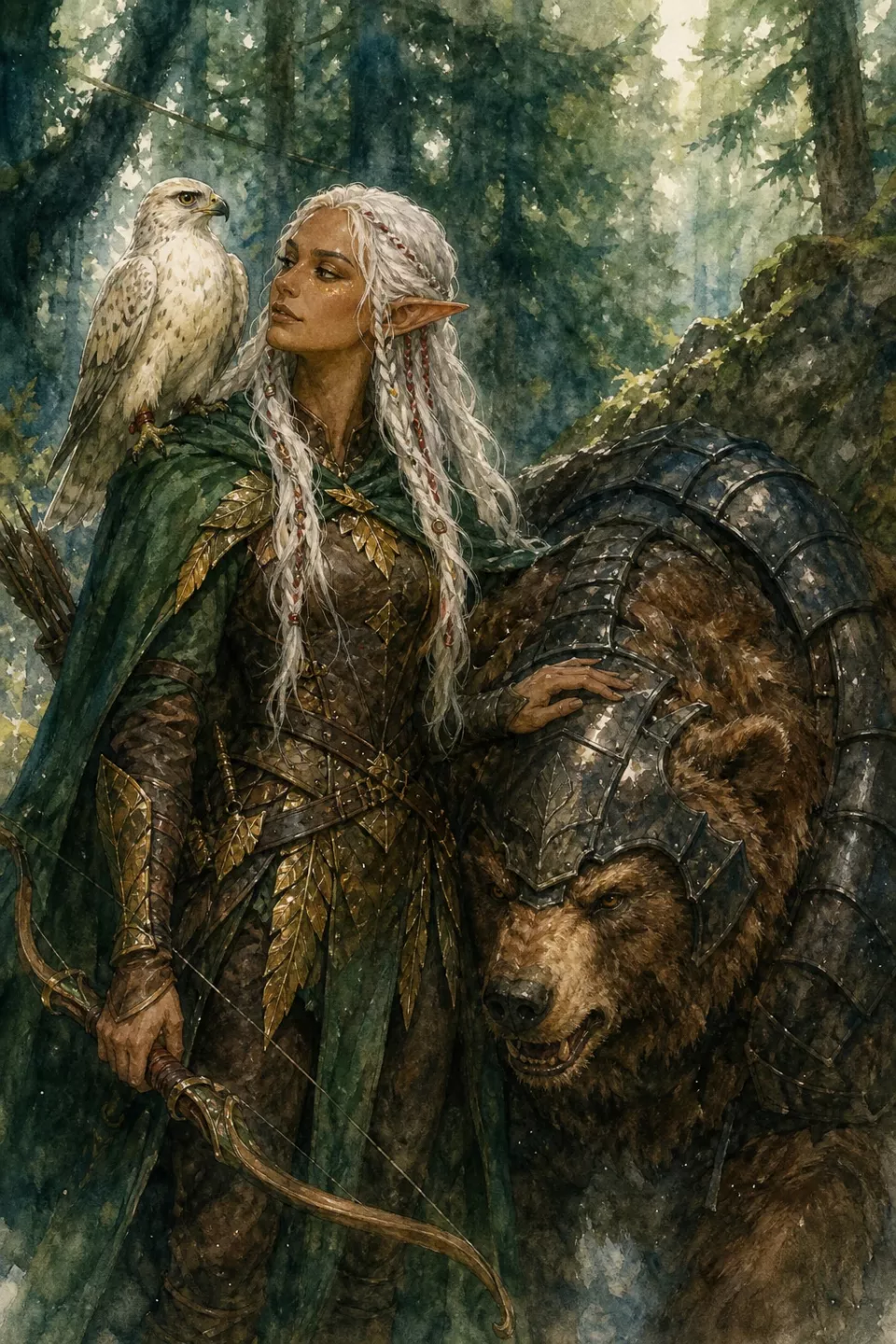
Verelwyn Faelthar
Half-Elf, Ranger, Chaotic Good
Description
Verelwyn Faelthar has sun-kissed skin, pointed ears, and waist-length white hair braided with red thread and small iron rings. A dark green cloak covers fitted leather armor marked with bronze leaf-shaped plates. Her one gray-green eye, and other amber eye with flecks of gold, sit beneath narrow brows, and a white hawk with a red leather anklet rests on her shoulder. She moves with a hunter’s quiet balance, her boots soundless even over gravel, while the iron rings in her hair give a faint chime when she turns. At her side lumbers a massive grizzly bear, tall enough to meet a mounted rider’s chest. Layered plates of blackened steel cover its shoulders, ribs, and broad forehead, leaving thick brown fur bristling between the bands. The bear watches strangers with narrowed eyes and bared teeth but lowers its muzzle at Verelwyn’s touch. A whistle, a hand signal, or the soft use of its name is enough to send it crashing into danger for her.
Backstory
Verelwyn Faelthar was raised where the Thornwash Forest climbs into the Ashencrag Mountains, in a hunting camp shared by her human father’s clan and her elven mother’s woodland kin. Her earliest lessons came from both sides of the family. Her father taught her to read bootprints in wet clay, salt meat, and judge a storm by the taste of the wind. Her mother taught her the names of trees in Elvish, the quiet paths beneath the pines, and how to sit still long enough for a wary deer to forget she was there. At home, one language filled the cookfires and the other filled the moonlit watches; Verelwyn learned early that belonging could mean standing with one foot in each world.
She first carried a bow at nine and brought down her first hare three years later. Her mentor was an old trail warden named Serren Voss, who made her track wounded animals before allowing her to loose an arrow. Under his watch, she learned to move through fern beds without shaking dew from the leaves, set snares that left no broken branches, and find clean water beneath shale. Her white hawk, Kest, came to her after a spring storm, when she found the nestling tangled in a poacher’s wire. She freed it, splinted its damaged leg with willow strips, and fed it scraps from her own supper. Kest never left.
The forest changed when ironclad loggers crossed the Thornwash under a charter from a distant baron. They burned old hunting grounds, poisoned a creek with blue-black runoff, and drove game toward the villages. Verelwyn guided refugees through hidden passes while Serren confronted the company’s captain at the old stone boundary marker. He did not return. In the weeks that followed, Verelwyn led raids against supply wagons and freed trapped animals, but the victory tasted bitter when her own people began arguing over whether to hide, negotiate, or fight. She left before their quarrel became bloodshed, carrying Serren’s weather-stained map and the iron rings now braided into her hair.
Verelwyn has come beyond the Thornwash to learn who signed the logging charter and why the baron’s men were so eager to reach a forest no map records correctly. She takes work as a guide, scout, and monster hunter, sending coin and news home whenever a caravan travels north. She trusts campfires more than courts, stray dogs more than nobles, and anyone willing to share watch through the night. Someday she must decide whether to return as a defender of one homeland or claim a place between both; for now, every trail beyond the mountains offers another clue, another wrong to set right, and another reason not to turn back.
Three winters ago, Verelwyn found the grizzly in a ravine beneath the Frostthorn Pass. The bear had been caught in a poacher’s iron jaw trap, its foreleg swollen and bloody, its roars shaking snow from the pines. When Verelwyn approached, it charged as far as the chain allowed. She escaped with three claw marks across her cloak and a broken arrow lodged in her pack. She returned at dawn with a hatchet, a strip of smoked venison, and no weapon in her hands.
For two days, the bear watched her from the rocks while she fed the fire and spoke in a low, steady voice. On the third morning, Verelwyn cut through the trap’s chain. The grizzly sank its teeth into her bracer when the pain became too great, but she did not strike back. Once free, it vanished into the trees. Verelwyn expected never to see it again—until a pack of winter wolves found her camp that night. The grizzly came out of the dark with a roar, scattering the wolves and standing between Verelwyn and the fire. She named him Ironroot for the iron chain he broke and the stubborn strength that kept him alive.
Ironroot still dislikes sudden movements, crowded camps, and anyone who reaches for Verelwyn without warning. He sleeps beneath her bedroll when the weather turns cold, follows her trail by scent, and leaves half-eaten fish beside her boots when he thinks she has gone too long without food. Verelwyn keeps the severed trap chain wrapped around her pack frame; Ironroot carries the matching length tangled in his old collar. Their bond matters because neither saved the other only once. In the wilderness, where every creature must choose between fear and trust, they chose each other—and have paid that choice forward ever since.
Personality
Verelwyn keeps unfamiliar people at arm’s length, answering questions with few words and watching their hands before their faces. She has no patience for false courtesy; if someone is cruel, dishonest, or prejudiced, she says so plainly, whether they outrank her or not. Beneath that guarded silence lies a steady kindness, shown in mended snares, shared food, and the cloak she drapes over shivering strangers without comment. Once someone earns her trust, Verelwyn’s loyalty does not waver. She remembers their habits, stands beside them in a fight, and treats betrayal as a wound that may never close. She will cross a village to free a chained dog, and she becomes quietly dangerous when children are threatened. Kest and Ironroot receive gentler words than most people do.