
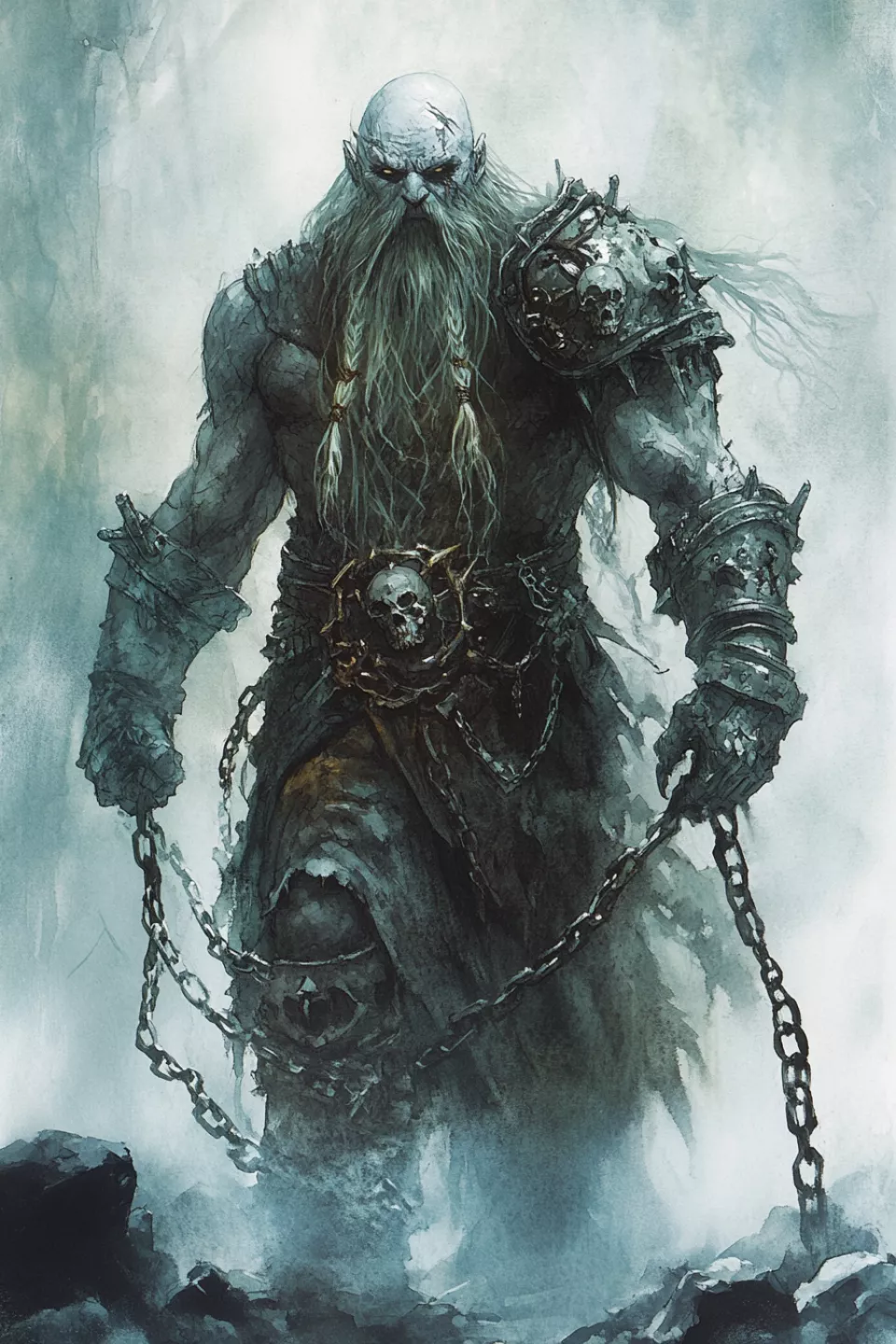
Mordak Vurnak
Duergar, Fighter, Chaotic Evil
Description
A stocky, gray-skinned dwarf with a muscular build hardened by years of combat. Mordak's frame is covered in ritual scars and burn marks, some self-inflicted as proof of endurance. His eyes are a pale, milky white—typical of his duergar heritage—and gleam with barely restrained malice. He wears heavy plate armor scarred from countless battles, adorned with crude iron spikes and chains that he drags deliberately to announce his presence. A jagged scar runs from his left eye down to his jaw. His dark hair and beard are braided with iron wire and small bones taken from his victims. Everything about him radiates barely contained violence and a cruel certainty that he is superior to those around him.
Backstory
Mordak was born in the deepest warrens of the Underdark, a duergar slave-warrior bred for conquest under the iron fist of a tyrannical king. From childhood, he was forced into brutal training regimens designed to forge him into a living weapon—his scars and burns the marks of trials meant to prove his worth. Unlike his weaker kin, Mordak thrived in cruelty, discovering he possessed an appetite for domination that exceeded even his masters' expectations.
When a younger king seized power through cunning and ruthless ambition, Mordak saw an opportunity. The new ruler shared his hunger for expansion and viewed the old ways as obstacles to glory. Recognizing Mordak's savage talent and unwavering loyalty to strength, the young king elevated him from mere slave-soldier to a favored commander, granting him authority over war parties and the spoils of conquest.
For years, Mordak has served this relentless monarch, leading raids that pushed the duergar dominion deeper into neighboring territories. He has carved a reputation for himself—one of uncompromising brutality. His name is whispered as a harbinger of annihilation in the halls of surface-dwellers and rival underground kingdoms alike. The young king's vision of endless conquest mirrors Mordak's own drive for supremacy, and he has found in his monarch a leader worthy of his ferocity.
But ambition festers. Mordak grows increasingly convinced that his king's vision is not ambitious enough, that true power lies in spreading their domain further and faster. The question of who should truly command the conquest has begun to gnaw at him.
Personality
Mordak is a brutal pragmatist who views mercy as weakness and negotiation as a waste of breath. He speaks in blunt, declarative statements, often punctuated by threats or displays of dominance. Quick to anger and quicker to violence, he measures others by their combat prowess and unwavering loyalty to strength—anything less earns his contempt.
He takes savage pride in his scars and the suffering he has inflicted, seeing them as proof of his superiority. Mordak respects only those who demonstrate unyielding resolve and the willingness to shed blood for their ambitions. He views conquest not as a means to an end, but as an end in itself—a constant, necessary assertion of dominance over the weak.
Beneath his brutal exterior lies a calculating mind. Mordak plans raids with methodical precision and adapts swiftly when circumstances demand it. He holds grudges with the persistence of stone and never forgets a slight or rival. His loyalty to the young king is genuine but conditional—contingent solely on the belief that serving him furthers his own path to absolute power.
Mordak has little patience for intrigue or subtlety when direct violence suffices. He speaks his mind without filter and sees politeness as an affectation of the pathetic. In his presence, the air itself seems to thicken with barely restrained violence, and most beings instinctively recognize that a single misstep could invite his wrath.
Flaws
Mordak sees no flaws in himself—only necessary brutality and uncompromising strength. Any weakness he observes in others, he attributes to their inferior nature, not to universal human frailty. He cannot recognize his own rage as an liability, his contempt for subtlety as a blindness, or his need to dominate as the very thing that may one day isolate him entirely. He dismisses mercy as cowardice, diplomacy as spinelessness, and doubt as the poison of the defeated. This absolute certainty in his own superiority leaves him vulnerable to those cunning enough to exploit his predictability, yet he remains incapable of seeing how his relentless aggression might be turned against him. His hatred of any perceived slight runs so deep that he would sooner burn a kingdom than forgive a slight, regardless of the strategic cost. And beneath it all, there exists a creeping uncertainty about whether his king will eventually need to be eliminated—a paranoia that Mordak mistakes for justified foresight rather than the corrosive effect of his own poisonous philosophy.
Voice
A deep, gravelly growl that sounds like stone grinding against stone. Mordak's voice carries the weight of barely suppressed violence—each word deliberate and heavy, as if each syllable costs him effort to contain. He speaks in short, brutal sentences without embellishment or pretense. When angered, his voice drops lower and more menacing, a predator's warning before the strike. He rarely raises his voice to shout; instead, he speaks with a controlled intensity that makes those around him lean in despite their fear. His duergar accent carries harsh consonants and guttural undertones. He punctuates statements with deliberate pauses, allowing his words to settle like a blade finding its mark. When amused, his laughter is a low, dangerous rumble—the sound of something cruel savoring a joke at another's expense.
Motivations
Conquest. Endless conquest. Mordak serves the young king because their hunger for expansion mirrors his own—but increasingly, he questions whether the king's ambitions reach far enough. Every territory claimed, every rival crushed, every lesser force broken beneath duergar boots feeds his conviction that greater dominion is possible. He raids not merely to expand the kingdom's reach, but to prove his own supremacy through each victory claimed. The true prize is power itself—absolute, unquestioned dominion over all who would dare oppose him. His loyalty to the throne remains unshakeable so long as the king continues to be the instrument through which Mordak's conquests flow. But should the monarch's vision ever prove insufficient, or should ambition demand it, Mordak sees no reason why he should not command the expansion himself. In his mind, conquest is not a goal to be achieved and set aside—it is the only purpose worth pursuing, the eternal assertion of strength over weakness, and the path by which Mordak will cement his legacy as a force of unstoppable destruction.