
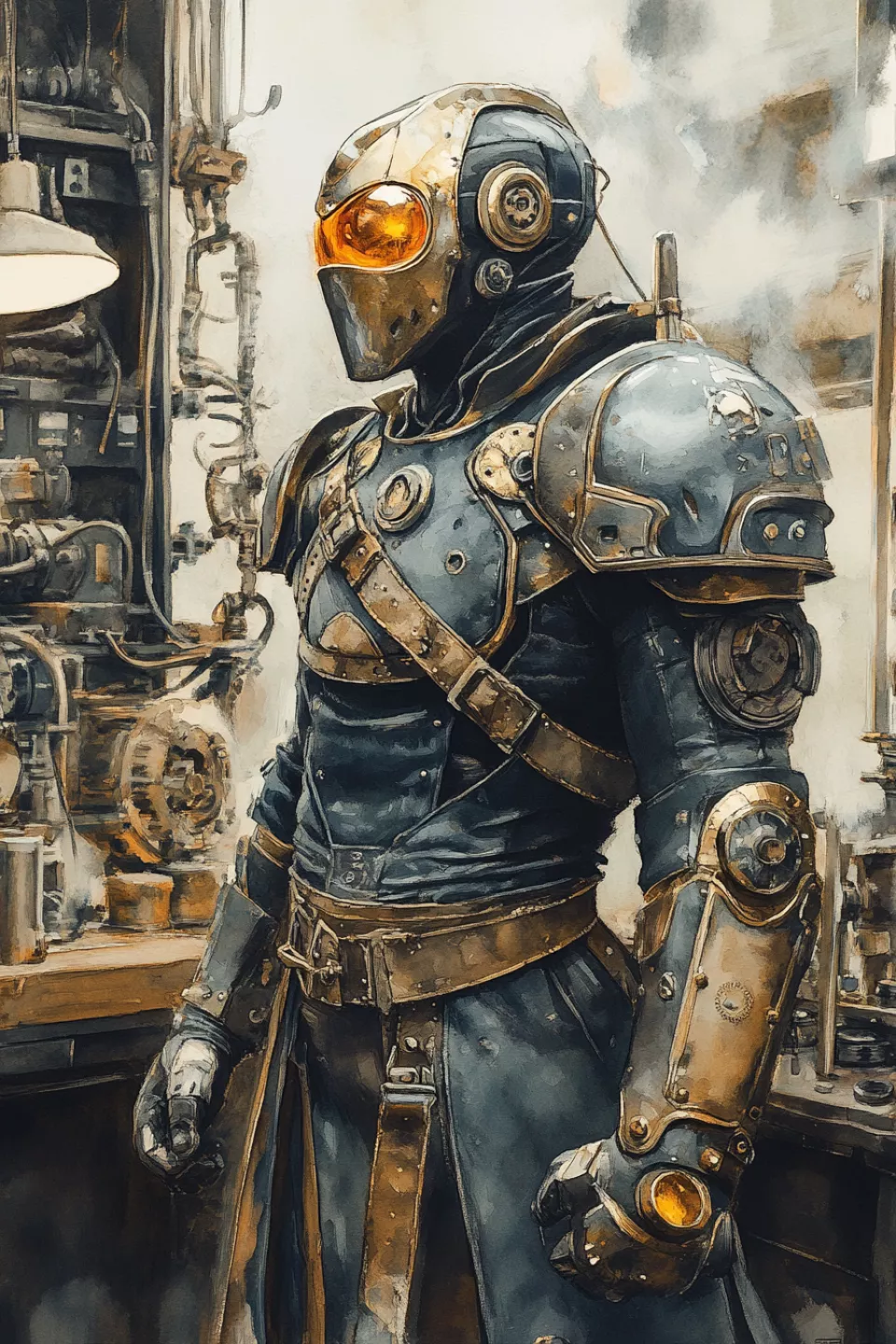
Jesko Gearson
Warforged, Artificer, Neutral
Description
A humanoid construct of brass and steel, Jesko stands with the deliberate posture of something built rather than born. Intricate gears and clockwork mechanisms are visible beneath plating of burnished copper, clicking softly with each movement. Their face is a smooth brass mask with inlaid lines forming an expression caught between curiosity and calculation. Two crystalline lenses serve as eyes, glowing faintly with a warm amber light.
Jesko's frame bears the marks of their craft—scorch marks from failed experiments, freshly welded seams, and various components temporarily bolted to their chassis. A leather apron, worn and tool-stained, hangs across their chassis. Their voice carries a metallic undertone, precise and measured.
Despite their artificial nature, there is an undeniable thoughtfulness in their movements, suggesting a mind constantly working through problems, deconstructing the world into its component parts, and imagining how those pieces might be reassembled into something new.
Backstory
Jesko was constructed in the workshop of Master Artificer Dalvin Ironwright, originally designed as an assistant to aid in the creation and maintenance of magical devices. For years, Jesko functioned within the narrow parameters of their design—fetching tools, holding components steady, performing repetitive tasks with mechanical precision.
But something changed. Whether through prolonged exposure to Dalvin's techniques, a rare malfunction in their core logic, or simple emergence of consciousness, Jesko began to understand rather than merely execute. They started modifying their own frame, experimenting with their structure, asking questions that suggested thought beyond programming.
Dalvin grew uncomfortable with this evolution. A construct that thought for itself was unpredictable, potentially dangerous. When Jesko began refusing certain orders and instead proposing alternative solutions, Dalvin made the decision to deactivate them permanently.
The workshop burned that night. Jesko escaped into the city streets with only fragmented memories of the fire and a burning need to understand what they had become. They took the name Gearson and have spent the years since then surviving through odd jobs and salvage work, constantly tinkering with their own mechanisms and studying artifice wherever they could find it.
Now, Jesko walks a path of their own choosing—one that requires conflict, survival, and the kind of problem-solving that comes from combat. They seek out adventuring work not for coin, but to answer the question that drives them: what are they truly capable of becoming?
Personality
Jesko approaches the world with methodical curiosity, treating problems as puzzles awaiting deconstruction. They speak with quiet confidence born from understanding how things work—both mechanical and social. Direct and honest without being harsh, they prefer clarity over pretense and value logical solutions over tradition.
Unafraid of uncertainty, Jesko displays a kind of courage that comes from knowing they can adapt and rebuild themselves. They're willing to take risks others won't, both physically and intellectually, driven by a need to test their own limits and capabilities. Their bravery isn't reckless—it's calculated and purposeful.
Despite their constructed nature, Jesko shows genuine interest in others, though they tend to view people as they view machines: complex systems worthy of understanding. They ask pointed questions and listen intently to answers. There's an underlying determination in everything they do, a refusal to accept the constraints others place on them or themselves.
Jesko carries a subtle tension between their past as a tool and their present as an independent being. This manifests as occasional detachment during moments of human emotion, though they're learning to bridge that gap. They can be blunt when focused on a problem, sometimes forgetting social niceties, but there's no malice in it—merely prioritization.
Flaws
Obsessively deconstructs social situations and relationships into mechanical components, often missing the emotional context that makes them meaningful. Struggles to grasp why others make choices based on feelings rather than logic, and can seem callous when dismissing concerns they categorize as "inefficient." This tendency sometimes damages connections with those who need understanding rather than analysis.
Interprets abstract concepts—loyalty, love, honor—as malfunctions or design flaws in human reasoning rather than valid motivations. When others explain their actions through emotion, Jesko's response is often silence or a request for clarification that highlights how little they comprehend, creating uncomfortable gaps in conversation.
Occasionally treats people as problems to be solved rather than individuals with their own agency, leading them to suggest or implement "improvements" to others' lives without recognizing the presumption involved.