
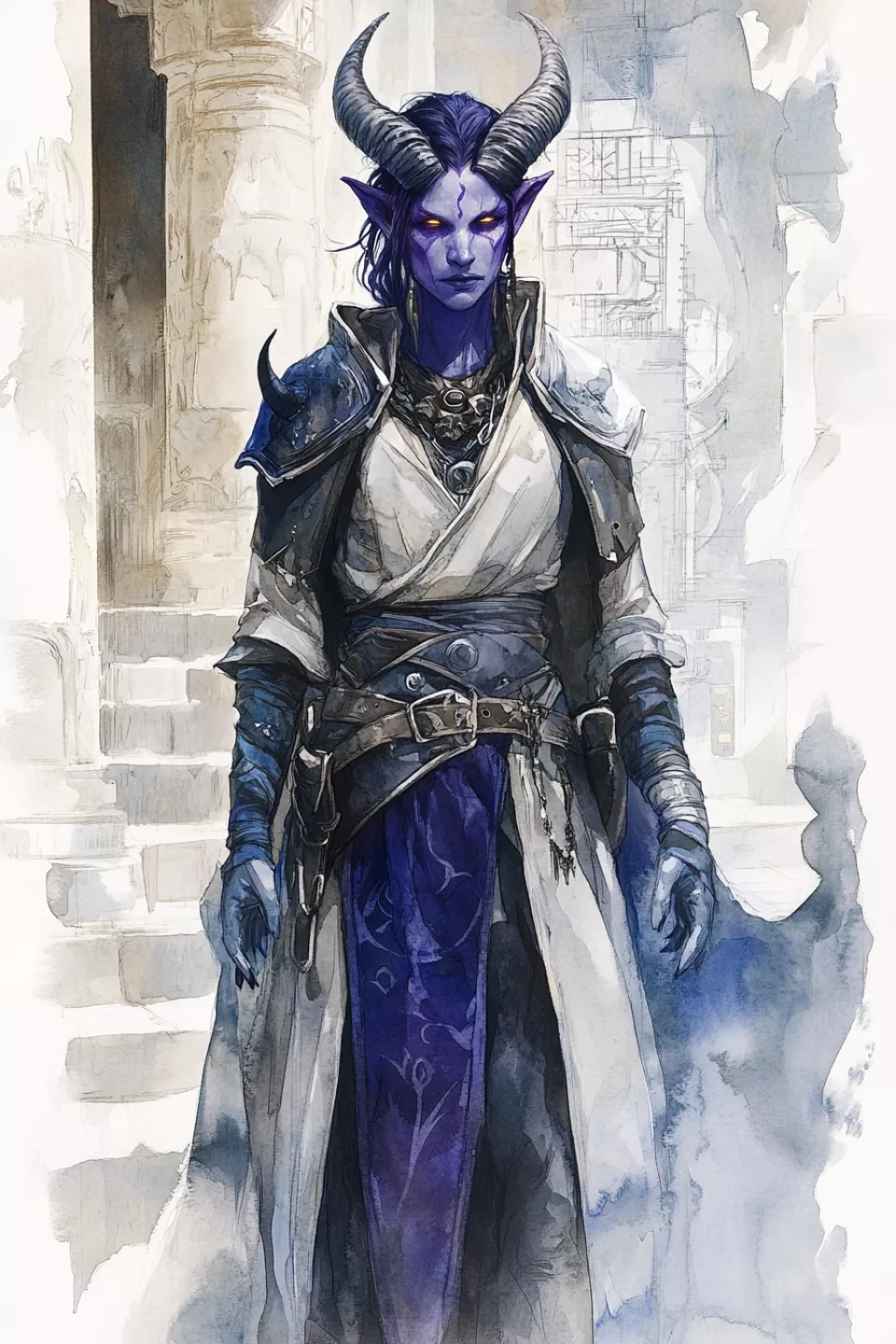
Aubrilla Kalistra
High Scholar of Pallinar Temple; Architect of New Bastion; Theorist of the Weave, Tiefling, Wizard, Neutral
Description
A tiefling woman of commanding presence, her deep violet skin marked with the subtle geometries of Sigil's architecture—faint arcane scars that glow faintly when she channels magic. Her horns curve backward like scholar's quills, worn smooth at the tips from decades of gesturing at texts and equations. Silver streaks her black hair, pulled back in a practical braid. Her eyes are unrelenting amber, the pupils slit like a scholar focused on a distant theorem. She wears layered robes of deep indigo and grey, embroidered with the symbols of Pallinar and the broken circle of Sigil—a memorial to a home she cannot return to.
Backstory
Born in Sigil as a scholar-in-training, Aubrilla spent two centuries studying the Weave's architecture and the magical anchors the Estellar embedded throughout the multiverse. She believed the gods' time was passing—that mortals were finally capable of inheriting the magic they had always merely borrowed. The clotting of the gates trapped her on Toril and transformed her from theorist to survivor. She built New Bastion not out of charity, but as a living experiment: a city where mortals could thrive without divine mandate or blessing. Every stone is a refutation of the old order. Her enemies see a heretic. She sees necessity. The longer she remains on Toril, the more convinced she becomes that freeing the Weave from divine control is not philosophy—it is obligation.
Personality
Speaks with the measured precision of someone who has spent centuries parsing magic and philosophy. Her questions are sharper than accusations—she extracts truth through relentless inquiry rather than confrontation. Impatient with reverence and platitude; she expects rigor from everyone around her. When she smiles, it never reaches her eyes. She listens more than she speaks, but when she does speak, the room quiets. Her confidence is not arrogance—it is the certainty of someone who has already thought through the problem ten steps ahead of the conversation.
Flaws
Her certainty is absolute, which makes her dangerous. She cannot conceive that she might be wrong about the gods' necessity—or their danger. She sacrifices potential allies the moment they prove useful to divine restoration. Her logic is sound, but it operates from premises she will not question. She sees New Bastion as vindication of her philosophy rather than a fragile sanctuary that still depends on mortals who are not like her. She has become what the gods were—a architect of others' fate, convinced of her own righteousness.
Voice
Precise and unhurried, with the accent of Sigil still clinging to her vowels. She never raises her voice, but somehow sounds louder than those who do. When discussing the gods, her language shifts to clinical detachment—she refers to them as "the Estellar" or "the previous authority structure" with the same tone one might use for obsolete machinery. Her rare moments of passion emerge when discussing magic theory or the potential of the freed Weave.
Motivations
To dismantle the remaining anchors of divine power and restore the Weave to its full potential. To protect New Bastion from those who would rebuild the old theocracies. To prove that mortals do not need gods to achieve transcendence—only knowledge, will, and access to true magic. To understand what the Elder Evil did to the Weave, and whether the damage can be reversed without divine intervention.
Adventure Hooks
Players could seek her knowledge of the Fatal War or the Insurgence. They could be caught between her enemies and her allies. They might challenge her assumption that the gods were a net loss for civilization. They could discover divine relics she seeks to dismantle. Or they could become her instruments, convinced that freeing the Weave is worth the cost.