
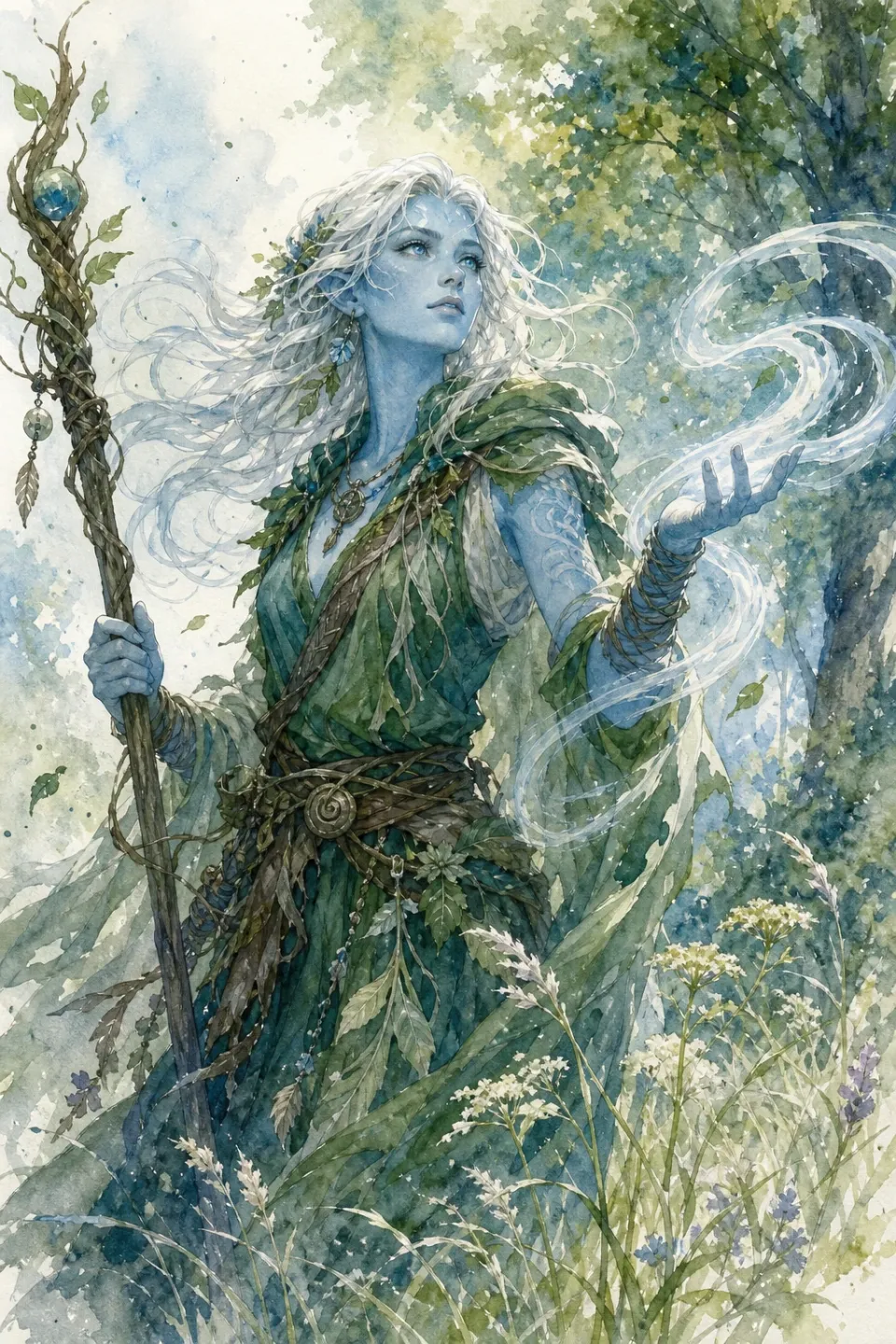
marigold
Air Genasi, Druid, Neutral Good
Description
Marigold is twenty-four years old, an air genasi whose pale hair lifts in a breeze even when the surrounding leaves hang still. She was raised among the high cloud groves, where trees grow from floating islands of soil and rope bridges sway above miles of open sky. As a small child, she followed her grandmother through the rain gardens, carrying seed pouches, mending torn nests, and leaving bowls of water for exhausted winged lizards. Her first lesson in druidcraft came when a storm tore a fledgling from its nest; Marigold held the shivering creature beneath her coat while her grandmother coaxed the broken branch back into place. She learned that kindness is not softness but attention—the choice to notice suffering and spend your own strength easing it. Her people read weather in the taste of the wind, hang prayer ribbons from the highest branches, and teach their children that every creature has a place in the living order. Marigold learned to climb before she could write, moving through the canopy with a scout’s light feet and a druid’s instinct for broken branches, frightened birds, and unnatural silence.
Among the cloud-grove druids, adulthood begins with a charge called the Balancing. Every air druid who comes of age must leave home and restore a damaged piece of nature, returning only when the harm has been mended or the people responsible have been brought to justice. Marigold’s elders gave her a target chosen with cruel precision: an exotic animal trafficking ring that traps rare creatures in the cloud forests, smuggles them through mountain passes, and sells them to collectors, fighting pits, and wealthy men who keep living trophies behind iron bars. The ring has bribed regional guards, bought silence from caravan masters, and left empty nests and bloodied snares throughout the high groves.
The mission is personal because Marigold has seen the ring’s work up close. Three years ago, while serving as a canopy scout, she and her closest friend discovered smugglers cutting a young cloud leopard from a net. They tried to intervene before the animals could be dragged to the valley roads. The smugglers fought back with hooked blades and weighted lines. A severed bridge rope sent both scouts plunging through the branches. But as she fell she heard one name "Zain". Marigold struck limb after limb on the way down, breaking her left arm, two ribs, and one ankle before landing in a bed of thornbushes. The scars along her shoulder and back still tighten in cold weather. Her friend fell farther than she could follow. Marigold reached for him, but her fingers closed around empty air. He struck a jagged shelf of stone far below. By the time she climbed down he was still alive, barely. With one hand pressed to the wound beneath his ribs, he made her promise: never kill unless there was no other way to save an innocent life. Don't become like them. Marigold swore it.
Marigolds life went on, but the sky became an enemy. The sight of a swaying bridge makes her fingers lock around the nearest solid surface. A sudden gust can steal the breath from her lungs. She avoids cliffs, treetops, ladders, and open balconies, choosing forest paths where roots press beneath her boots and the canopy closes overhead. After the accident, she withdrew to the forest floor, spending months beside mossy springs and hollow trees while healing under the care of badgers, dryads, and an elderly ground-dwelling druid. She learned to sleep beneath low branches and to listen for danger in the brush rather than the wind.
Her retreat could not last. When the elders named the same trafficking ring as her rite of passage, Marigold understood the choice beneath their words: face the smugglers, or let grief decide the shape of the rest of her life. She accepted the charge without protest, though she spent the night before leaving sitting beneath the lowest tree in the grove, one hand pressed to its roots. She now travels from settlement to settlement, tracing the ring’s routes through missing-animal reports, butchered snares, coded caravan marks, and frightened stable hands.
Marigold keeps her voice level when panic claws at her ribs. She pauses before answering difficult questions, as if considering a joke only she can hear, then offers a dry remark that leaves everyone unsure whether she is mocking them. She speaks in riddles when she wants someone to reveal more than they intended, answers direct questions with small puzzles, and lets silence stretch until liars fill it themselves. She watches where people look when an animal cries, who checks the exits, and who touches a coin before claiming not to care about money.
She does not seek a bloody victory. Marigold befriends stray dogs, trained ravens, foxes, and half-wild pack animals, using them to carry messages, follow wagons, and locate hidden cages. Vines creep through locks under her hands. Moths gather around the lamps of guilty men. A stolen creature may vanish from a guarded warehouse hours before the authorities arrive, leaving behind an empty collar and a note written in mud.
Marigold intends to free every living creature the ring has taken, expose the guards and merchants who protect it, and bring its leaders before a court that cannot be bought. She knows the final confrontation may lead her back into the high canopy, perhaps even to the same kind of bridge where her friend died. She is afraid of that day. She is going anyway.
Write something about how she
Backstory.
Marigold was born in a cliffside village where houses clung to the rock with rope bridges, canvas roofs, and iron rings hammered into the stone. Her mother gathered stormwater for the cisterns; her father repaired windmills and taught children how to read the weather by the taste of the air. Marigold’s pale blue skin, white hair, and habit of lifting a few inches from the ground when startled marked her as air genasi from the day she was born. Her name came from the first flower she planted: a stubborn marigold growing in a crack beside the family door, its orange head nodding in every breeze.
Her people believed that air belonged to no one. A traveler could ask for shelter, but never be trapped beneath another person’s roof. Doors were left unlatched during daylight, guests were given the best seat near the window, and no one was permitted to swear an oath while holding another person’s wrist. Promises had to be spoken where the wind could carry them. Children learned to mend sails, read cloud shapes, and leave a portion of every meal uncovered for any hungry creature that found its way inside. Hoarding food, blocking a road, or silencing someone who needed to speak were treated as serious offenses. Marigold still sleeps better with a window open and becomes visibly uneasy in rooms without moving air.
As a child, she spent her mornings climbing the watchtower to scatter seed for the swifts and her afternoons following her father along the ridge paths. She learned which mosses held drinkable moisture, which mushrooms grew after lightning, and which trees bent without breaking in a gale. When a landslide buried the village’s lower spring, Marigold found a second water source by following a line of thirsty foxes into the hills. The elders called it luck. An old druid named Sella Cloudroot recognized the truth and took Marigold as her apprentice, teaching her to listen for the difference between wind moving through healthy leaves and wind moving through dead branches.
Her closest friend is Tavin Reed, a broad-shouldered Air genasi with a crooked smile and a talent for making useful things from scraps. His mother kept the village bell tower, and Tavin spent his youth repairing the bells after storms tore loose their ropes. He and Marigold learned to climb together, racing from rooftop to rooftop while carrying messages between distant homes. Tavin is practical where Marigold is impulsive; he checks the knots she ties, counts the healing herbs she gathers, and reminds her to eat before she wanders into the wilderness for three days. He carries a brass whistle on a cord around his neck, a gift from Marigold after he nearly fell from the bell tower. One sharp note means danger. Two mean she has found something worth seeing.
After Tavin’s death, Marigold spent three days beneath a lightning-split cedar, unable to leave the place where the storm had torn the earth open. On the fourth morning, she heard a thin scratching beneath the wet ferns and found a small flying fox with one wing bent at an ugly angle. Its red fur was soaked flat, its ears were torn, and its teeth snapped at every hand that came near.
Marigold wrapped the wing in strips of her own undershirt and braced it with reed stems gathered from the creek. Through three nights of fever, she kept the fox tucked against her ribs beneath her cloak, humming the same low melody she had once sung for Tavin. When dawn came, the creature opened one bright, furious eye and stole a berry from her palm.
She named him Saffron for the golden dust on his muzzle. He never regained the strength for long migrations, but he can launch from Marigold’s shoulder, ride warm air above a battlefield, and circle back with scraps of cloth, bright feathers, loose buttons, or anything else that catches his attention. His favorite treasures are red thread and polished bone. He sleeps curled in the hood of Marigold’s cloak, claws hooked gently into the lining, and bites anyone who reaches for her food without asking.
Marigold insists Saffron is a free creature, not a pet. Saffron has never agreed to the distinction; he follows her from camp to camp, screams when she walks out of sight, and considers every unattended pocket an invitation.
Personality
Marigold speaks in a soft, measured voice, pausing between words as if waiting for the wind to carry each one somewhere worth hearing. Her breath always stirs the loose strands of her hair, even in a sealed room, and dried leaves sometimes skitter across the floor when she grows thoughtful. She knows her riddles and deliberate silences irritate people, but rarely hurries for their sake; when someone snaps at her, she only tilts her head and asks, “Would you rather hear the answer, or merely hear it quickly?” She never raises her voice to win an argument. Instead, she lets a silence settle until the other person begins filling it with their own regret.
Her calm seldom breaks, though a quiet grief hangs around her like the scent of rain on dry earth. She avoids speaking of what was lost, but watches empty nests, abandoned burrows, and dying groves longer than she should. A snapped twig may stop her mid-sentence. She gathers fallen feathers, smooths them between her fingers, and leaves them beneath the nearest living tree. When she finds a withered plant, she presses two fingers to its stem and whispers an apology before moving on, even when she knows no spell can bring it back.
When conversation grows cruel, she redirects it with a riddle. Her favorite questions have no clean answer: “What has roots but cannot hold the ground?” or “When does a storm become a shelter?” She asks them with such quiet sincerity that mockery often dies before the answer arrives. When words fail, she kneels beside the nearest living thing and lets the breeze speak for her. Grass bends toward her hands. Leaves tremble without rain. For a moment, the air around Marigold carries the scent of wet soil, crushed marigolds, and a forest waiting to heal.her
She also struggles to remain in one place when people are suffering. Marigold promises help too quickly, takes on more burdens than she can carry, and leaves problems half-solved when another cry for aid reaches her ears. Her companions may need to remind her that refusing one rescue does not make her cruel—and that even the wind must sometimes be still.