
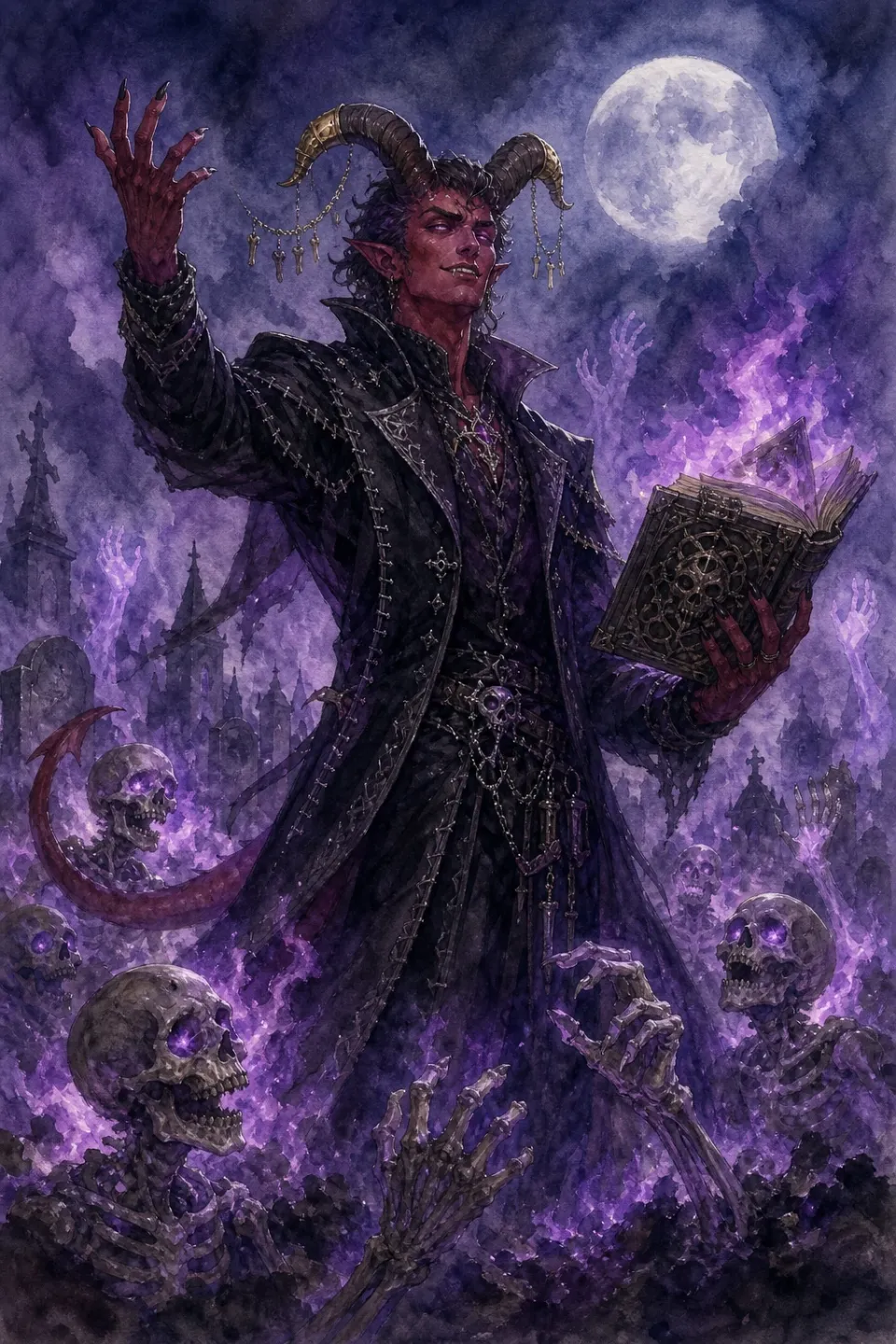
Sinagod
Tiefling, Wizard, Chaotic Neutral
Description
Sinagod is a tall tiefling in a black coat stitched with silver funerary thread, his horns capped in brass and his crimson skin powdered to a corpse’s gray. A gold chain hangs between his horns, bearing tiny jawbones that click when he turns his head. He speaks as though every conversation is a lecture delivered to lesser minds, correcting names, accents, and customs with a thin smile. He calls elves “perfumed archers,” dwarves “tunnel vermin,” and humans “unfinished drafts,” treating every ancestry outside his own as proof that the world has settled for inferior materials. His contempt is vile, deliberate, and matched only by the offense he takes when anyone dares return it.
In battle, Sinagod raises one hand and expects the dead to rise before he finishes giving the order. Corpses claw out of the earth in neat ranks, their bones lacquered with violet fire, while ghostly hands applaud from the air around him. He names each spell after himself—Sinagod’s Magnificent Reanimation, Sinagod’s Final Correction—and pauses for applause that never comes. His arrogance masks no hidden nobility: he helps when it amuses him, betrays allies who bore him, and would rather lose a victory than share credit for it.
Backstory
Sinagod was raised beneath the banners of General Veyr, a celebrated commander whose victories filled the streets with bronze statues and fresh recruits. Veyr taught his son that blood determined worth, that mercy was weakness, and that tieflings survived only by standing above everyone who spat at them. At council dinners, the general made cruel jokes about other peoples; at home, he demanded Sinagod repeat them until the boy could deliver each insult without hesitation. Sinagod learned early that contempt could serve as armor, and he wore it before he was old enough to understand who had forged it.
His father’s fall came at Blackglass Pass. Veyr ordered three battalions through a ravine despite warnings from his scouts, certain that no “lesser” officer could question him. The army was trapped beneath the pass’s collapsing cliffs. Hundreds died, the supply train burned, and Veyr surrendered before dawn. When the survivors returned, they carried his command pennant upside down. His medals were stripped in the public square, and the name Veyr became a tavern punchline: a general who lost a war to a mountain.
Sinagod was fifteen when the family manor emptied. Servants vanished, creditors pried silver from the walls, and old allies crossed the street rather than be seen with a Veyr. He turned to wizardry in the ruined library, teaching himself from his father’s campaign notebooks and stolen academy texts. Every spell became an argument with the world—proof that a Veyr could still command fire, bend minds, and make an entire room regret laughing first. His magic is aggressive and theatrical, built to win attention before it wins battles.
When strangers hear his name and snicker, Sinagod bares his teeth and gives them a sharper insult in return. He challenges mockery over family banners, cracked medals, and even jokes about Blackglass Pass, defending a legacy already too damaged to save. He often makes himself the punchline by shouting in crowded taverns or demanding formal duels from people who barely remember the insult. Sinagod knows his father was a tyrant and a fool; he simply considers admitting it a greater disgrace than becoming one himself.
Personality
Sinagod enters every room as though the conversation has been waiting for him. He announces his spells before casting them, corrects other people’s pronunciation of arcane terms, and turns minor successes into lectures about his “superior infernal discipline.” He expects silence when he speaks and visibly checks who is watching before doing anything impressive. When challenged, he smiles thinly and says, “You may doubt me after I have finished proving you wrong.”
He assumes a person’s species tells him what they are capable of, praising tieflings as naturally gifted while treating humans, halflings, and other peoples as lesser students or useful servants. He uses patronizing nicknames, refuses advice from anyone he considers “lesser-born,” and disguises insults as scholarship. These views have cost him apprentices, allies, and several chances to learn from people more capable than himself. Sinagod is not blind to the doors his arrogance closes, but he would rather blame prejudice against tieflings than admit he caused it.