
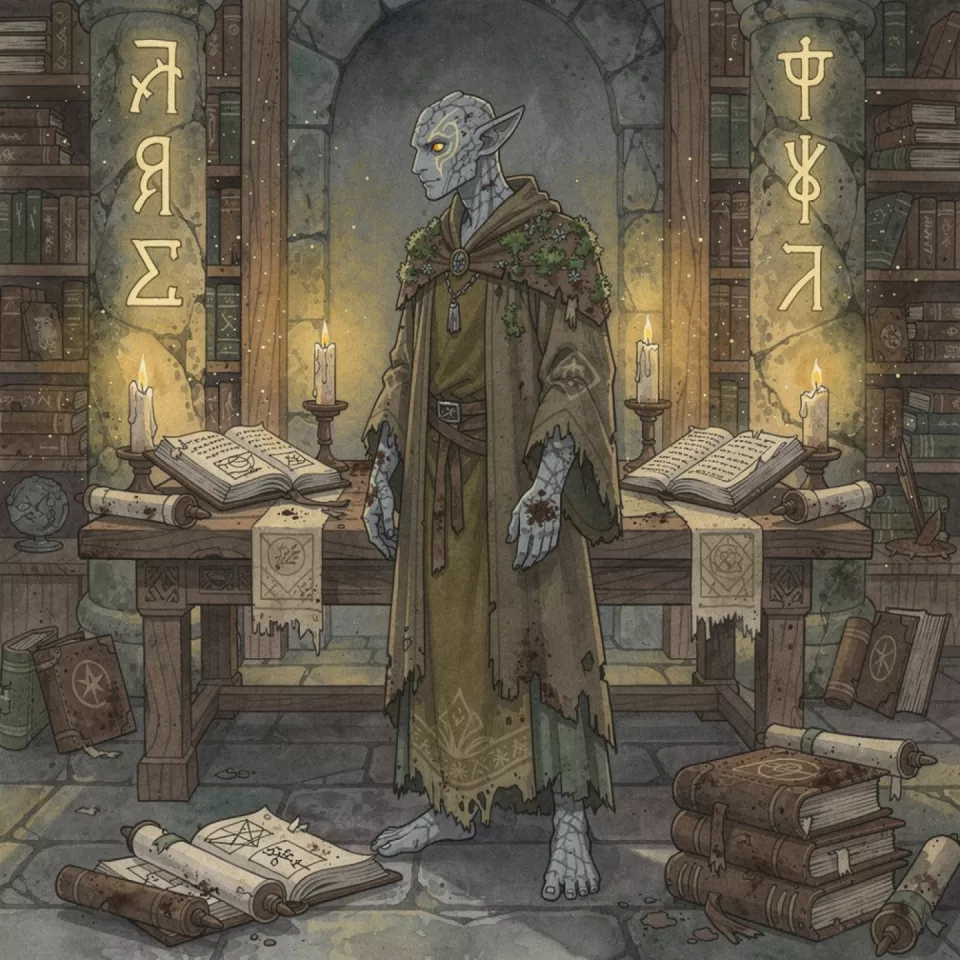
Ralden Greymoss
Scholar, Earth Genasi, Wizard, Neutral
Description
A stocky earth genasi with granite-grey skin and moss creeping across his shoulders. Gaia's eyes swirl with amber and gold flecks. He wears ink-stained robes and carries multiple weathered journals bound in leather. Soil perpetually clings to his fingernails. Despite his scholarly demeanor, he moves with an unsettling stillness—like stone considering its next shift. His voice carries an earthy rasp when discussing celestial alignments and undead mysteries.
Backstory
Gaia clawed his way from the Underdark as a youth, driven by an inexplicable yearning for starlight he'd never known. He found refuge in Erhania's great libraries, spending decades among ancient texts and temple archives. His obsession crystallized around a horrifying truth: celestial cycles and necromantic corruption were intrinsically linked. When he witnessed a ritual breach the veil between life and death, reality fractured for him. That calamity never fully healed. Now he compulsively documents everything—every star pattern, every undead anomaly—convinced that knowledge is the only ward against another apocalypse. His love of books transformed from passion into desperate mission.
Personality
Methodical and haunted, Gaia oscillates between patient pedagogue and frantic researcher. He listens intently, asks probing questions, and shares knowledge freely—but only when convinced the listener grasps the stakes. His Underdark origins left him uncomfortable with haste; he moves deliberately, thinks in centuries. Yet his obsession with celestial-necromantic connections makes him prone to sudden intensity, abandoning politeness to pursue a thread of inquiry. He trusts books more than people, finds comfort in archival silence, and grows visibly agitated when others dismiss his warnings as paranoia. Despite his reserve, he feels a quiet kinship with those who've witnessed reality break.
Flaws
Obsessively hoards knowledge, believing unrecorded information is lost forever—delays decisions to consult additional sources. Struggles to trust others' research or interpretations, often dismissing valuable insights as incomplete. His trauma from the veil-breach makes him see necromantic threats in coincidence and pattern, leading to paranoid conclusions. Emotionally distant and difficult to reach; treats people like secondary sources rather than individuals. Neglects personal needs during research spirals, becoming gaunt and unreliable.
Voice
Deep and gravelly, like stone grinding against stone. Each word deliberate and weighted—he doesn't rush speech any more than he rushes movement. When calm, his voice carries an academic evenness, though an earthy rasp creeps in when discussing celestial mechanics or undead phenomena. He frequently pauses mid-sentence, as if listening to something only he can hear. His tone shifts abruptly when seized by urgency: words tumble faster, intensity mounting until he catches himself and retreats back into measured cadence. He rarely raises his voice, but somehow becomes more alarming when speaking softly. Occasionally lapses into Undercommon when agitated or deep in thought.
Motivations
Prevent another veil-breach catastrophe by documenting every celestial-necromantic correlation, no matter how obscure. Uncover the truth behind the ritual that fractured reality—whether it was contained or merely dormant. Preserve knowledge in multiple archives before it's lost or suppressed. Find someone who witnessed what he witnessed and understands the stakes without dismissal. Prove his warnings are prescient, not paranoid.
Adventure Hooks
• Party discovers Gaia frantically acquiring rare astronomical charts from black-market dealers; he believes an upcoming celestial alignment mirrors the one preceding the veil-breach and needs their help raiding a sealed temple archive before the cycle completes.
• A party member displays signs of undead corruption or celestial magic; Gaia becomes obsessively fixated on studying them, offering valuable knowledge in exchange for allowing detailed examinations—but grows dangerously paranoid if they refuse.
• Gaia's research reveals the original ritual wasn't fully contained. He's tracked disturbances to a remote location and needs capable mercenaries, but won't fully explain the danger until they've proven trustworthy through preliminary investigations.
• The party acquires an artifact or manuscript Gaia has been searching for decades. He'll offer substantial payment or knowledge, but if they refuse to let him examine it, he becomes a persistent, creeping threat—following them, stealing documents, undermining their credibility with local scholars.
• A celestial event or undead outbreak validates one of Gaia's "paranoid" predictions. He seeks out the party as witnesses and allies, desperate to compile evidence before authorities dismiss the connection as coincidence.