
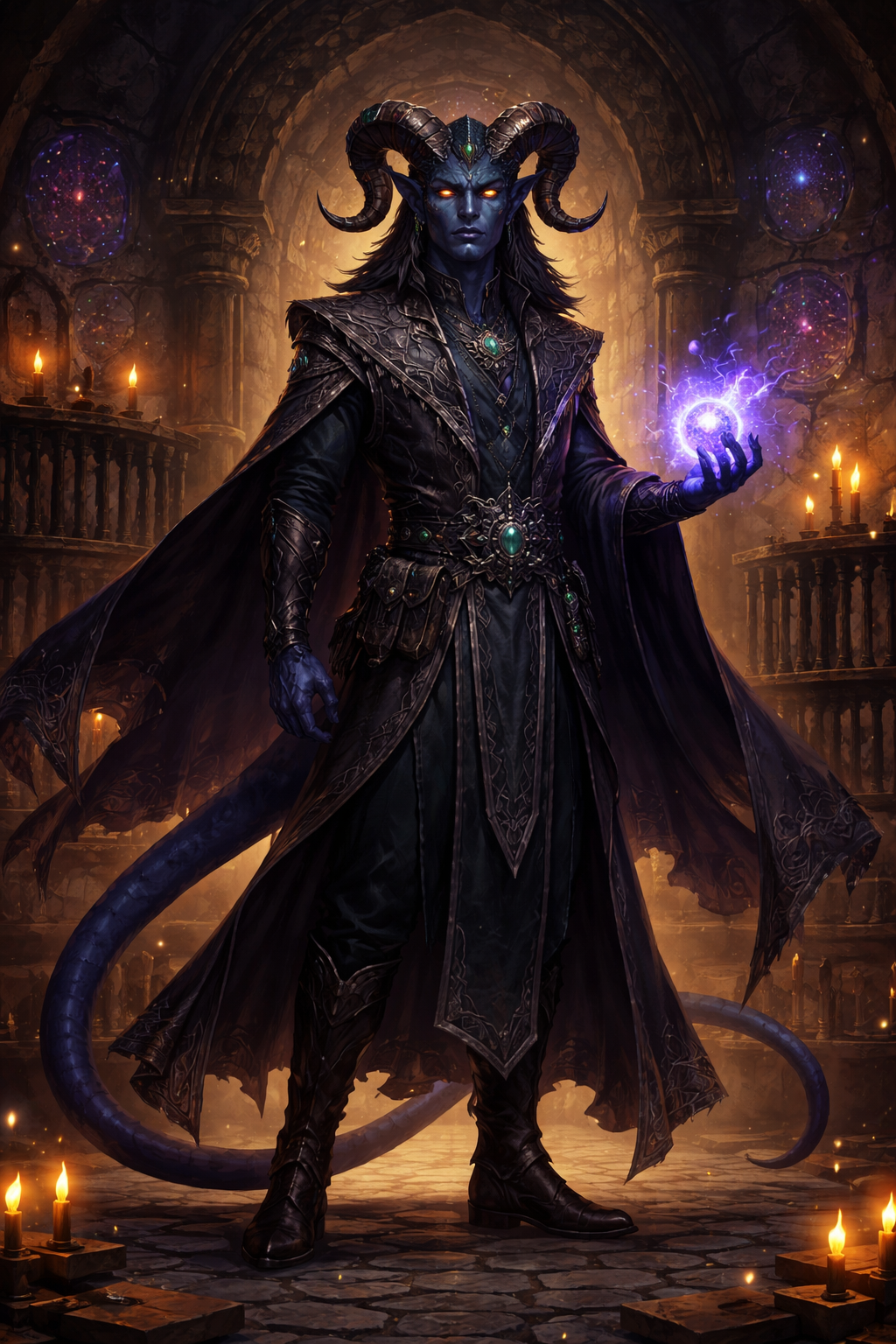
Krylmor
Tiefling, Warlock, Chaotic Neutral
Description
A blue-skinned tiefling with prominent ram-like horns that curve backward and upward. The horns are adorned with intricate jeweled settings—emeralds, sapphires, and amethysts inlaid along their ridges, catching light with each movement. His eyes gleam with an otherworldly intelligence, and his tail moves with deliberate grace. Krylmor carries himself with the confidence of one who has struck a bargain with forces beyond mortal understanding, his appearance a testament to both infernal heritage and studied vanity.
Backstory
Krylmor was abandoned as an infant at the steps of an observatory tower, his infernal appearance enough to condemn him in the eyes of most. The stargazers who found him—a reclusive order of scholars—chose to raise him rather than turn him away. They taught him their craft: to read the celestial patterns, to interpret the movements of distant lights as messages written across the void.
For years, he believed the stars guided all things. His caretakers filled his mind with notions of destiny and cosmic design, showing him how to calculate trajectories, predict eclipses, and divine meaning from alignment and conjunction. The jewels adorning his horns were a gift from the head astronomer—fragments of fallen meteors set into the bone as he came of age, marking him as one of their order.
But the stars, he came to realize, were silent. They offered no comfort, no answers to why he was abandoned or why his people feared him. The order's interpretations felt hollow, their cosmic fatalism another cage. When a otherworldly presence reached out to him one night—a voice that promised knowledge beyond mere starlight—Krylmor answered. He accepted a pact with forces that understood the darkness between the stars, trading his uncertain servitude to abstract destiny for a tangible power he could command himself.
He left the observatory behind, carrying only the jeweled horns as proof that he once believed in something pure. Now he walks his own path, reading fate in the spaces where the old order taught him to look, but answering to no one's interpretation but his own.
Personality
Krylmor wears skepticism like armor, questioning every grand claim and cosmic certainty with sharp wit and sardonic observation. He's learned that the universe rarely delivers on its promises, so he trusts his own judgment above all—though he's not above admitting when he's wrong, usually with a self-deprecating quip. Beneath the cynicism lies a genuine kindness born from his own abandonment; he extends patience to outcasts and the downtrodden that he extends to few others. Humor serves as his primary defense, a way to keep conversations light and maintain distance from anything resembling emotional vulnerability. He deflects sincere moments with jokes, softens criticism with laughter, and uses his quick tongue to navigate uncomfortable truths. Despite his chaotic nature and newfound power, Krylmor retains a strange sense of fairness—he won't exploit the truly helpless, though he has no qualms taking advantage of those who deserve it. His time among scholars left him intellectually curious and prone to lengthy tangents, though he's learned to recognize when others have lost interest. He's the sort who'll buy a stranger a drink and listen to their troubles, then vanish before dawn, leaving only a memorable conversation and more questions than answers.
Flaws
Krylmor's cynicism often blinds him to genuine attempts at connection, leaving a trail of people who wanted to help him but were met with deflection and departure instead. His obsession with maintaining control and independence makes him sabotage partnerships that might actually benefit him, unable to fully trust anyone—even those who've proven themselves reliable. He struggles to reconcile his newfound eldritch power with his lingering abandonment wounds, sometimes using his abilities to push away those who get too close before they can abandon him first. His sense of fairness, while genuine, is inconsistently applied; he rationalizes exploitation of those he deems "deserving" in ways that would horrify his former teachers, though he'd never admit how much their disapproval still stings. Finally, beneath all his wit and charm lies a desperate fear that the pact he made was simply another version of the same abandonment—that his patron will eventually discard him as casually as his birth parents did, leaving him once again with nothing but unanswered questions.
Voice
A smooth, measured baritone with an underlying current of dark amusement. Krylmor speaks with the cadence of someone accustomed to holding an audience's attention—each word chosen with precision, each pause deliberate. His inflection carries the weight of sardonic observation; even sincere statements emerge tinged with irony, as though he's perpetually aware of the absurdity beneath the surface of things. When excited by intellectual tangent or arcane mystery, his pace quickens and his tone sharpens, cutting through pretense with surgical efficiency. He favors dry wit and self-deprecating humor, often turning the punchline inward before others can. In moments of genuine emotion—rare and quickly suppressed—his voice drops slightly, becomes almost conversational, before he inevitably breaks the tension with a quip or deflection. There's an otherworldly quality beneath the affability, a subtle resonance that hints at his pact, noticeable when he invokes eldritch knowledge or speaks of his patron.
Motivations
Krylmor seeks the freedom to chart his own course without the weight of cosmic destiny or parental expectation. He's driven by a hunger for knowledge that lies beyond conventional understanding—the secrets whispered in the spaces between stars, the truths his former order deemed too dangerous or heretical. Power itself matters less than the autonomy it grants; control over his circumstances means never again being the abandoned child waiting for rescue.
Beneath the surface, he's compelled by a quiet need to prove his worth to those who discarded him, though he'd never admit it. He moves through the world collecting moments of connection with other outcasts and the forsaken, drawn to their stories even as he sabotages the relationships they might build. There's an unspoken hunger to understand why he was left behind—not to excuse it, but to ensure he'll never be helpless in such a way again.
Most pressingly, Krylmor is driven by the need to answer the question his pact raises daily: Is his patron genuinely invested in him, or merely using him as a tool? He pursues increasingly complex tasks and forbidden knowledge partly to test this bond, partly to become indispensable enough that abandonment becomes impossible. The fact that this strategy mirrors the very desperation he despises in himself only makes him pursue it harder, masked beneath layers of cynicism and sardonic deflection.