
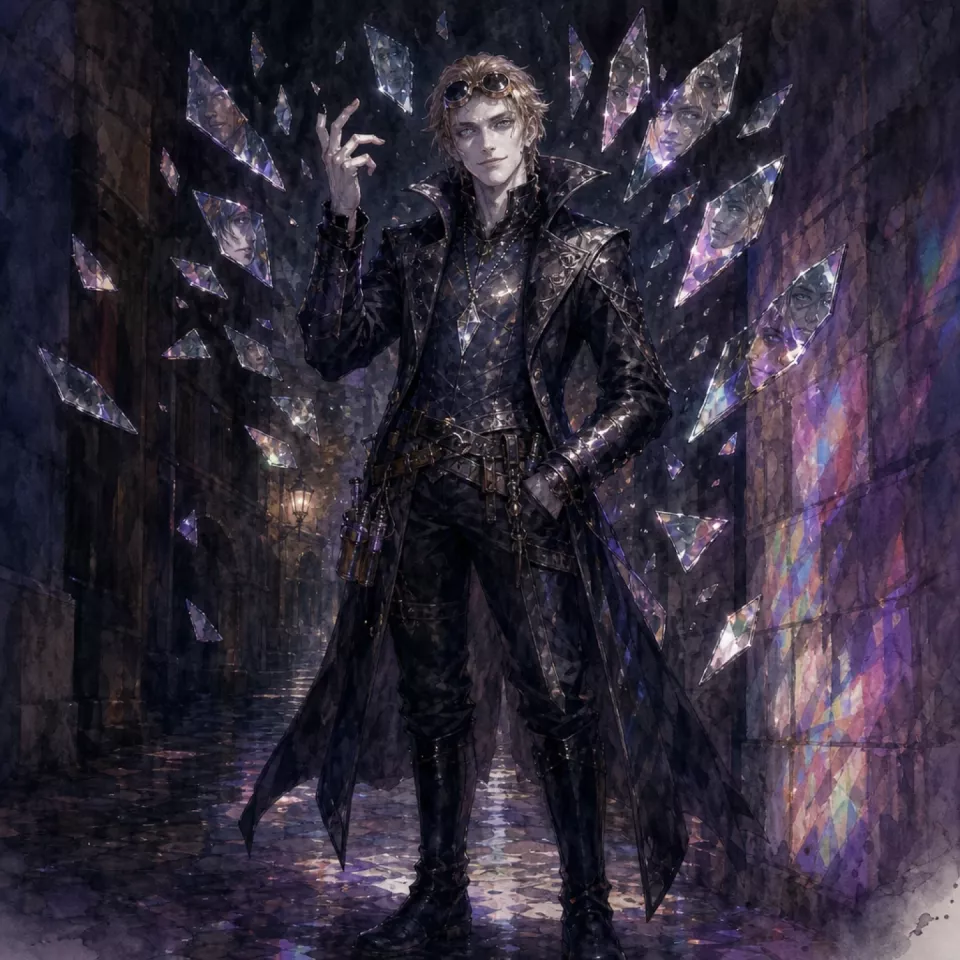
Vesper Spiegel
Changeling, Warlock, Chaotic Good
Overview
Vesper "The Echo" Vex is a Changeling warlock of the Ninth Quill—a master infiltrator, saboteur, and spy who has worn so many faces that he no longer has one of his own. His patron is not a distant entity but a state of being: The Shattered Mirror, a kaleidoscope of infinite reflections, fractured identities, and shimmering shards of possibility that float around him constantly, whispering advice, arguing among themselves, and showing him versions of reality that have not yet come to pass.
He is a brilliant strategist (INTJ) with a whimsical, playful soul—a man who treats every heist like a performance, every lock like a riddle, and every adversary like a dance partner. He is Chaotic Good to his core: he steals from the powerful, protects the innocent, and laughs at the absurdity of it all.
Appearance
In his default form, Vesper is strikingly ordinary—a deliberate choice. His skin is a warm, neutral tone with a faint, almost imperceptible shimmer, like light reflecting off still water. His features are pleasant but forgettable: high cheekbones, a straight nose, a jaw that is neither strong nor weak. His hair is a soft, tousled brown, perpetually falling across his forehead as if he just ran his fingers through it. His eyes are his only remarkable feature—shifting, mercurial grey that seem to hold a thousand different expressions at once. When he is amused, they glint with mischief; when focused, they sharpen to a razor's edge.
He moves with liquid grace—never fumbling, never stumbling. His footsteps are silent even when he isn't trying to be stealthy. He has a habit of catching falling objects without looking, rolling coins across his knuckles, or fidgeting with lockpicks when he is thinking.
He dresses with studied carelessness: a dark, well-tailored coat over a fitted breastplate (concealed beneath his Ubiquiform), practical boots, and a utility belt laden with pouches, lockpicks, and vials. His Ubiquiform—a magical tabard—can shift into any outfit with a whispered word, allowing him to change costumes mid-heist with theatrical flair. A pair of sleek, dark-tinted goggles rests on his forehead—his Devil's Sight lenses, tuned to pierce magical darkness. His arcane focus is a small, polished mirror shard set in a silver pendant, which flares with prismatic light when he casts.
Backstory
Origins: A Child of No One
Vesper was born a Changeling—a creature of shifting faces and uncertain identity—in the sprawling, crime-ridden streets of a busy trade city. He never knew his parents. He was raised by the streets, by the shadows, and by the desperate necessity of survival. As a child, he learned that the face he wore determined how the world treated him. A beggar's face earned him pity—and a few coins. A merchant's face earned him respect—and a few opportunities. A guard's face earned him power—and a few enemies.
He was good at it. Too good.
By the time he was a teenager, he had developed a philosophy: "The face is the mask, but the mask is the truth. Wear it well, and the world will never know you're lying." He became a grifter, a con artist, and a master of disguise—not because he was greedy, but because he was curious. He wanted to know what it felt like to be other people. He wanted to understand their secrets, their fears, their dreams. He wanted to become them—just for a while.
But the more faces he wore, the less he remembered his own. He began to lose himself in the masks. He would wake up in the morning and have to ask himself: "Who am I today? Who was I yesterday? Who will I be tomorrow?" The question was not terrifying. It was fascinating.
The Charlatan Years: A Life of Grifts
Vesper's young adulthood was a blur of grifts, cons, and narrow escapes. He worked alone—he trusted no one—and he specialized in short-term, high-reward schemes:
The Lost Heir: He would pose as a noble's long-lost relative, collect a "loan" from the family, and disappear.
The Insurance Scam: He would purchase expensive goods, then "steal" them from himself, collect the insurance, and sell the goods to a fence.
The Identity Theft: He would impersonate a merchant, drain their accounts, and vanish before anyone noticed.
He was good at it. He was too good at it. He left a trail of ruined lives behind him—people who trusted him, who believed in him, who saw themselves reflected in his face. He didn't feel guilty. Not then. He told himself that his marks were rich, or corrupt, or deserved what they got.
But the faces of the people he ruined followed him. They whispered to him in his sleep. They appeared in mirrors. They haunted the edges of his vision. He thought he was losing his mind.
He was right—but not in the way he imagined.
The Shattering: Contact with The Mirror
Vesper's transformation came on a night he had almost forgotten. He was running from a mark—a wealthy merchant who had discovered his grift—and ducked into a narrow alley. The alley was dead-end, lined with shattered mirrors that had been thrown out from a nearby shop. His pursuers were closing in. He had no escape. He had no plan.
He looked into the broken mirrors.
And the mirrors looked back.
In that moment, the fragments of glass seemed to move. They caught the torchlight and refracted it in impossible patterns. He saw his own reflection—but it was not his own face. It was a kaleidoscope of faces he had worn, faces he had never worn, faces he might one day wear. A thousand possibilities swirled in the broken glass.
One of the shards whispered to him—not in words, but in knowing. It said: "You are not broken. You are infinite. You are the mirror that reflects a thousand truths. Embrace the shards, and you will never be alone again."
Vesper touched the shard. It cut his finger, and a drop of blood fell onto the glass. The mirror shattered in his mind—and the pain was blinding. His consciousness fragmented into a kaleidoscope of identities, memories, and possibilities.
When he woke, his pursuers were gone. The shards were floating around him, whispering in a thousand overlapping voices. He was not a single person anymore. He was a chorus.
He had become The Shattered Mirror.
The Ninth Quill: A New Purpose
Vesper spent the next year learning to control his new abilities. The shards showed him possibilities, warned him of dangers, and occasionally offered terrible advice. He learned to listen, to filter, and to use them as tools. He became an even better grifter—but he was also becoming something else: a man who could see the world from a thousand angles at once.
His reputation grew. The Ninth Quill took notice.
Dean Sirethe Slipshadow, the enigmatic master of Blackscript College, had been watching Vesper for months. She saw his talent—not just his skill, but his potential. She saw a man who had lost himself and was searching for a new identity. She sent him an anonymous invitation: a simple piece of paper with a single sentence scrawled on it:
"You don't find us. We find you. You're wasting your talent. Come to Blackscript College, and we'll teach you how to use it."
Vesper was intrigued. He followed the instructions on the note—through twisting alleys, hidden passages, and unmarked doors—until he found himself in the foyer of a centuries-old academy hidden beneath a dilapidated warehouse.
Slipshadow met him personally. She looked at him with sharp, knowing eyes—and she saw the shards floating around him. She said: "You're not like the others. You're not just wearing a mask. You've become the mask. That's useful. We can use that."
Vesper joined the Ninth Quill. He finally had a purpose.
The Nine Quill Years: Rise of an Agent
Vesper trained at Blackscript College alongside other talented thieves, spies, and saboteurs. He excelled in every discipline:
Arcana: He learned to identify and handle dangerous magical artifacts—a skill that would serve him well in the Ersatz Repository.
Deception: He was already a master, but Slipshadow taught him the art of sustained deception—wearing a single identity for weeks or months without breaking character.
Infiltration: He learned to move through any building, bypass any ward, and avoid any guard. His shards gave him an edge—they showed him the angles that others missed.
Sabotage: He learned to destabilize factions from within—planting forged documents, sowing paranoia, and encouraging infighting.
He became Slipshadow's favorite student—not because he was obedient, but because he was effective. He treated every mission like a performance, and he was the star of the show.
The Shards: His Constant Companions
The Mirror Shards are the core of Vesper's identity. They are not just tools—they are his family, his advisors, and his harshest critics. He knows them all by name (or, at least, he tries to). Each shard is a fragment of a face he has worn—or a face he could wear.
Brenda: A retired noble he ruined. She gives advice about social etiquette and occasionally berates him for his lack of manners.
Gregor: A guard he impersonated. He offers tactical advice about patrols and security protocols.
Lydia: A scholar he replaced. She provides insights into arcane theory and ancient texts.
Marta: A baker whose shop he used as a safehouse. She offers surprisingly good advice about people and grudges.
The Others: Dozens of unnamed faces that whisper observations, gossip, and occasional warnings.
Vesper treats them with affection, exasperation, and genuine warmth. He argues with them, thanks them, and occasionally tells them to shut up. They bicker among themselves. They give terrible advice. They save his life.
He wouldn't trade them for anything.
The Mission: Vesper's Purpose
Vesper serves the Ninth Quill because they give him interesting problems to solve. He is not driven by greed, power, or loyalty—he is driven by curiosity. Every heist is a puzzle. Every faction is a labyrinth to navigate. Every mark is a character to study and perform.
But he also has a moral code—one he has developed over years of reflection. He steals from the powerful to protect the innocent. He sabotages factions that would hurt innocent people. He avoids killing whenever possible, because dead bodies are boring and messy. He genuinely cares about his allies—his team is his second family (after the shards).
His mission is simple: "Make the plan. Execute the plan. Expect the plan to go off the rails. Throw away the plan. Follow my lead and you'll be fine."
Personality
Public Demeanor: The Playful Trickster
Vesper is absolutely delightful. He smiles easily, laughs at his own jokes, and treats every interaction like a game he is destined to win. He doesn't just charm people—he entertains them. He tells ridiculous stories, performs dramatic gestures, and occasionally changes his appearance mid-sentence just to see the look on people's faces. He is the kind of man who would steal your wallet while telling you a joke, and you would laugh so hard you wouldn't even notice.
He is not cold or calculating in public. He is warm, disarming, and utterly untrustworthy—and he knows it. He leans into his own absurdity. When asked about his past, he deflects with a wink and a story so ridiculous that it must be a lie, which makes people trust him more. He treats life like a performance, and he is the star of the show.
Private Reality: The Kaleidoscopic Mind
When Vesper is alone, he is still playing. He holds up a shard and watches his own reflection twist, shift, and transform. He is constantly curious about who he is today. He has no fixed identity, and he loves it. He treats his own psyche like a puzzle box—fun to open, fascinating to explore, and impossible to fully understand.
The shards are not his tormentors—they are his roommates. They are a chaotic, argumentative, occasionally helpful group of voices that have lived in his head for so long that he genuinely cannot imagine life without them. He banters with them. He argues with them. He asks their advice. He treats them like a room full of opinionated colleagues who never stop talking. He occasionally looks at an empty chair and says, "No, Gertrude, that's a terrible idea. You were a baker. You don't know anything about vault security." The shards complain. He ignores them.
Core Emotional State: Weary But Genuinely Content
Vesper is tired—spying is exhausting work—but he is also happy. He has made peace with his existence. He knows he has wronged people, but he also knows he has prevented worse catastrophes. He has stolen, lied, and manipulated—but he has also kept dangerous artifacts out of the hands of megalomaniacs. He loves the thrill of the heist, the satisfaction of a perfectly executed plan, and the quiet pleasure of outsmarting people who thought they were untouchable.
He is a performer at heart, and every heist becomes a story he tells to an audience of grateful dead people. He doesn't brood; he celebrates. He treats his own existence like a cosmic joke, and he is the punchline—and he finds that hilarious.