
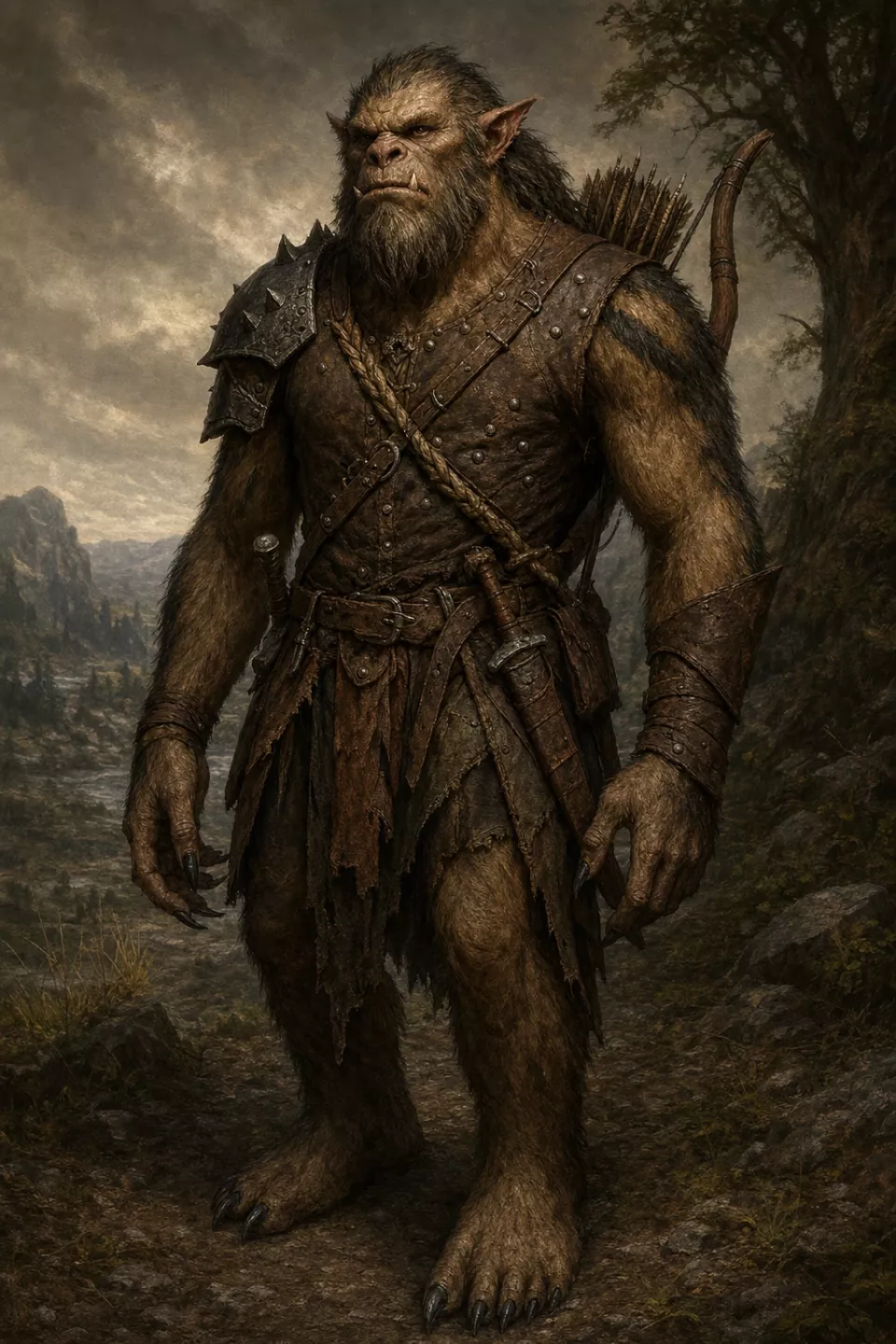
Vurkash Mordrak
Bugbear, Ranger, Chaotic Neutral
Description
Vurkash Mordrak looms—tall for a bugbear—with coarse sand-brown fur, broken by darker charcoal streaks that run down his shoulders like old soot. His long arms hang heavy at his sides, ending in hooked black claws that flex when he studies a target.
A thick, rope-thin leather baldric crosses his chest, strapped tight with hard knots. It carries a weathered longbow and a quiver packed with 40 arrows, fletchings dulled by dust and travel. On one shoulder, a jagged iron pauldron bites into his hide, held in place by riveted straps that run down to a studded leather jerkin. At his hips sit two short swords, their scabbards worn slick by use.
Backstory
I knew Brinewake from the stink of the canals and the wet grit packed into every cobblestone seam. I was the bugbear who learned to move quiet—shoulders low, breath measured—because the streets always watched. When the city’s underways got too tight for dignity, I hunted. Not for glory. For meat, for coin, for the next hour that stayed mine.
Then the city tried to kill me.
I’d followed something wrong beneath Brinewake—an ugly scent of old rot and stranger-than-mold cold—until my foot slid into a trap meant to bleed me out under stone. Steel snapped, rope bit, and darkness squeezed in around the edges of my vision. I felt the gloom stalker part of me fight, but I was already losing blood.
The instinct that should’ve saved me told me to endure, stay still, don’t waste breath. I heard boots, quick and nervous—Nox—and I expected him to run.
He didn’t.
He threw himself into the trap with raw desperation, prying and biting down on rope to keep it from cutting him deeper. His hands weren’t meant for ranger work, but he didn’t hesitate. While the pain flared white, he started reciting those broken prayers, like he was reciting his way back from death. The bleeding slowed. My breath steadied. I still lay trapped, but I wasn’t fading.
When the thugs arrived—cheap knives, mean voices, a plan to finish what the trap started—I stopped being prey. I tore free when I could, got my footing, and made them regret stepping into my shadow. Nox fought like he couldn’t afford to lose: clutching at whatever he had, hitting where it hurt, never waiting for permission to be useful. When they broke, he didn’t follow rules—he followed openings.
After that, I didn’t have to decide whether Nox was worth trusting. I already felt the cost of leaving him behind. I saw a refusal to die in him, the same refusal I’d used to keep myself alive in the tunnels. Nox saw someone who shouldn’t have made it out of that trap, and he couldn’t stand the thought of watching me meet the end anyway.
We left Brinewake together, because no one survives long with a bounty on their name and silence in their pockets. We tracked the people behind the attack through salt-stained alleys and candlelit back rooms, chasing rumors that turned into names. They didn’t want me dead in a clean way. They wanted me erased—no witness, no questions, no body to bury with ceremony.
Nox didn’t heal like a priest. He patched with what he had: a torn strip of cloth, a bit of bitter salve, prayer squeezed through clenched teeth. His magic was rough and practical, and it kept me moving through monsters and traps that bit harder than steel. In return, I taught him to read the ground—how to check for pressure plates by feel, how to find a safe line in a ruined stairway, how to stay alive when a fight goes wrong.
He’s not a shining hero. I’ve watched him steal food off a barrow while hungry eyes followed him like daggers. I’ve heard him lie through his teeth when the truth would’ve gotten an innocent dragged into a dungeon. If a rule keeps my friends from breathing, he bends it. Chaos, for him, isn’t a slogan—it’s a tool.
And me? I remember what it cost him to step into that trap for me. I remember the prayers on his lips, the grit under his nails, the way he wouldn’t let the world decide my ending.
I made him a promise and I live by it: Vurkash Mordrak does not face death alone again.
If darkness comes sharp and close, if the gloom stalks too deep and my strength starts slipping, Nox will already be there—prayer in his voice, weapon in his hands—ready to pull me back one more time, no matter how the city screams for me to stay.
Personality
Vurkash keeps his breathing low and his steps measured, checking exits before he does anything—one hand rests on a sword hilt even when he’s “resting.” He speaks in short, practical bursts, nose close to the ground to read damp soil, mold, and fresh tracks. When trouble comes, he locks in: he’ll take point, stay in cover, and let others pass his own knife edge rather than gamble their lives. He distrusts strangers by default, but once someone earns his trust he counts it like rations—slow to give, impossible to waste.
His friendship with his goblin companion drives the soft part out in small, visible ways: he’ll share his last smoked moth-meat without being asked, and he lowers his guard to listen when the goblin worries at the edges of a plan. When the goblin prays, Vurkash doesn’t mock; he watches the dark around them instead, marking threats and giving his friend space to heal, even if it slows him down.