
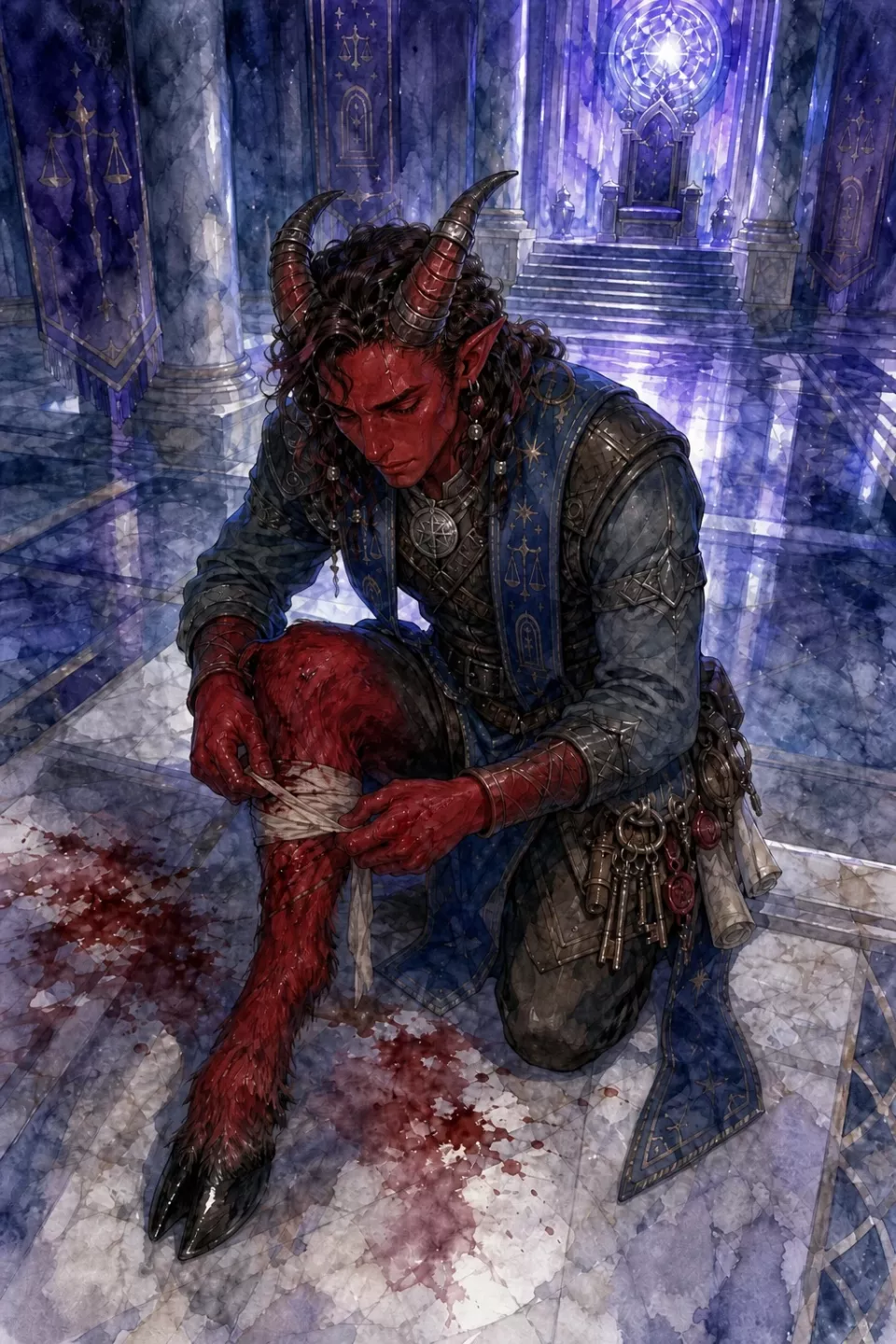
Uru
Satyr, Cleric, Lawful Neutral
Uru was born in Red Mergold Village during the Slugs Age, when the lowlands were ruled by rain, rot, and the slow advance of the great marsh slugs. Red Mergold stood on a ridge of iron-rich earth above the Mergold Fen, its mud-brick houses painted with red clay to keep them from dissolving in the wet season. Every roof carried gutters made from split river reeds. Every doorway held a dish of salt. The villagers measured time by floodmarks on the bell tower and by the arrival of the pale slugs that crawled out of the fen each spring, devouring grain, leather, and anything left unattended. People in Red Mergold were practical and exacting. They kept written tallies of seed, tools, debts, and favors. A promise spoken before the village bell carried the force of law, while a promise made in private was treated as a hope until witnessed.
Uru’s mother, Senna, tended the village herb beds and knew which marsh plants soothed a sting, stopped bleeding, or made a person sleep through the worst fever. Their father, Dorr, repaired floodgates and carved the wooden markers used to divide pasture, reed beds, and fishing pools. Uru grew up among sharp smells: peat smoke, sour milk, crushed mint, wet wool, and the metallic scent of red mud. Their earliest lessons were not taught in a schoolhouse. Senna taught them to sort healing leaves by touch in the dark. Dorr taught them to inspect a hinge before trusting a door and to count the nails returned after every repair. Uru’s older sister, Pell, taught them less useful skills, such as climbing the bell tower, whistling through two fingers, and dancing on the narrow beams of the old ferry shed without falling into the water.
The Slugs Age changed Red Mergold before Uru was old enough to understand its name. First came the Harvest Blight, when black-shelled slugs crossed the northern fields in such numbers that the ground appeared to move. The village burned half its barley and survived on turnips, eel meat, and cakes made from ground cattail roots. Then came the Crown’s Salt Law, which placed every salt pan and ferry under distant officials who had never stood knee-deep in fen water. Salt became scarce, arguments became common, and smugglers began hiding sacks beneath funeral boats. When the Red Mergold floodgates failed during the Year of Nine Rains, the village council refused to wait for royal engineers. Dorr led the repairs, Senna organized the evacuation, and twelve-year-old Uru carried messages through waist-deep water while the bell tower rang until its rope snapped.
That flood left its mark on Uru. Pell disappeared while helping a group of children reach the shrine hill, and her body was never found. For weeks afterward, Uru searched the reed beds at dawn, tying red threads to every willow they checked. Senna eventually took the threads down and told them that grief could be honored without being allowed to command every choice. Uru did not accept the lesson at once. They became watchful, suspicious of unrecorded plans, and quick to ask who had authority to give an order and what would happen if it failed. At the same time, they learned to move through flooded ground without splashing, read water levels from floating debris, and recognize the faint clicking sound that meant a slug colony was close.
Uru’s closest friendship belonged to Marrow Venn, the miller’s child, who had a talent for turning discarded objects into useful tools. Together they built traps from fish line and bent spoons, then used them to protect the remaining gardens. Their greatest success came during the Long Pale Swarm, when thousands of white slugs poured over the eastern wall. The adults wanted to abandon the lower fields, but Uru noticed that the creatures avoided ash from burned alder wood. They and Marrow spent a night spreading ash trenches between the village and the gardens while the rest of Red Mergold carried seed stores uphill. By sunrise, the swarm had stopped at the gray lines. The harvest was poor, but the village kept enough seed to plant again. The council awarded Uru a brass witness token, stamped with the village bell, and recorded their name among the people who had preserved Red Mergold.
The victory also brought a harder truth. The Crown’s officials arrived after the danger had passed and demanded a portion of the saved seed as a levy. Dorr refused. The officials seized his tools and arrested him for obstructing lawful collection. Uru stood before the council and produced Dorr’s repair ledgers, the floodgate agreements, and the witness statements of every family whose homes had been saved. The council could not overturn the Crown’s order, but it delayed the levy long enough for the village to hide half the seed in sealed jars beneath the shrine floor. Dorr was released after three months. He returned thinner, quieter, and unwilling to repair anything for officials who could not name the people they endangered. From him, Uru learned that law could protect the weak only when someone kept the records, remembered the terms, and forced powerful people to obey their own rules.
As Uru grew older, Red Mergold became both refuge and boundary. They served as a runner between the fen settlements, carrying sealed messages through roads that vanished under water and settling disputes over traps, grazing lines, and ferry fees. Their satyr nature made them welcome at some festivals and suspect at others. Uru answered mockery with patient questions, wrote down every accusation, and returned to the speaker with witnesses and dates. They rarely raised their voice. A calm correction, delivered in front of the right people, proved sharper than an argument. Senna feared that this habit would leave Uru lonely. Marrow feared it would make them useful to people who did not deserve their trust. Both fears proved true.
Uru left Red Mergold after the Fen Compact, when several villages joined to reopen the old trade road and resist the Crown’s salt collectors. The compact required a neutral courier who could carry its records between settlements without belonging to any one council. Uru accepted the brass witness token, packed Senna’s dried herbs, Dorr’s repaired knife, and Pell’s last red thread, then followed the road out beneath a sky heavy with rain. They have not stopped keeping records. Uru still counts supplies before a journey, asks who benefits from every agreement, and refuses to accept a spoken promise when ink and witnesses are available. The Slugs Age taught them that survival belongs neither to the strongest nor the kindest, but to those who notice what is happening, prepare for what can be prevented, and make certain no one can later claim that they were not warned.
Description
Uru is a satyr who appears in their late twenties, standing just over five feet tall with a lean, sure-footed build. Their warm umber skin fades into short russet fur along their legs, which end in polished black cloven hooves. Two swept-back horns rise from their brow, ridged like old wood and capped with narrow bands of hammered iron. Their face is angular and watchful, with a straight nose, a sharp chin, and a small silver ring through one pointed ear.
Their thick dark-brown hair falls to their shoulders in uneven curls, threaded with red cord and tiny brass bells whose sound they silence when entering a temple or courtroom. Their eyes are pale amber with horizontal pupils, and they hold a person’s gaze without blinking until an answer is given. A narrow scar crosses their left eyebrow; another pale line circles their right wrist, left by a consecrated chain during their initiation.
Uru wears a high-collared ash-gray tunic beneath fitted leather armor, its plates marked with clean geometric lines and stamped seals. A deep blue stole hangs from their shoulders, embroidered with the symbols of scales, closed doors, and watchful stars. Their holy symbol is a flat iron disk worn at the throat, while a ring of keys, wax seals, and folded writs hangs from their belt. They carry themselves like a walking ordinance: calm, orderly, and difficult to interrupt. Even among laughing satyrs, Uru leaves the impression of a temple at midnight—quiet, guarded, and prepared to pass judgment.
Backstory
Uru was born beneath the silver boughs of the Feywild, in a satyr settlement built around a standing stone older than any living song. Their people marked the seasons with revels, contests, and bargains spoken over honeyed wine, but Uru was drawn to the quiet hours between celebrations. They listened to the old stone when dawn frost cracked across its face, and learned the names of every oath carved into its base. The shrine’s keeper, an austere satyr named Thessa, recognized the difference between simple curiosity and devotion. She taught Uru that a promise was not made stronger by joy, sorrow, or good intentions—only by being kept.
At sixteen, Uru’s faith was tested when a band of goblins crossed into the grove under a truce marked by blood and blue thread. The goblins stole three sacred bells and slew one of Thessa’s acolytes before fleeing through the thorn paths. The settlement wanted an immediate raid. Thessa refused. The truce had been broken, but its terms required seven days before judgment could be passed. Uru hated the delay, yet spent those seven days gathering testimony, tracing footprints, and naming each injured party before the stone. On the seventh night, the shrine’s god answered—not with thunder, but with a single bell ringing from the darkness. Uru led the search party to the goblins’ camp, recovered the bells, and demanded restitution instead of slaughter. The choice earned them enemies, but it also made their calling plain.
Thessa remained Uru’s closest companion until the old keeper’s death during a winter when the Feywild’s borders shifted. A mortal road appeared beside the standing stone, and creatures from the mortal world began stumbling into the grove: frightened travelers, hungry wolves, and one wounded knight carrying a stolen relic. Thessa spent her last strength sealing the road, leaving Uru her iron key and a final command: “Guard the boundary. Mercy without order is only another kind of ruin.” Uru buried her beneath the shrine steps, where every visitor would have to pass over her resting place, and took up the keeper’s bells.
Now Uru walks beyond the Feywild as a cleric, carrying Thessa’s key at their throat and a ledger bound in green hide. They record broken oaths, unpaid debts, unlawful killings, and every kindness that restored a balance. Uru offers protection before punishment and judgment before vengeance, but once a verdict is given, they do not bend it for friendship, fear, or gold. Their past taught them that laws can shield the weak or serve the cruel; the difference lies in who enforces them, and whether that person has the courage to keep the same rules when the cost is personal.
Personality
Counts every promise aloud before accepting it.
Keeps a small book of rules and adds notes in the margins.
Greets strangers with the same formal phrase every time.
Straightens crooked objects while speaking.
Refuses to answer a question until its wording is precise.
Pays debts early, even when no one expects repayment.
Carries a bell used to mark the beginning of prayers.
Never interrupts a ritual, no matter the emergency.
Taps two fingers against their palm when weighing a choice.
Treats written agreements as sacred objects.
Corrects breaches of etiquette without raising their voice.
Gives everyone one chance to explain themselves.
Keeps careful track of who has earned their trust.
Believes fairness matters more than kindness.
Uses full names when angry.
Uses nicknames only after formal permission.
Begins difficult conversations by stating the relevant facts.
Folds clothing into identical squares before sleeping.
Refuses to waste food, candles, water, or words.
Asks who benefits from every proposed action.
Keeps a strict daily prayer schedule.
Dislikes people who change plans without warning.
Stands whenever someone enters a room.
Treats servants, nobles, and beggars by the same rules.
Saves the best portion of a meal for someone absent.
Recites regulations from memory.
Admits mistakes quickly, then records how to prevent them.
Considers punctuality a form of respect.
Carries spare writing tools for anyone who needs one.
Keeps their holy symbol polished despite constant travel.
Measures distance in walking time rather than miles.
Never borrows anything without naming the return date.
Expects the same discipline from themselves and others.
Offers practical help before emotional comfort.
Pauses before speaking whenever anger rises.
Keeps a list of unresolved disputes.
Refuses gifts that might create hidden obligations.
Believes mercy should follow a clear standard.
Separates personal affection from official judgment.
Avoids exaggeration, even when telling entertaining stories.
Uses silence to make others finish their own arguments.
Prefers a plain answer to a comforting one.
Treats every oath as binding, including careless ones.
Dislikes being praised for ordinary responsibilities.
Follows local customs until they conflict with core principles.
Carries a ruler and uses it for suspiciously many tasks.
Reorganizes communal supplies without asking permission.
Corrects bad records before correcting bad manners.
Never sleeps with an open door.
Keeps travel routes written in three different places.
Hums during repetitive work, always slightly off-key.
Touches their holy symbol before making a promise.
Believes every punishment should teach something useful.
Asks witnesses to repeat important events separately.
Refuses to judge a dispute after hearing only one side.
Keeps their temper until someone harms a dependent person.
Gives directions using landmarks, sounds, and smells.
Dislikes riddles when a direct question would suffice.
Repeats instructions exactly as received.
Counts footsteps across bridges.
Feels personally responsible for every person under their care.
Corrects people who call duty a burden.
Leaves a clean space wherever they camp.
Uses prayer as a way to organize difficult thoughts.
Keeps a spare blanket for the least prepared traveler.
Believes rules should protect the vulnerable first.
Has no patience for ceremonial rules without a clear purpose.
Treats punctuality as more important than comfort.
Refuses to gamble with another person’s safety.
Makes decisions quickly once all evidence is collected.
Resents being forced to decide with incomplete information.
Asks permission before touching another person’s possessions.
Keeps their tools arranged by frequency of use.
Notices who is missing from a gathering.
Remembers birthdays, debts, injuries, and grudges.
Gives advice only after asking whether advice is wanted.
Accepts criticism better when it includes a proposed remedy.
Keeps a private record of every kindness received.
Returns borrowed books with the pages uncreased.
Speaks softly when others become loud.
Becomes frighteningly formal when betrayed.
Uses a person’s preferred title without exception.
Refuses to flatter anyone for advantage.
Believes leadership means being accountable first.
Takes the last watch without announcing the sacrifice.
Never complains about discomfort they chose willingly.
Bristles when someone calls obedience the same as virtue.
Follows orders until they violate a sworn principle.
Can recite their own failures more easily than their successes.
Keeps promises made to enemies.
Distrusts anyone who claims never to have made a mistake.
Believes apologies require changed behavior.
Forgives insults faster than broken contracts.
Asks exact questions when someone says they are “fine.”
Offers their cloak without mentioning the cold.
Prefers useful presents such as rope, soap, or dried food.
Maintains eye contact during accusations.
Looks at hands instead of faces when judging honesty.
Smiles rarely, but means it when they do.
Laughs hardest at jokes about authority.
Has a dry answer for nearly every complaint.
Uses proverbs, then argues with them.
Speaks in short sentences when tired.
Gives long explanations only when rules are disputed.
Calls reckless plans “emotionally satisfying catastrophes.”
Refuses to use pet names.
Names every animal they tend.
Answers sarcasm with complete sincerity.
Pretends not to notice harmless flirting.
Notices every insult and files it away.
Enjoys gossip only when it reveals a useful pattern.
Avoids crowds but remembers individual faces.
Stands at the edge of celebrations, supervising exits.
Joins dancing only after someone formally invites them.
Treats music as a physical need rather than entertainment.
Cannot resist matching a rhythm with their hooves.
Becomes more cheerful after communal singing.
Hates being told to “relax.”
Collects unusual bells, buttons, and stamped tokens.
Keeps small gifts from children in a hidden pocket.
Makes tea for people who are too upset to ask.
Refuses to discuss theology while hungry.
Becomes talkative after midnight.
Falls silent around fresh graves.
Sleeps lightly and wakes at unfamiliar sounds.
Keeps one hand near their holy symbol when nervous.
Paces in exact circles while planning.
Ties colored cords around objects that need attention.
Snaps twigs into equal lengths while listening.
Cleans their weapon when troubled.
Polishes their horns before important negotiations.
Braids ribbons into their tail for celebrations.
Removes every ribbon before serious work.
Keeps their hooves carefully trimmed.
Hides embarrassment behind sudden housekeeping.
Claims not to care about appearances, then checks every buckle.
Refuses to travel in wet socks.
Has strong opinions about the proper temperature of soup.
Sleeps best beside a steady fire.
Distrusts beds that are too soft.
Keeps a familiar stone beneath their pillow.
Never eats the first serving from a communal pot.
Tests every chair before sitting.
Checks windows twice before bed.
Avoids standing beneath unsecured balconies.
Carries snacks for animals they have not met yet.
Gives names to recurring headaches.
Apologizes to doors after slamming them.
Thanks tools aloud after difficult work.
Whispers encouragement to frightened patients.
Talks to their reflection during moral arguments.
Keeps a running count of consecutive peaceful days.
Refuses to whistle indoors.
Treats sneezing during prayer as a serious omen.
Knocks twice on wood before making uncertain plans.
Frowns at empty cups left on tables.
Saves interesting feathers without knowing why.
Can identify friends by their footsteps.
Dislikes the smell of boiled leather.
Gets distracted by unusual knots.
Fears becoming useful only when needed.
Fears that mercy will be mistaken for weakness.
Fears losing control in front of dependents.
Fears making a decision no rule can justify.
Fears dying before completing their obligations.
Fears being remembered inaccurately.
Fears becoming dependent on comfort.
Fears empty rooms more than dark ones.
Fears being unable to recognize a friend.
Fears that their faith is built on habit alone.
Fears disappointing a mentor who is already dead.
Fears celebrations that require spontaneous speeches.
Fears deep water despite enjoying rain.
Fears losing their holy symbol.
Fears their anger will outlive its cause.
Fears public praise more than private criticism.
Fears being forgiven too easily.
Fears that strict justice will hurt someone innocent.
Fears needing help and refusing it.
Fears becoming cynical after repeated betrayal.
Feels guilty when resting during another person’s hardship.
Feels responsible for strangers who share their road.
Feels uneasy when praised without specific reasons.
Feels calmer after assigning every task a place.
Feels embarrassed by tears but never by grief.
Feels protective toward anyone excluded from a group.
Feels jealous of people who act without hesitation.
Feels envy toward carefree travelers.
Feels shame when anger provides the correct answer.
Feels relief when someone else takes command competently.
Feels insulted by pity.
Feels tenderness toward old tools and repaired clothing.
Feels suspicious of sudden generosity.
Feels safest when everyone knows the plan.
Feels lonely in rooms full of laughter.
Feels proud when an apprentice surpasses them.
Feels responsible for enemies who surrender.
Feels disgust toward cruelty disguised as discipline.
Feels admiration for people who admit ignorance.
Feels awkward around romantic declarations.
Feels drawn to people who keep difficult promises.
Feels restless after unresolved arguments.
Feels calm in hospitals, kitchens, and workshops.
Feels guilty after enjoying another person’s misfortune.
Feels comforted by repeated prayers, even without certainty.
Feels more honest when speaking to animals.
Feels wounded when their judgment is questioned publicly.
Feels grateful for blunt friends.
Feels protective of anyone carrying too much.
Feels contempt for people who demand sacrifices they avoid.
Feels curiosity before fear when confronted with the unknown.
Feels fear before curiosity when someone breaks a ritual.
Values fair process over favorable results.
Values loyalty proven through inconvenience.
Values competence more than charm.
Values truth, but not careless disclosure.
Values chosen obligations over inherited expectations.
Values clean endings to unfinished disputes.
Values names, records, and accurate memory.
Values hospitality with clearly stated limits.
Values forgiveness that does not erase consequences.
Values discipline as a form of freedom.
Values festivals that include everyone.
Values silence when words would cheapen grief.
Values promises made without witnesses.
Values people who repair what they break.
Values courage that admits fear.
Values traditions that still serve the living.
Values useful beauty in clothing and objects.
Values rest as preparation, not indulgence.
Values a clear conscience over public approval.
Values shared meals more than private feasts.
Values people who protect strangers without expecting praise.
Values honest disagreement over false harmony.
Values patience until patience becomes an excuse.
Values knowledge that prevents future suffering.
Values law as a shield, never a weapon.
Values consequences that fit the harm done.
Values spiritual practice grounded in daily action.
Values humor that relieves pain without mocking it.
Values promises kept in secret.
Values the right to refuse unwanted help.
Values belonging, though they rarely admit it.
Values restraint more highly than victory.
Values people who remain kind while exhausted.
Values predictable routines during uncertain times.
Values direct questions and complete answers.
Values small acts repeated faithfully.
Values the living more than monuments to the dead.
Values practical compassion over dramatic rescue.
Values being trusted with unpleasant truths.
Values freedom within agreed boundaries.
Values accountability from leaders before followers.
Values a repaired friendship more than an untested one.
Values courage after careful preparation.
Values rules that can survive scrutiny.
Lies convincingly only when protecting someone else.
Refuses to lie about a person’s condition.
Keeps secrets so carefully that friends mistake silence for suspicion.
Breaks minor rules to preserve the rule’s purpose.
Follows unjust orders long enough to expose their flaws.
Can forgive personal cruelty but not cruelty toward dependents.
Offers mercy, then imposes strict conditions.
Wants freedom but builds routines wherever they go.
Craves companionship and guards their solitude.
Enjoys celebration while criticizing its waste.
Distrusts authority but seeks competent leadership.
Believes in second chances and third warnings.
Defends tradition while quietly replacing its worst parts.
Wants to be needed but resents being indispensable.
Appears patient until someone wastes another person’s time.
Speaks of equality while favoring the most prepared.
Claims to dislike attention but performs beautifully when required.
Demands honesty while hiding personal doubts.
Preaches moderation and hoards favorite treats.
Insists on fairness, then bends rules for children.
Avoids violence but ends conflicts with startling efficiency.
Loves music but dislikes musicians who ignore schedules.
Wants forgiveness without wanting to discuss the offense.
Gives excellent advice and rarely follows it.
Protects others from danger while ignoring personal danger.
Calls themselves practical while keeping sentimental keepsakes.
Dislikes superstition but observes several private rituals.
Rejects nobility yet enjoys being treated with ceremony.
Believes emotions matter, provided they do not control decisions.
Wants companions to trust them but tests that trust constantly.
Refuses to abandon anyone, then complains about the burden.
Demands preparation and improvises when preparation fails.
Enjoys solitude until something frightening happens.
Seeks justice but secretly enjoys being proven right.
Believes people can change, but remembers exactly how they failed.
Offers forgiveness publicly and withholds trust privately.
Loves simple pleasures and distrusts sudden happiness.
Defends the law while knowing some laws deserve disobedience.
Appears stern with strangers and gentle with animals.
Makes promises cautiously, then keeps them obsessively.
Avoids arguments until one precise sentence ends them.
Keeps old grudges as lessons, not weapons.
Apologizes with supplies, repairs, or completed tasks.
Shows affection by checking straps, bandages, and provisions.
Shows grief by becoming unusually efficient.
Shows fear by asking more questions.
Shows anger by becoming perfectly polite.
Shows affection through shared silence.
Shows trust by allowing someone else to lead.
Shows respect by remembering small preferences.
Shows shame by volunteering for unpleasant work.
Shows joy by singing too loudly.
Shows suspicion by offering excessive hospitality.
Shows loneliness by inventing errands.
Shows gratitude by giving away something valuable.
Shows uncertainty by quoting a rule and then challenging it.
Shows approval with one solemn nod.
Shows disapproval by cleaning nearby objects.
Shows affection toward rivals through vigorous debate.
Shows panic only after everyone else is safe.
Shows confidence by asking for help early.
Shows sorrow by avoiding mirrors.
Shows hope by repairing rather than replacing.
Shows pride by teaching the skill to someone else.
Shows embarrassment by switching into formal speech.
Shows tenderness through careful, practical questions.
Shows impatience through increasingly precise diction.
Shows distrust by standing near the nearest exit.
Shows curiosity by collecting contradictory accounts.
Shows courage by volunteering for the least celebrated task.
Shows resentment by becoming excessively punctual.
Shows forgiveness by using someone’s name again.
Shows affection for friends by memorizing their injuries.
Shows spiritual doubt by praying longer, not less.
Shows relief by loosening every buckle and braid.
Shows exhaustion by forgetting to correct minor errors.
Shows delight whenever a plan works exactly as written.
Shows contempt through silence rather than insults.
Shows respect for enemies who protect their own.
Shows fear of failure by preparing three backup plans.
Shows grief through offerings left in ordinary places.
Shows gratitude by maintaining another person’s equipment.
Shows courage through calm instructions during disasters.
Shows humility by naming the people who taught them.
Shows anger by removing decorative ribbons before confronting anyone.
Shows affection by sharing the last sweet thing they own.
Shows trust by sleeping within another person’s watch.
Shows hope by teaching someone a prayer.
Shows discipline by finishing unpleasant work before celebration.
Shows compassion without changing their judgment.
Speaks to children as though their opinions matter.
Speaks to animals as though they understand every word.
Speaks to officials with careful courtesy and sharp questions.
Speaks to criminals without assuming they are beyond repair.
Speaks to the dying about practical matters first.
Speaks more warmly when discussing food.
Speaks faster when defending someone absent.
Speaks slowly when choosing between mercy and punishment.
Uses humor to interrupt self-pity.
Uses titles as a shield against intimacy.
Uses questions instead of accusations.
Uses silence instead of admitting hurt.
Uses formal prayers when ordinary words fail.
Uses compliments sparingly, making each one memorable.
Uses blunt language with people who invite it.
Uses examples from daily chores to explain moral ideas.
Uses song to remember lists and instructions.
Uses their horns to hang bags, scarves, and keys.
Uses travel time to settle internal arguments.
Uses meals to repair strained friendships.
Uses chores to welcome nervous guests.
Uses written notes when emotional speech becomes difficult.
Uses precise legal language when negotiating.
Uses deliberately simple language around frightened people.
Uses a different prayer for each kind of loss.
Uses old jokes only with people who know their history.
Uses silence to honor someone else’s story.
Uses ritual to make painful choices bearable.
Uses gifts to apologize when words feel insufficient.
Uses work as an excuse to avoid celebration.
Uses celebration as an excuse to avoid work.
Keeps walking after an argument until the anger fades.
Rehearses difficult conversations with empty chairs.
Leaves a coin beside every completed shrine offering.
Checks on the quietest person at every gathering.
Memorizes the exits before admiring the decorations.
Asks new companions what they need during emergencies.
Refuses to let anyone eat alone after a bad day.
Records dreams only when they contain familiar faces.
Keeps a private ranking of the best resting places.
Carries a tiny emergency sewing kit.
Repairs torn banners instead of replacing them.
Volunteers for burial details and cleanup.
Saves the names of strangers who died under their care.
Gives every journey a planned stopping point.
Changes plans only after naming the reason.
Announces danger before acting, unless