
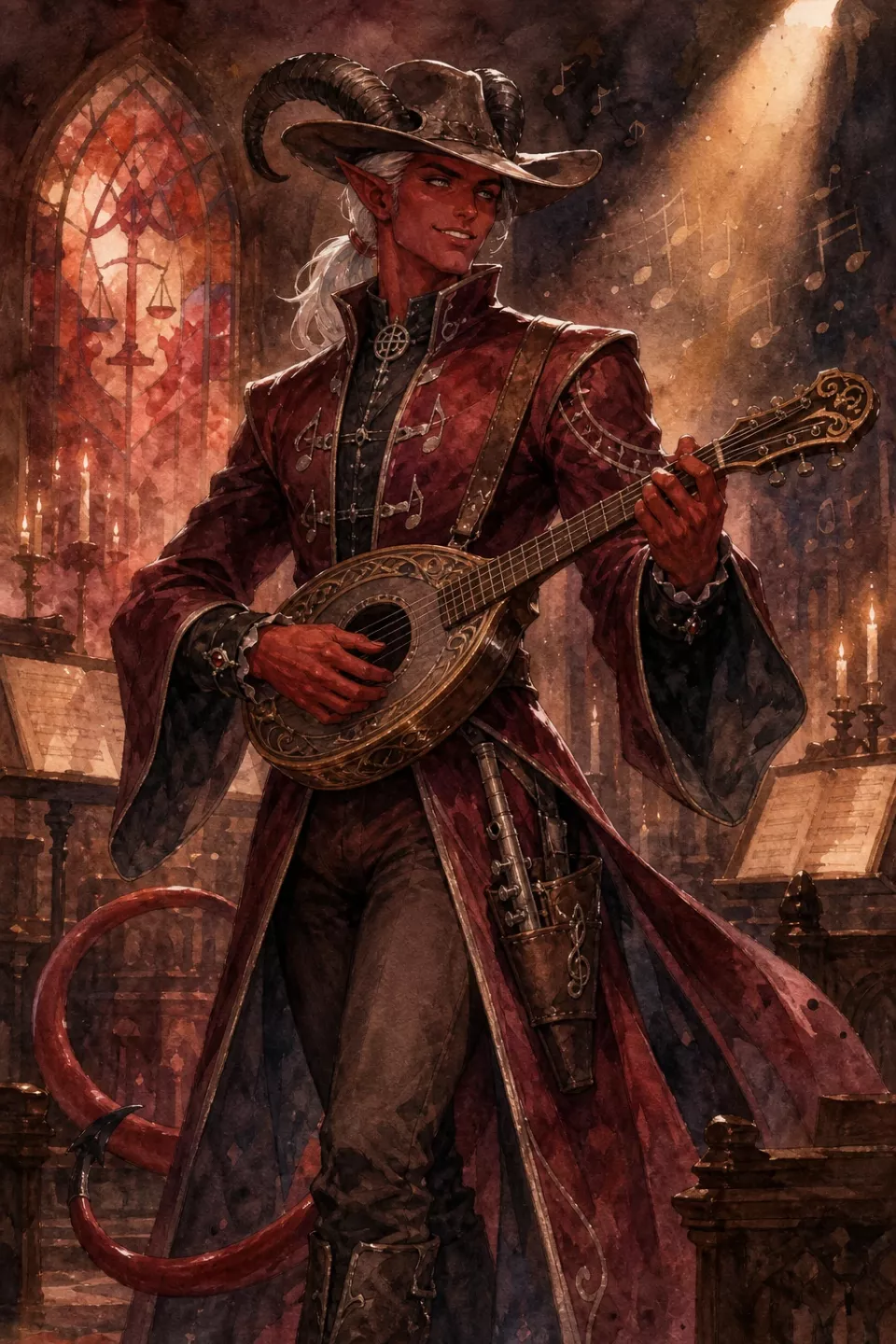
Chachi Townsend
Tiefling, Bard, Lawful Neutral
Description
University learning
Backstory
Chachi Townsend was born in Portland, Oregon, beneath a sky the colour of wet slate and a steady curtain of rain. His mother delivered him in a second-floor room above the Rosewater Music Hall, where the floorboards shook whenever the house band played below. The midwife found nothing unnatural in his birth: no summoned fire, no whispered omen, no mark carved by unseen hands. He arrived screaming, red-faced, and hungry, just like any other child. His horns, pointed ears, crimson skin, and narrow golden eyes were inherited traits—ancestral features carried through his family for generations, not the result of a pact, bargain, curse, or supernatural contract.
His father, Elias Townsend, was a tiefling of the old Vhal-Sith bloodline, a fabled strain whose ancestors were said to have crossed with abyssal fiends in an age before written history. The Vhal-Sith were known for black-tipped horns, red or wine-coloured skin, long tails, and a disciplined culture built around oaths, record-keeping, and mastery of the voice. Their connection to the Abyss was part of their blood, not a debt owed to it. Elias wore his heritage openly, serving as a legal clerk in Portland’s courthouse and keeping a brass-bound family ledger in which every birth, death, marriage, and broken promise was recorded.
Chachi’s mother, Maribel Reyes, was also a tiefling, though her family belonged to the gentler Ashkar branch. The Ashkar carried copper skin, swept-back horns, and a gift for music that had made them singers, dancers, and instrument-makers throughout the Pacific Northwest. Their ancestral stories claimed that an Ashkar ancestor had been born from the mingling of mortal blood and an abyssal noble line, but the family treated that tale as history rather than religion. Maribel played violin at the Rosewater and repaired damaged instruments in a cramped workshop filled with spruce shavings, rosin dust, and the sharp smell of varnish.
From Elias, Chachi inherited his dark red skin, narrow golden eyes, and the Vhal-Sith tendency toward careful speech. From Maribel came his swept horns, nimble fingers, and a voice that could carry over a crowded room without becoming harsh. Neither parent had made a deal to produce him. Neither had called upon a devil, demon, or distant power. Chachi was conceived and born naturally, the latest child in two old tiefling families whose bloodlines had endured for centuries.
He grew up between Portland’s rainy streets and the music hall’s crowded backstage corridors. As a boy, he knew the smell of wet pavement outside Powell’s, the clatter of MAX trains crossing the river, and the green chill of Forest Park after a storm. He sold handbills for the Rosewater, carried instrument cases for his mother, and spent long afternoons in the courthouse while his father worked. Elias taught him that a promise was a kind of law, even when no magistrate was present. Maribel taught him that a song could make strangers breathe together for three minutes. Chachi learned both lessons early and took them seriously.
His appearance made childhood difficult in quieter ways than outright cruelty. Other children asked whether his horns had been glued on, whether his tail could feel pain, and whether he had crawled out of the sewers beneath the city. Chachi answered every question with exact detail until he understood that some people were not seeking knowledge. They wanted a reaction. He stopped giving them one. Instead, he memorized names, watched who laughed, and kept a small notebook listing every insult, apology, and favour. When a group of older boys cornered him behind the Saturday Market, Chachi did not fight. He recited the city ordinance against harassment, quoted the market’s posted rules, and brought a security officer back with him. The boys never bothered him again.
At thirteen, Chachi discovered that his voice could do more than carry. During a winter performance, a drunk patron drew a knife on one of the musicians. Chachi stepped onto the stage and began singing the chorus of an old Ashkar work song. His tone cut through the shouting. The room fell silent long enough for the bartender to disarm the man. Chachi’s voice had not controlled anyone, but it had seized the moment and given everyone a single beat in which to act. Afterward, Maribel taught him scales, breath control, and the difference between commanding an audience and holding its attention. Elias insisted that every performance contract be written down.
As Chachi grew older, he began performing across Portland: in rain-dark pubs along the river, at outdoor markets under patched canvas, and in private rooms where tiefling families gathered to trade news. He built a reputation for songs that remembered names and exposed lies without ever stating them plainly. He also studied the Vhal-Sith family records, tracing the lineage that had shaped his body and listening to stories of ancestors who had been feared, hunted, praised, and misunderstood. The Abyss appeared in those records as a place of origin and old blood, not a master waiting to claim him.
Chachi left Portland only after a dispute over the Rosewater’s ownership threatened to divide his family. A developer offered Elias a fortune to sell the building, while the musicians who worked there insisted the hall belonged to the community that had kept it alive. Chachi uncovered forged documents hidden among the property records and exposed the scheme during a packed city hearing, using testimony, music, and carefully timed questions to turn the crowd against the corrupt broker. The Rosewater survived, but Chachi understood that his talents could serve more than entertainment.
Now he travels as a bard, carrying his father’s brass-bound ledger, his mother’s repaired violin, and a silver pen he uses to record every agreement he makes. He follows roads, laws, and written promises wherever possible. When forced to choose between kindness and order, he prefers to find a rule that protects both. Chachi does not deny his Abyss-connected heritage, but neither does he worship it or fear it. His horns and blood are facts of ancestry. The choices that define him—his discipline, his music, and the promises he keeps—belong to him.
Personality
Chachi can make a crowded room feel like an intimate confession. He remembers names after hearing them once, notices who turns a ring when lying, and hears the half-second pause before someone says they are fine. His smile arrives quickly, usually accompanied by a raised brow and a remark sharp enough to draw blood without leaving a mark.
He treats conversation like a book he has already begun annotating. A boastful noble becomes “the tragic hero in Act Two, still mistaking applause for love.” A jealous friend is compared to a minor character who keeps setting fires just to prove someone will come looking. Chachi rarely makes these comparisons aloud at first. He watches, listens, and waits until the right moment to deliver one with such warmth that the target laughs before realizing they have been accurately described.
His humor keeps difficult conversations from collapsing under their own weight. He turns an awkward confession into a joke, then circles back before anyone can escape the truth beneath it. He asks questions other people avoid: What do you call loyalty when it hurts you? How much of love is choice, and how much is habit? If someone forgives you but never trusts you again, what exactly have you been given? He asks with genuine interest, not scholarly detachment, and remembers the answers long after the speaker wishes he would forget them.
Chachi’s curiosity is a form of hunger. He wants to know how people stay, why they leave, and whether affection can survive being examined too closely. Flirtation comes easily; believing that someone might choose him without being charmed into it does not. When a conversation grows quiet after one of his questions, his tail goes still and his thumb finds the edge of his silver pen. He fills the silence with a quip, then watches carefully to see whether anyone reaches back.
He keeps promises with courthouse precision, but hopes—secretly and fiercely—that love might be the one agreement no one needs to write down.
Chachi’s latest side business began with a case of cigarettes, a crate of apple cider juice, and more Pepsi than any sensible person could drink. He bundles the cigarettes beneath drink labels, tucks them into taped-together six-packs, and sells the packages wherever people linger long enough to complain about the price of everything else. The arrangement is absurd, lightly dishonest, and profitable enough to keep him interested. He knows which bartenders want a cut, which students need a favour, and which regulars will trade gossip for a cold bottle; every sale adds coins to his purse and another name to his ledger. He insists the hustle is temporary, but he grins whenever someone asks where he gets the “special cider,” enjoying the quick money, the small network of obligations, and the clean little thrill of making a ridiculous plan work.
Description
Chachi wears a long, custom-made clerical coat with a fitted waist, high collar, flared panels, and a split back that leaves his tail free. Its wine-red wool is lined with black silk, edged in cream thread, and fastened with silver clasps shaped like miniature musical notes and scales of judgment. The cut borrows from ceremonial robes and stage costume rather than conventional men’s clothing, giving him a sweeping silhouette without hindering his movement or violin playing. Maribel stitched it for his first formal service and performance, adding the small silver clerical seal at his throat; Chachi has worn it ever since, repairing the cuffs and replacing its lining whenever necessary because it reminds him that music, duty, and identity need not be kept separate.
Chachi Townsend enters a room as though the room has been waiting for him. His crimson skin lends rich contrast to the white hair drawn into a sleek, slicked-back ponytail, every strand held obediently in place beneath a small tiara-like crown perched atop his head. Swept horns frame his face like polished crescents, while narrow golden eyes gleam above a mouth made for velvet melodies and perfectly timed remarks. He favours fitted coats, flowing sleeves, jeweled cuffs, and high boots, combining masculine tailoring with the graceful lines and delicate flourishes of courtly fashion. His movements carry a dancer’s precision: a turn of the wrist, a tilt of the chin, the languid sweep of his tail behind him. Whether singing beneath stage lights or negotiating over a crate of contraband cider, Chachi presents himself on his own terms—elegant, flamboyant, and impossible to mistake for anyone else.
Chachi Townsend is a red-skinned tiefling man with a tall, lean frame and an easy, balanced posture suited to both the stage and the saddle. His gray eyes sit beneath strong black eyebrows, their cool color set sharply against his dark crimson face. Long, ram-goat-like black horns curl back from his head, thick at the base and ridged along their length. A weathered cowboy-style hat rests between them, its extended brim cut with two precise holes fitted around the horns.
His pointed ears emerge beneath the hat, framing a face made expressive by a quick smile and a raised brow. His clothing is practical and tailored for movement, with a fitted shirt, sturdy trousers, and boots that reach above the ankle. A holster rides at his side, its leather worn smooth from use; a flute is secured along its outer edge, ready to draw between songs. In one hand, he carries a shallow bard guitar, its slim body held comfortably against his hip.
From beneath his coat, his tail stretches to an unusual length, sweeping behind him like the tail of a Peruvian lion. It moves with deliberate grace and ends in a distinct black tip. His boots strike a measured rhythm wherever he walks, often matching the quiet tap of his fingers against the guitar’s polished frame.