
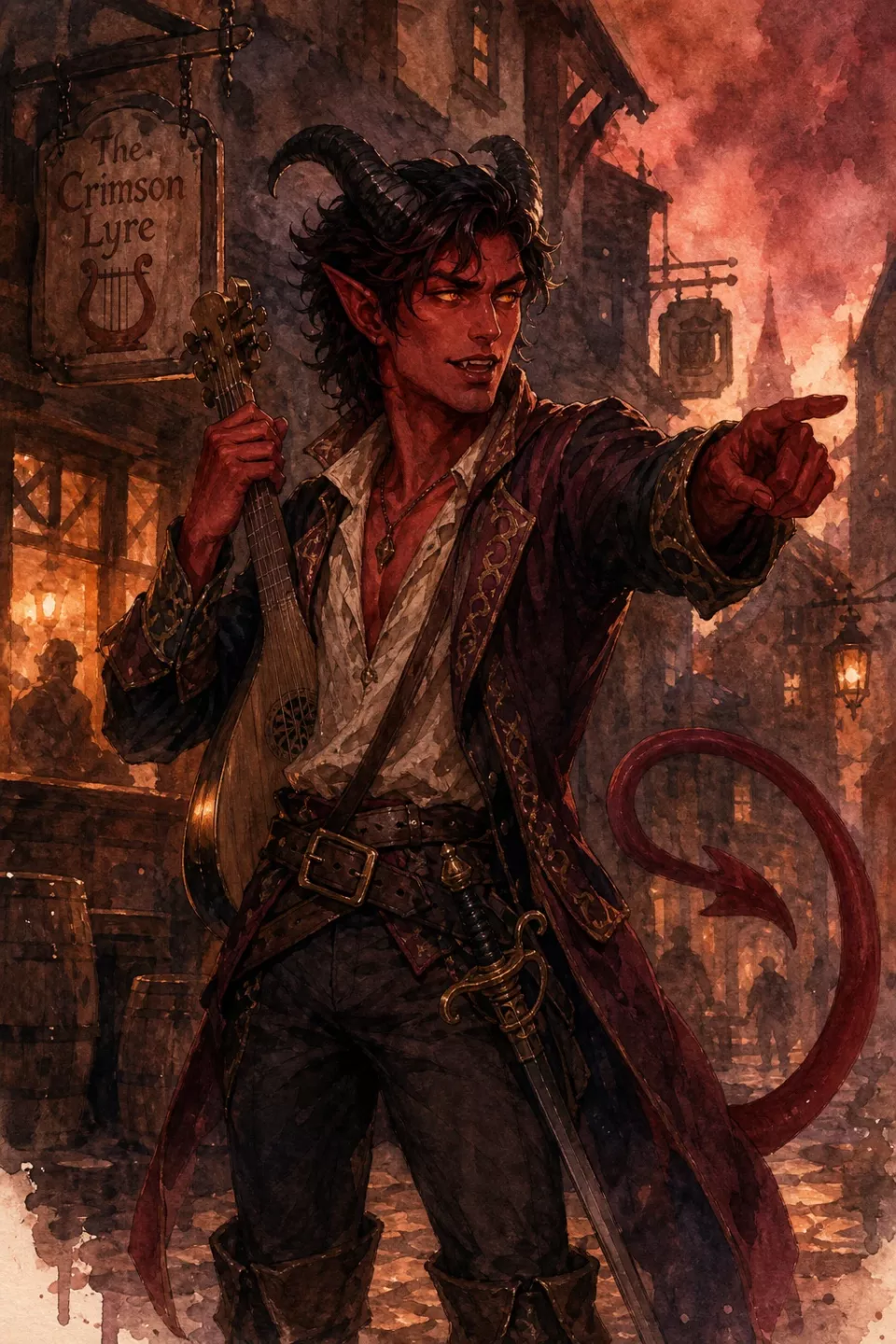
Chachi Townsend
Tiefling, Bard, Chaotic Neutral
Description
Chachi Townsend talks to himself constantly, arguing one moment and offering encouragement the next. His conversations often include a second voice no one else can hear, especially when guilt leaves him torn between a clever escape and doing what is right. He fiercely protects his best friend, a girl from a tavern town about an hour from Portland. Bullies have been harassing them for weeks, and she finally urged others to deal with them—or stop them before Chachi did something reckless. He cannot stand anyone who uses fear against the weak. Beneath his chaotic jokes, Chachi is loyal, compassionate, and always ready to put himself between danger and a friend.
Backstory
Chachi Townsend was born in a two-room shack on the edge of Mergold village, one of identical tiefling twins. His brother, Craig—who took the harder-sounding name Cragar when he joined a street gang—was born minutes later, and the two were rarely seen apart. Their mother dressed them in matching cleric-style jackets scavenged from a traveling temple, each jacket patched with red thread and brass buttons. The garments made them look like young acolytes from a distance, which was useful when their gang needed to pass through a town without being chased out.
Chachi never developed the gifts other tieflings expected. No flame curled from his fingers, no darkness answered his call, and holy symbols made no difference to him. Instead, he grew broad-shouldered, fast over short distances, and difficult to injure. He could haul a loaded cart by himself, run beside a horse for several minutes, and walk away from blows that would have broken another man’s ribs. Smoke, spoiled meat, bitter tonics, and several common poisons failed to put him down, though he has never learned exactly why. His tail was another matter: he trained it to hook ankles, knock weapons aside, and pull a chair out from beneath an enemy at the worst possible moment.
The gang gave Chachi a place to sleep but taught him little beyond lookout work, intimidation, and the value of leaving before the shouting began. His real education came from a girl named Marnie Vale, a human cowgirl who camped with her family outside Portland, Oregon. She caught him stealing a blue-painted hat from their tack shed and, instead of shooting him, made him track the hat’s trail after he tossed it into the blackberry thickets. Marnie taught him to read bent grass, broken spiderwebs, hoofprints, ash, and the tiny changes in birdsong that mark a passing traveler. Chachi repaid her by finding a missing mare, then a lost child, then three gang members who had tried to rob her family.
He also learned how not to be found. Marnie showed him how to walk on stone, step inside his own footprints, scatter a false trail with a branch, cross running water where tracks disappeared, and leave a boot print pointing the wrong way. Chachi added his own tricks: carrying his boots through soft ground, rubbing strong-smelling herbs on his trail, and sending Cragar ahead to lay a second set of tracks. The brothers became experts at vanishing from both pursuers and creditors. When they wanted trouble to find them, Chachi wore his hat crooked and let his tail drag in the dust. When they wanted to disappear, even a bloodhound usually found only cold ashes and a circle of footprints leading nowhere.
His early years among tiefling crews and frontier travelers filled his head with songs, stolen histories, and half-true stories about buried temples. He learned card tricks from gamblers, old ballads from cowgirls, lockwork from a gang fence, and pistol craft from a ranch hand who caught him trying to take a pair of pearl-gripped pistols. Chachi claimed the guns were “evidence” and surrendered them only after winning a shooting contest with a borrowed weapon. He kept the cowboy hat. Cragar acquired a matching one a week later, along with a pair of cleric jackets whose pockets were large enough to hide maps, dice, and a small relic.
A fascination with relics led Chachi away from gang work. He entered the University of Portland under a borrowed name, paying his first term’s fees by recovering a stolen collection of Mergold burial coins from a smuggler’s wagon. He studied languages, old roads, temple records, and the habits of people who hide valuable things. His professors valued his field reports even when they objected to the lock picks, false names, and occasional gunfire included in them. Chachi eventually became a historian and university professor, teaching the practical history of ruins: where explorers camped, why tomb doors were built a certain way, and which famous treasure maps were written by liars.
He still works as a bard, rogue, hunter, and treasure hunter whenever the university gives him leave—or whenever a promising rumor reaches his desk. Chachi sings for information, steals only from people who deserve the loss, and keeps a loaded pistol beneath his lecture notes. Cragar remains his closest companion, rival, and occasional body double. Together they travel in matching cleric-style jackets and battered cowboy hats, following old trails across the wilds while Chachi records every discovery in a journal that contains equal parts scholarship, travel log, and list of people who owe him money.
Personality
Chachi knows exactly how much trouble he is causing—and takes care to make it look accidental. He lies with a grin, redirects blame with a well-timed compliment, and prefers schemes that leave everyone arguing over who made the first mistake. He hates bullies, especially the sort who mistake loud commands for authority. His cousins earn his deepest irritation by constantly telling him what to do, what not to do, and what he ought to become. When they start lecturing, Chachi nods politely while planning the part they will regret.
He resents those cousins, but he does not abandon them. He needs their connections, protection, or practical help, and he knows they may need his talents in return. That bargain keeps him tolerant when patience would be easier to fake than to feel. Chachi may whisper to one of the hook-lips in the herd of small amps that they should teach his cousin a lesson, then stand nearby wearing an expression of sincere concern when the chaos begins. He rarely sees deception as cruelty; to him, it is leverage, entertainment, and sometimes the only way to make a bully listen.