
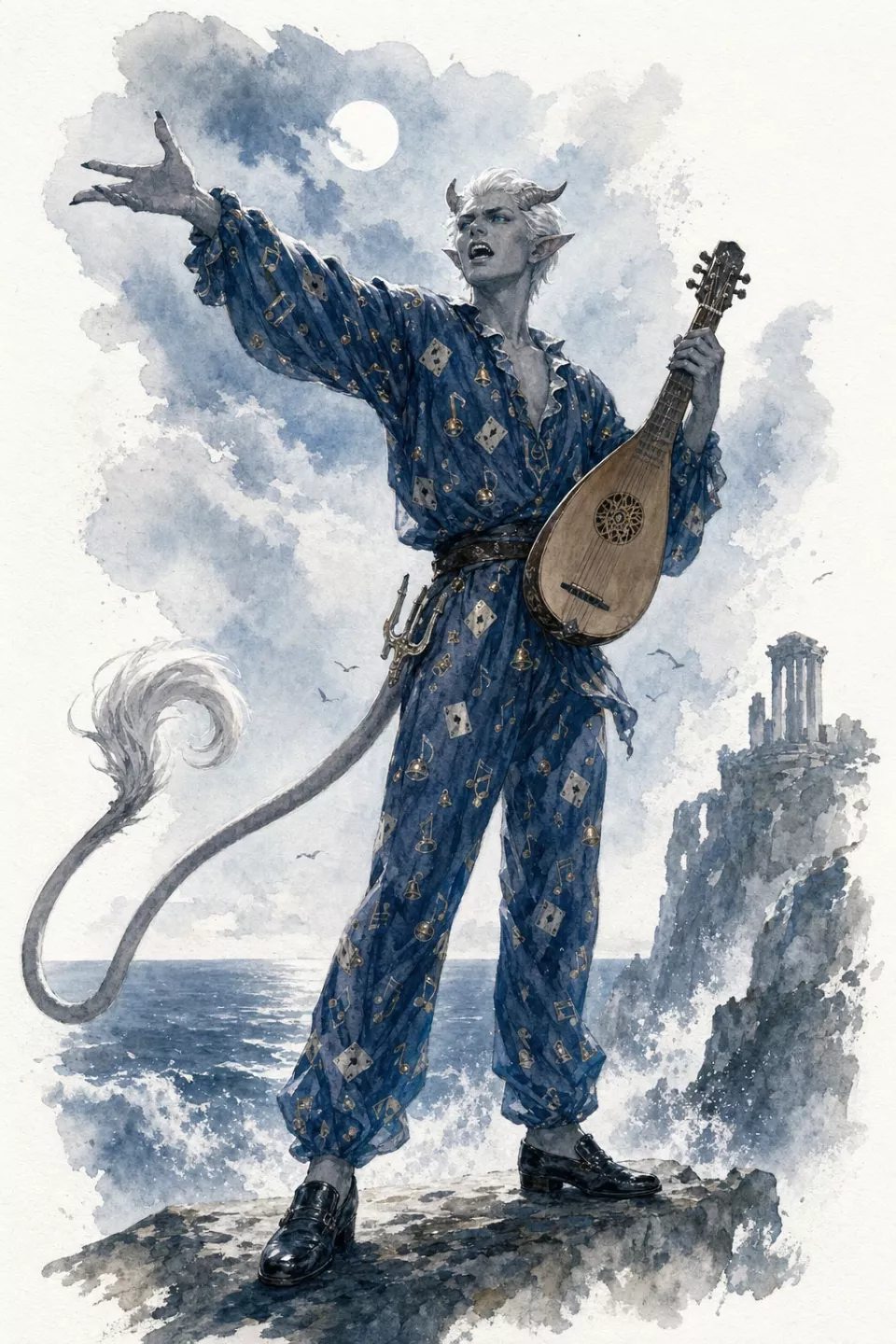
Chachi Townsend
Tiefling, Bard, Chaotic Neutral
Description
Chachi Townsend is a non-binary tiefling bard with gray skin, a lean humanlike build, and white hair cut close at the sides and tapered neatly toward the crown. Their ordinary blue eyes lack any supernatural glow, though small swept-back horns and pointed ears mark the demonic blood in their face. Their bloodline combines Alvin demon blood, partial human ancestry, brass devil lineage, and ties to the Abyss, showing in the subtle heat of their skin, sharp canines, and long prehensile tail. The tail extends fully behind them like a lion’s, thick at the base and tapering to a flexible tip crowned with a tuft of white hair; it curls around chair legs, hooks dropped objects, or keeps time with the music. Chachi wears loose bard pajamas patterned with tiny bells, cards, and crooked musical notes, cinched at the waist beneath a belt carrying a small pitchfork that serves as both weapon and theatrical prop. Black shoes cover their feet, polished enough to catch the light as they bow, dance, or spring into a fight.
Backstory
Chachi Townsend was born in Portland, capital of Marigold, on the rain-soaked world of Tiburon. Their mother, Veyra, was a demon who served as a midwife in the city’s Riverward, delivering human, tiefling, and demon-born children beneath the red lanterns of Saint Orra’s House. Their father, Brassel Townsend, carried the old Brass tiefling bloodline: copper horns, furnace-bright eyes, and a voice that could make a crowded room fall silent. Their union scandalized Portland’s respectable families, but it was not forbidden. Tiburonian law recognizes demons as citizens, though old temple customs still treat their blood as a thing to be watched.
Chachi’s birth gave the gossips little to discuss. They came into the world screaming, hungry, and entirely natural, with no burst of flame or omen in the room. Veyra cut the cord herself. Brassel held the child beneath the window while rain struck the glass, then swore that Chachi would never be made to apologize for the blood in their veins.
They grew up between two worlds. In Marigold’s markets, people asked Chachi to touch their luck charms, then counted their fingers afterward. Demon families welcomed them to midnight feasts but laughed when Chachi admitted they disliked the taste of ash-wine. Their father taught them Brass-blood songs played on hammered metal, while their mother taught them the names of every herb used to ease labor, fever, and grief. Chachi learned early that a smile could be armor and a song could open a door that horns could not.
At nineteen, Chachi stopped changing. Years passed, but their face remained the same: no new lines, no altered height, no shifting voice. Wounds healed normally, hunger and exhaustion still found them, yet mirrors showed the same young tiefling Veyra had held at the birthing table. Chachi is now thirty-four by the calendar, though strangers rarely guess more than nineteen. No priest, physician, or demon scholar in Portland has found an answer. Veyra believes the cause lies in Chachi’s birth; Brassel suspects the Brass bloodline has awakened in an unheard-of form. Chachi suspects both are wrong and collects every rumor they hear.
They left Portland with a battered fiddle, a pouch of midwife’s herbs, and a talent for turning uncomfortable truths into songs. Chachi performs wherever Tiburon’s roads carry them, trading music for meals and secrets for amusement. They do not know whether their unchanging body is a blessing, a curse, or a debt waiting to be collected—but they intend to find out before anyone else decides what it means.
Personality
Turns every conversation into a performance, complete with finger snaps, sudden songs, and dramatic bows—even when asking for directions.
Changes plans the moment a better story presents itself; a locked door is an obstacle, but a locked door with guards behind it is an invitation.
Lies easily about their name, birthplace, and breakfast, but never about a friend in danger.
Collects rumors like other people collect coins, trading them freely until someone threatens the source.
Has a soft spot for outcasts, nervous servants, and anyone being mocked by a louder voice; Chachi always finds a seat beside them.
Gives lavish compliments with such confidence that strangers often mistake mischief for sincerity—and sometimes it is sincerity.
Refuses to obey rules that protect bullies, landlords, tyrants, or anyone who says, “That’s simply how things are done.”
Treats danger as an audience demanding an encore, grinning widest when everyone else starts running.
Remembers every kindness and repays it with music, favors, or a wildly disproportionate surprise.
Sleeps lightly, keeps one hand near their instrument, and leaves a different farewell note in every room they enjoy.