
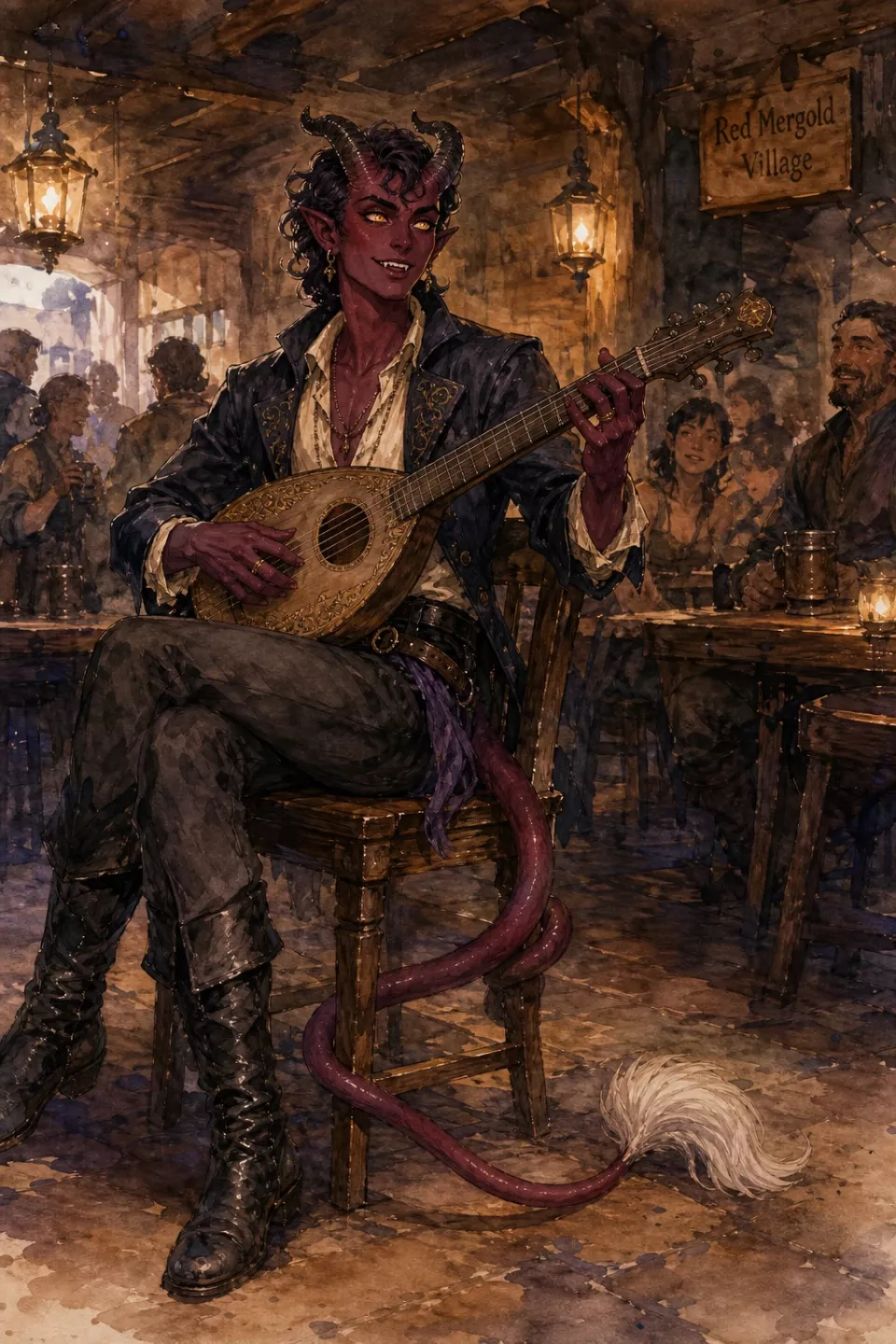
Foxy lady
Tiefling, Bard, Neutral
Description
Foxy Lady’s silhouette is dominated by an unusually large tail, shaped like a great curling plume rather than a true monkey’s tail. It sweeps from the base of their spine in a long, muscular arc, thick as a ship’s hawser near the root and tapering slowly toward its end. The hide is smooth and warm beneath the fingers, marked by subtle ridges that flex when the tail moves. Its final span gathers into a dense, blunt tuft of black hair, heavy enough to brush the ground when they stand still.
The tail alters their every movement. It balances their turns, coils around a chair leg when they lean back, and traces restless half-circles whenever music catches their attention. In a crowded room, it arrives before they do, sliding around ankles and knocking aside loose stools; on the roads near Red Mergold Village, it curls beneath their cloak to keep clear of brambles and muddy cartwheels. The rest of their appearance remains open to detail—horns, eyes, clothing, jewelry, and the small signs of a bard accustomed to being watched.
Backstory
Foxy Lady was born on 2 May 1995, the morning after the Seven-Moon Festival, when all seven moons appeared together above the city of Veyr. Bells rang until dawn, witches set red candles in their windows, and every child born beneath that sky was marked as a “Second-Blessed”—someone believed to belong wholly to no single path. Foxy’s tiefling mother gave birth in the back room of the Copper Fox tavern while minstrels played to drown out the thunder. A crescent-shaped birthmark appeared beneath Foxy’s left eye, and the tavern keeper claimed the newborn’s first cry matched the final note of the song being sung.
They grew up among gamblers, caravan guards, actors, and thieves. Their mother taught them old ballads and how to alter a melody with a single breath; a retired burglar named Pell taught them to palm coins, read a room, and leave through a door before anyone thought to stop them. Foxy learned early that a good song could turn suspicion into laughter, while a well-timed lie could make a locked purse feel lighter. They took the name “Foxy Lady” from the tavern sign, first as a joke and later as a declaration that no title, costume, or expectation could decide who they were.
At seventeen, Foxy joined a hunting band that tracked creatures through the ashwood beyond Veyr. Their leader, Mara Venn, taught them to read bent grass, fresh claw marks, broken spiderwebs, and the silence that falls when prey is close. Foxy carried a shortbow and skinning knife, but their greatest weapon was patience. They learned to wait beneath rain-soaked branches for hours, then loose one arrow between a monster’s ribs. Around the campfire, they traded hunting calls for drinking songs and discovered that rhythm could guide a group through darkness as surely as a trail marker.
The hunting band ended when Mara vanished during a pursuit of a horned beast that left no footprints. Foxy found only her blood on a blackthorn branch and a strip of red cloth tied around it. Since then, they have wandered from road to road, performing in crowded inns, lifting secrets from careless nobles, and following rumors of beasts that should not exist. They remain neutral in the quarrels of kings and churches, but they never ignore a wounded traveler, a trapped animal, or a song that carries Mara’s missing final verse.
Personality
Foxy Lady enters a room as if they have already been invited to lead the song. Their tail curls around chair legs, their grin arrives before their greeting, and within five minutes they know who is cheating at cards, who wants to be noticed, and who is pretending not to listen. They meet bluster with a raised brow and answer insults with polished sarcasm. “That was almost clever,” they say, often enough that friends have learned to duck before the second sentence. Foxy rarely raises their voice; a softer tone makes people lean closer, and leaning closer means listening on Foxy’s terms.
Their confidence is practiced, not effortless. They keep one hand loose near their belt in unfamiliar places, sit with their back to a wall, and count exits without appearing to look. In the wild, they are quieter but no less watchful. Foxy can follow a boot print through gravel, tell a deer’s trail from a hunter’s by the bent tips of grass, and read broken twigs, disturbed spiderwebs, bird calls, and patches of silence. They sleep lightly, pack their camp before dawn, and scatter ash over footprints when they expect pursuit. If someone follows them, Foxy leads them through thorn country, across running water, and beneath low branches until the pursuer is chasing an old trail and cursing an empty cloak.
Their singing voice is warm enough to make a crowded tavern hush. Foxy uses it shamelessly. A ballad can draw every eye toward the stage while they slip a message beneath a tankard, and a mourning song can keep a suspicious guard listening long enough for companions to vanish. When traveling, they sing fragments into the trees to suggest a false campsite or lure trackers toward the wrong ridge. Some people remember the voice for years; others remember only that Foxy smiled while their purse disappeared.
They love their brother fiercely and quarrel with him as if arguing were a family sport. Their father receives letters full of jokes, useful coin, and details carefully chosen to hide how much Foxy misses home. Their other brothers and sisters get songs written for embarrassing childhood incidents, though Foxy becomes dangerous when anyone else mocks them. Cousins and extended kin are treated as a sprawling network of gossip, shelter, and emergency favors; Foxy complains about every one of them and trusts nearly all of them.
Their grandmother Bridget was the exception to every rule. Bridget taught Foxy the old hunting hymns, the patience to wait without fidgeting, and the difference between a secret worth keeping and a lie that harms someone. Foxy still sings Bridget’s favorite verse before sleeping. They claim it is superstition. No one who hears the tremor in the final note believes them.