
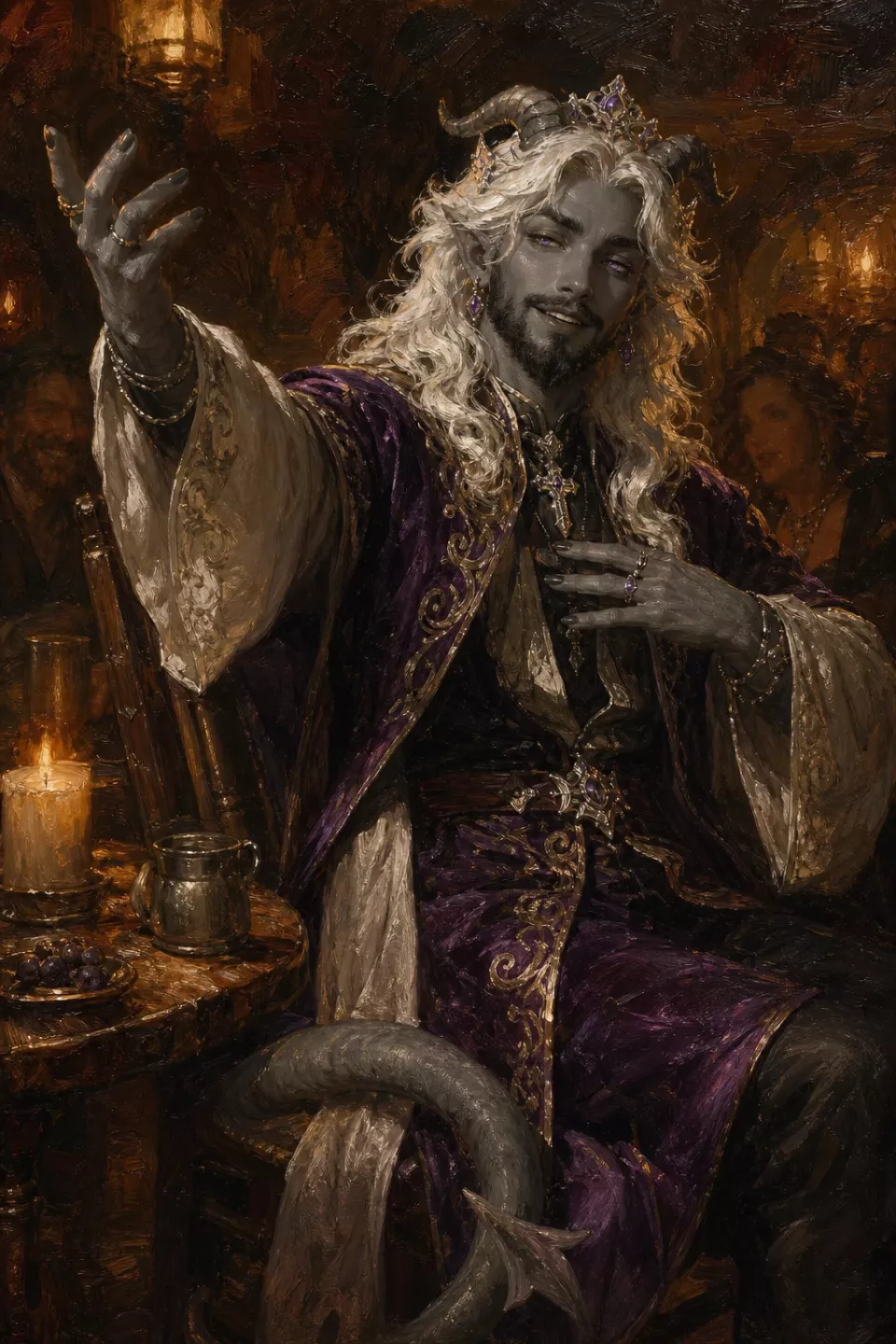
Chachi Townsend
Tiefling, Bard, Chaotic Neutral
They live by appetite, applause, and whatever story sounds best in the moment. A tiefling bard with a silver tongue and a talent for turning minor inconveniences into three-act dramas, they flirt with danger, steal punch lines, and leave every room with at least one new secret. They dislike schedules but keep perfect time with music, tapping their horns or rings against any nearby surface. Their favorite television is loud, tawdry, and impossible to pause: courtroom spectacles, cooking competitions, backstage scandals, and cheap fantasy serials where everyone betrays everyone by episode three. They shout advice at contestants, boo villains, and claim not to care who wins.
Their mornings begin with burnt coffee, vocal warm-ups, and a quick inventory of possessions, debts, and grudges. They practice new songs while dressing, usually changing outfits twice before leaving. Afternoons vanish into taverns, markets, rehearsal rooms, or anywhere a good story might happen. They collect playbills, unusual buttons, overheard insults, and songs with terrible lyrics. At night, they oil their instruments, replay the day’s conversations, and write the best lines in a black notebook.
Their home is a cramped second-floor nest above a noisy street, crowded with velvet cushions, half-empty bottles, costume pieces, instrument cases, and candles burned down in mismatched holders. A small television sits on a milk crate beside the bed, its screen flickering through reruns long after they fall asleep. Every wall is covered with pinned notes, favors owed, invitations, maps, and names connected by colored thread—not a conspiracy, they insist, just “a useful arrangement of future possibilities.”
Description
Born in the late Dawn Era, they are an ageless prince of the Guardian People, born of tiefling and human blood. Their gray skin, small horns, and otherworldly bearing mark their fiendish heritage, but their human features remain unmistakable in the shape of their face, warm expressions, and easy laughter. Luxurious snow-white hair frames a neatly kept beard and mustache; they appear mature, never elderly, and cannot age or grow old.
They wear rich cleric-bard vestments of velvet, embroidered trim, and polished silver clasps beneath a regal crown-like tiara. A silver crucifix rests at their throat. Some called them a failure as a prince; others saw someone judged for being misunderstood rather than incapable. They now earn their own coin through performances in courts, temples, and busy taverns, bringing in roughly 25 gp per week and keeping about 180 gp in savings.
He is a male tiefling bard with a distinctly feminine beauty: soft features, a narrow waist, long lashes, carefully shaped brows, and hair worn in glossy waves around his horns. He dresses in fitted silks, loose sleeves, and bright jewelry that catch the eye when he moves. His tail is never still; he curls it around a chair leg while listening, brushes it lightly against an ally’s ankle when flirting, and snaps it across a bully’s path as a warning. A steady gaze, a crooked smile, and the faint pull of his enchanted presence make strangers look twice and linger longer than they intended. Tieflings often gravitate toward him in a crowded room, sensing a kindred spirit, while others are drawn by his voice, his warmth, or the suspicion that he knows exactly what they want to hear.
He eats simply each day: spiced eggs or fruit and bread in the morning, a bowl of beans, rice, or stew at midday, and roasted meat or vegetables with cheese at night. He snacks constantly on sugared dates, salted nuts, and strips of dried meat while traveling. Each week, he seeks one proper feast—usually honey-glazed fish, peppered lamb, or cream-filled pastries—and once a month he spends too much money on an exotic dish from a distant land. His graceful build conceals considerable strength; he can haul a full traveling trunk, overpower an unprepared assailant, and hold his ground when a fight turns physical. He hates bullies, especially those who prey on the weak, and answers them with a humiliating song, a sabotaged scheme, or a sudden shove when words fail. Few people trick him twice: he watches hands, listens for changes in a voice, and treats flattering promises as traps. He lies readily when it serves his purpose, preferring a clever deception or theatrical outwit to a fair contest.
Backstory
Chachi was born last among a special set of twins, though no midwife could agree whether “last” meant second from the womb or the final arrival promised by the year’s first prophecy. They were born sexless and have never claimed a gender, answering to they and them with a theatrical bow. The prophecy, scratched in red chalk beneath the old bell tower, named a child tied to the bloodline of Duke Rook and Lilith—a lineage some scholars trace through noble houses, some through thieves’ guilds, and some through stories told by people who have never met a living member of either family. Chachi’s twin was said to be the beginning of the omen. Chachi, according to the oldest version, was the part that survived it.
Their horns, tail, sharp teeth, and ember-dark skin have led generations of strangers to call them a child of Hell. Chachi finds this flattering when it is useful and insulting when it is not. The family records insist their blood did not come from the underworld or any lower plane. One account claims their ancestors crossed into the mortal world from the fables of Portland, where bridges whisper names and impossible beasts appear in newspaper margins. Another places the first ancestor in Baldur’s Gate, stepping out of a locked cellar during a thunderstorm. A third says the bloodline was altered by the lower planes but never belonged to them. All three accounts end with the same maddening phrase: “Ask Mer Gold.” No surviving document explains who—or what—Mer Gold might be.
Chachi grew up surrounded by people who treated every cough, joke, and spilled cup as a possible sign of prophecy. Tutors taught them dead languages so they could read the warning hidden in their own birth. Aunts measured their horns. Priests inspected their shadow. Family thieves taught them which floorboards complained and which locks could be persuaded with a hairpin. Chachi answered this attention by stealing the tutors’ shoes, performing rude puppet shows during religious ceremonies, and inventing a different version of their ancestry for every visitor. By the time they were old enough to leave home, three towns believed Chachi was a lost prince, a disguised devil, or Mer Gold’s unpaid apprentice.
They became a bard because songs opened doors that keys could not, and a rogue because doors remained more honest when opened with keys. They performed in roadside theaters, duke’s banquets, plague villages, and once from the roof of a moving funeral wagon. Their humor is quick, their sarcasm quicker, and their favorite joke is to treat grave danger as an audience that has paid for a comedy. They have served as a thief, trickster, hunter, and occasional cleric, though no god has ever answered their prayers. Chachi still knows the rites, carries a battered holy symbol, and can deliver a sermon capable of making a room cry—usually from laughter. They claim the silence from the heavens proves either that the gods are cowards or that Chachi has been praying to the wrong ones.
There is little ordinary about their body. Chachi can bend through spaces that should reject a human skeleton, catch a falling blade between two fingers, and lift a grown warrior by the belt when sufficiently annoyed. They see in darkness with the clean focus of a hunting cat, yet bright daylight does not blind them; torchlight, moonlight, and noon sun all reveal colors and edges other folk miss. Their gray eyes are narrow and feline, appearing almost white in total darkness. Children call them ghost-eyes. Chachi tells children that the eyes belong to a cat they ate.
For all their performances, Chachi is bored. Prophecies, bloodlines, divine silence, and rumors of Mer Gold have followed them so long that even wonder has begun to feel like paperwork. Restlessness sends them from one road to the next: after a stolen relic, a strange beast, a vanished twin, a better audience, or a clue written in a language nobody admits to knowing. They do not seek a grand destiny so much as a reason to care when the curtain rises. If the first prophecy of the birth year truly named them, Chachi intends to find out what it wanted—and charge it admission.
Personality
Turns every conversation into a performance, adding flourishes, punch lines, and an occasional improvised verse.
Collects secrets the way other people collect coins, then trades them for favors, drinks, or a better story.
Changes their name, accent, or stated hometown whenever a situation becomes boring.
Compliments strangers with unsettling accuracy, then asks for something before they can recover.
Keeps a battered songbook filled with gossip, half-finished lyrics, and names crossed out in red ink.