
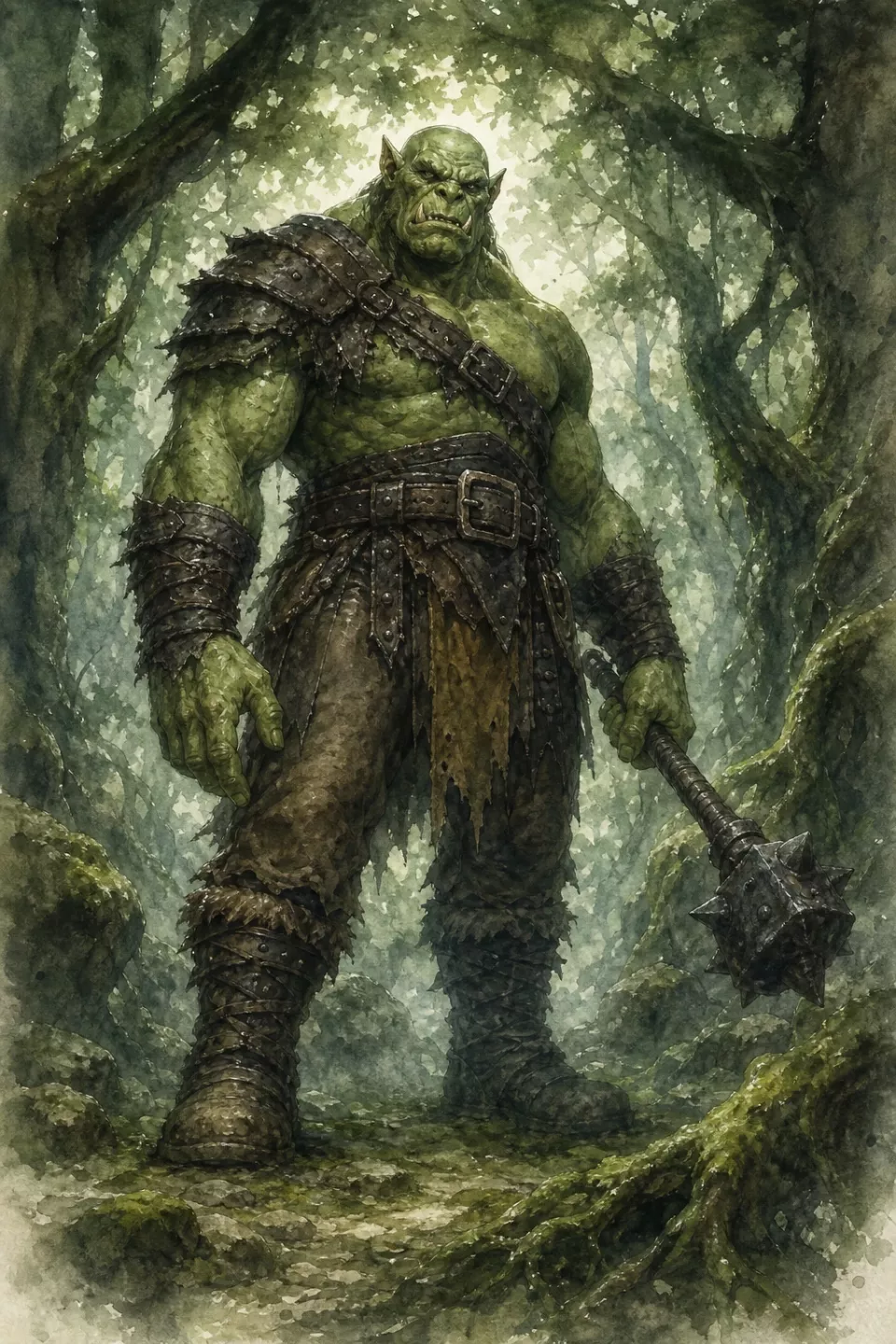
Gravok Thornlash
Bugbear, Paladin, Neutral
Gravok has no patience for trespassers or thieves prowling near the watchhouse. He checks unfamiliar footprints, barred doors, and disturbed latches before greeting anyone, and he meets those who enter without permission with shield raised, hand near his weapon, and a demand to explain themselves. His home is under his protection; anyone who threatens it is treated as an enemy until proven otherwise.
Warm, emotionally evocative family portrait inside a weathered stone watchhouse above the sheep roads outside Dunmere. Gravok Thornlash, a broad male bugbear paladin with russet-brown fur, heavy shoulders, small ivory tusks, and a tired but gentle expression, kneels beside his family without removing his battered road armor. His wife, Maela, stands close at his side in a patched work dress and leather apron, one hand resting on his shoulder and the other holding a copper nail. Tessa, sharp-eyed and defiant, keeps a sling partly hidden beneath her belt; Orren proudly polishes his father’s dented shield; little Bim clings to the lowest stair of the watchtower, caught halfway between climbing and joining the portrait. A goat peers through the open kitchen door. Buckled armor hangs beside the hearth, evening bread cools on the table, and golden lamplight falls across worn stone, muddy boots, family ledgers, and the holy symbol at Gravok’s throat. The mood is tender, lived-in, and quietly aware that he may leave before supper, painterly fantasy character art, natural expressions, detailed textures, warm amber light.
The Roadwarden of Dunmere
Focused three-quarter portrait of Gravok Thornlash standing outside the stone watchhouse at dawn, a towering male bugbear paladin with thick russet-brown fur, a broad square face, blunt ivory tusks, and deep-set eyes softened by years of guarding ordinary people. His battered plate armor bears old dents and carefully repaired straps; a plain holy symbol rests at his throat, and one rough hand closes around the first copper nail Maela ever gave him. His shield is scarred from patrols along the sheep roads, while a folded letter from his children is tucked beneath its strap. Wind lifts the coarse fur around his jaw, distant pasture fences fade behind him, and the watchhouse windows glow with the last light of home. His expression is steady rather than stern—prepared to ride, but reluctant to turn away. Grounded fantasy portrait, muted earth tones, crisp worn metal, soft morning mist, intimate emotional realism.
Backstory
Gravok Thornlash is a straight bugbear, and he says so without shame or apology. He speaks with the same blunt honesty he brings to battle: a trespasser is a trespasser, a promise is a promise, and a locked gate means someone has chosen not to be welcome. He learned the value of boundaries long before he learned the words of his paladin’s vows.
He met Maela at the roadside shrine of Saint Orra, where Gravok had stopped to mend a broken bell. Maela was replacing the shrine’s roof with one hand and chasing off grave robbers with the other. She struck the first robber across the mouth with a roofing hammer, then shouted directions to Gravok as if they had been married for years. They shared patrols after that—she with her hammer and sharp eyes, he with his spear and the holy symbol at his throat. They married after a year. Gravok still carries the first copper nail Maela handed him, its head worn smooth from his thumb.
They built their home in a stone watchhouse overlooking the sheep roads outside Dunmere. The watchhouse stood inside a gated settlement of six families, bound together by a waist-high wall, an iron gate, and the shared understanding that every household watched the others’ backs. Maela tended the goats and kept the accounts. Gravok served as roadwarden for the nearby villages. Their children grew up among stacked firewood, salt barrels, drying herbs, and the constant creak of the gate hinges: Tessa, sharp-tongued and quick with a sling; Orren, who followed his father everywhere and polished his shield; and little Bim, who learned to climb the watchtower stairs before learning to read.
Gravok took the gate seriously from the beginning. He replaced the rusted hinges, drove iron spikes along the top of the wall, and marked the nearest hedgerows with bells made from scrap. He showed Tessa where an intruder would likely step over the ditch. He taught Orren how to check a latch without making noise. He carried Bim through the house at night, pointing out the safest rooms and the windows that opened onto the roof. Maela called this excessive until the first winter, when she found three sets of boot prints circling the house after a snowstorm.
The tracks belonged to men who had watched the settlement for several nights. They came during a hard rain, wearing cloaks marked with the white knot of Saint Orra and claiming to be pilgrims seeking shelter. Gravok opened the gate only after checking their names against the shrine’s travel ledger. The names were false. One man knew the saint’s prayers but not the order of the verses. Another kept glancing at the kitchen windows. Maela noticed the third had no rain on his boots.
Gravok refused them entry. The men laughed at him. They called the settlement a pen and asked whether the large dog at the gate had been taught to bark or only to bite. When Gravok barred the gate, one of them threw a torch onto the goat shed roof.
The fire spread fast. Maela rang the alarm bell while Gravok broke the shed door and drove the goats into the yard. The three men climbed the wall during the confusion. Gravok found one inside the house, reaching beneath Bim’s bed. The child was hiding there, clutching a wooden horse and trying not to breathe. The intruder turned with a knife in his hand.
Gravok had time to choose between the man and the child. He chose the child.
He struck the intruder with the flat of his sword hard enough to break his jaw, then pinned him against the hearthstone until Maela dragged Bim from beneath the bed. Outside, Tessa sent a sling stone into one attacker’s knee. Orren pulled the gate bar free so the neighbors could enter. The third man fled across the sheep road, leaving a trail of blood in the mud.
No one in the settlement died. The goat shed burned to its foundation, two families lost their winter feed, and Bim would not sleep beneath a bed again. For three nights, he slept in Maela and Gravok’s room with one hand twisted in his father’s shirt. Gravok sat awake beside the door, still wearing his armor, listening to every shift of the roof and every scrape of branch against stone.
The captured trespasser confessed that the men had been hired by a bandit captain who had learned the settlement kept silver from the autumn wool sales. They had watched the homes, counted the children, and waited for the right night. The man spoke of these things as if he were describing weather. He seemed surprised that Gravok was angry.
The law wanted the prisoner taken to Dunmere. Gravok agreed, but only after searching him for hidden blades and binding his hands twice. When the man spat through his broken teeth and called the attack business, Gravok nearly killed him in the yard. Maela stopped him by placing one hand against his breastplate. She did not plead. She only said, “If you kill him because you want to, do not call it protection.”
Gravok listened. He delivered the prisoner alive.
That decision did not make him gentler. It made him careful. He learned that danger rarely announced itself with a drawn weapon. It arrived as a friendly voice at the gate, a stranger asking too many questions, a missing latch pin, or footprints that appeared only after dark. He began checking the walls before breakfast and after supper. He kept a written list of every visitor, wagon, and delivery. He moved the family’s bedchambers away from the windows and hung bells beneath the porch steps. The armor beside the kitchen door stayed polished, buckled, and ready.
A second incident hardened those habits into something closer to law. Months later, a frightened boy came to the gate claiming that wolves were chasing him. Gravok saw no wolf tracks. The boy’s story changed twice, but Maela let him inside long enough to give him bread. While Gravok questioned him, two men rose from the drainage ditch behind the wall. They had counted on the settlement opening its gate for the child.
This time, Gravok had prepared for the approach. He pulled the gate shut before the boy could reach it, ordered Maela to take the children into the watchhouse, and sounded the alarm. The men tried to climb. One made it over the wall and found Tessa waiting with her sling. Orren carried the alarm rope to the neighbors. Gravok met the last intruder on the stairs, where there was no room for the man to swing his sword. He broke the sword arm, drove him to his knees, and held him there until the village guards arrived.
The boy was not part of the bandit gang. They had threatened his mother and promised to kill her if he refused to help. Gravok fed him, gave him a blanket, and rode with him to Dunmere. He remembers that night whenever someone calls him cruel for questioning a stranger. Mercy, he learned, still requires a locked gate. A frightened face does not make a house safe. Compassion without caution can leave a child bleeding on the floor.
Maela is the only person who can tell him when caution has become fear. She reminds him that a home is not a fortress if no one inside can breathe. Gravok tries to remember this. He eats with his family when patrols allow it. He sends half his pay to Maela, writes to the children when the roads keep him away, and never leaves without letting them touch the holy symbol at his throat. His vows protect more than temples and travelers; they protect the ordinary life waiting behind the gate.
Still, he sleeps lightly. A hand on the latch wakes him. A loose shutter brings him downstairs with his sword in hand. He studies visitors before answering, asks where they came from, and watches their eyes when they look toward the children. He dislikes people who enter rooms without knocking, cross fences as a joke, or treat another family’s home as a place they may claim by confidence alone. To Gravok, trespass is not a small breach of manners. It is the first step taken by someone who has decided that his family’s safety matters less than their own wants.
His father, Hurn Blackmaw, taught him another lesson at Kettlecrag, the city built into the red cliffs where the Ashen River leaves the highlands. Hurn broke a siege with a tree trunk and held the eastern road until dawn, earning the gatehouse from the city council. He now repairs its doors, drinks sour goat beer, and carves the names of the dead into the lintel. He calls Gravok “little shield,” then complains that the boy has grown too soft to hold a proper gate.
Gravok lost their first wrestling match in three breaths. He returned the next morning to try again. Years later, when Gravok described the men who had entered his home, Hurn did not tell him to forgive them. He told him to build better hinges, keep a second key, and learn which boards would bear a man’s weight on the roof. The two now patrol Kettlecrag’s walls in silence, stopping whenever Hurn finds another place where the stonework needs mending.
Gravok carries those lessons into every village he protects. He does not seek fights, but he ends them quickly when someone crosses a boundary after being warned. He will offer water to the lost, food to the desperate, and a road out to anyone willing to leave peacefully. He will not offer a second invitation to someone testing the gate. If a stranger reaches for a latch, steps through a marked doorway, or threatens the people behind him, Gravok becomes the wall between them and his family. He knows exactly what he is willing to break to keep that wall standing.
During those years, Gravok would have torn down a wall, crossed a burning roof, or faced a whole gang alone to keep Maela and the children safe. They returned that devotion without hesitation: Maela stood beside him with her hammer, Tessa and Orren took their places at the gate, and even little Bim refused to hide when his father was threatened. Gravok guarded them with his life, and they guarded his with the same fierce certainty.
In Dunmere, people tell darker stories about Gravok than the ones he tells himself. They say he murdered three bandits after they surrendered, though he remembers their hands reaching for hidden knives. They say he burned the old tollhouse with a family trapped inside, though he remembers the tollhouse being used as a watch post by men who had taken Maela’s name from a stolen ledger. They say he dragged a magistrate from his bed and threatened to break every finger until the court returned the watchhouse deed. Gravok admits the last charge. The magistrate had sold the settlement’s land to a mining company while its families were away defending the road. Gravok placed the man’s hand on the chopping block and let him choose between signing the deed back or losing a finger. The deed was signed. No finger was cut.
He calls these acts protection. Others call them murder, extortion, and the rule of a monster who believes ownership is a holy right. Gravok does not see the difference when the roof over his children’s heads is at stake. A stolen goat, a seized field, a family’s name erased from a ledger—these are not small crimes to him. They are hands on his gate. He has begun to wonder whether every hand must be broken before he feels safe.