
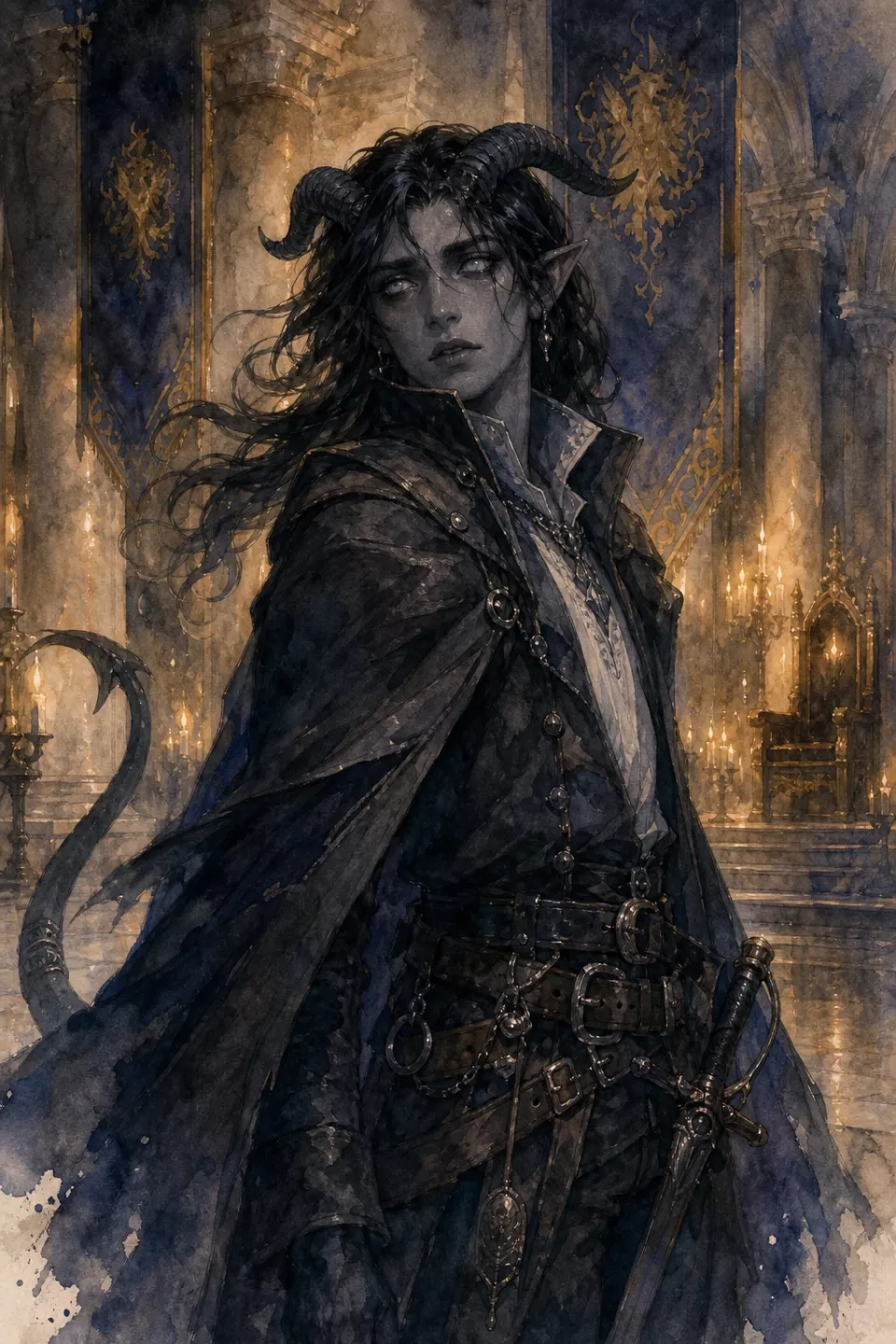
Kairos xyloph
Tiefling, Bard, Chaotic Neutral
Backstory
Kairos Xyloph was born on the thirteenth night of Frostwane, when the moon hung low over Fables and every hearth flame burned blue. Their mother, Maribel Xyloph, went into labor during the Lantern-Telling at the village of Once Upon a Hill, with half the town gathered beneath the old oak to hear a tale about a prince who had forgotten his own name. The midwife later swore that Kairos arrived laughing. Their first cry sounded so much like a plucked harp string that the musicians stopped playing and the storyteller lost his place. A pair of small horns crowned their brow, their tail curled around the midwife’s wrist, and a red mark shaped like a comma rested over their heart.
Maribel was a traveling balladeer who collected songs the way other people collected buttons. She could sing a beggar’s lament in seven voices and remember the name of every village she had passed through. Kairos’s father, Orlan Vell, was a mapmaker, peddler, and occasional liar who drew roads that did not exist until someone believed in them. He met Maribel at the Briar Market, where he sold maps of impossible places and she accused him of inventing three of the rivers. They married after a week, separated after three months, and remained fond of one another for the rest of their lives. Orlan vanished into the western folktales when Kairos was six, leaving behind a brass compass that points toward the most interesting trouble rather than north.
Kairos was raised mostly by their grandmother, Ysabet Xyloph, in a crooked house built from the ribs of an old storybook dragon. Ysabet had once been a court musician, though no one agreed which court, or whether it belonged to a king, a witch, or a particularly well-spoken fox. She taught Kairos the family trade: never trust a song with only one verse, always leave a coin beneath a guest’s pillow, and never accept a gift from a creature that refuses to say what it wants in return. Ysabet also taught them the lute, the fiddle, the pennywhistle, and the sharper arts of a performer—how to make a crowd laugh before it noticed the purse had gone missing, and how to turn an insult into a chorus everyone would sing by morning.
Their mother returned whenever the roads allowed, filling the house with rainwater, foreign sweets, and rumors from distant chapters of Fables. Maribel loved Kairos fiercely but disliked staying anywhere long enough for love to become an obligation. Their partings were never quiet. She would leave at dawn while Kairos slept, then discover a new verse nailed to her wagon by sunset. Kairos learned early that affection could be sincere and still fail to remain. They now greet promises with a crooked smile and judge devotion by who is still present after the music stops.
Kairos has two younger siblings: Pippa, a human girl with Maribel’s singing voice, and Rook, a tiefling boy whose horns grow in a lopsided pair like crooked branches. Pippa stayed with Maribel and now performs in the river towns, sending Kairos letters full of gossip and pressed flower petals. Rook remained with Ysabet, where he repairs instruments and claims to hate every song Kairos writes. The two siblings bicker through enchanted mirrors, trade insults in three languages, and would cross a cursed forest for one another without asking why. Their older half-sister, Elowen Vell, is Orlan’s daughter from a marriage before Maribel. Elowen is a stern keeper of roads and regards Kairos as a charming disaster, though she quietly replaces the soles of their worn boots whenever they pass through her town.
The wider Xyloph family is no less troublesome. Cousin Moth plays cards with goblins beneath the roots of the King’s Oak. Cousin Tansy married a talking wolf, divorced him, and still sends him birthday cakes. Cousin Bell has been turned into a porcelain swan three times and insists the third transformation was deserved. At family gatherings, stories are treated as evidence, insults are offered as gifts, and no one leaves without owing someone a favor. Kairos learned to listen for what people mean beneath what they say. They can hear a lie in a badly timed breath, a lonely person in the way they applaud, and an invitation hidden inside a threat.
When Ysabet died, she left Kairos her black-lacquered lute, a room full of unfinished songs, and a final instruction written on the kitchen wall: “Do not become the ending someone else wrote for you.” Kairos took the lute, Orlan’s wayward compass, and three silver coins from the family shrine before leaving the dragon-bone house. They now wander Fables as a singer, rumor-trader, card cheat, and occasional rescuer of people who insist they do not need rescuing. Kairos performs for coin, secrets, and the pleasure of watching a room change when they find the right song. They do not seek a throne, a prophecy, or a clean answer. They seek the next good story—and intend to make certain their name is not written in the margins