
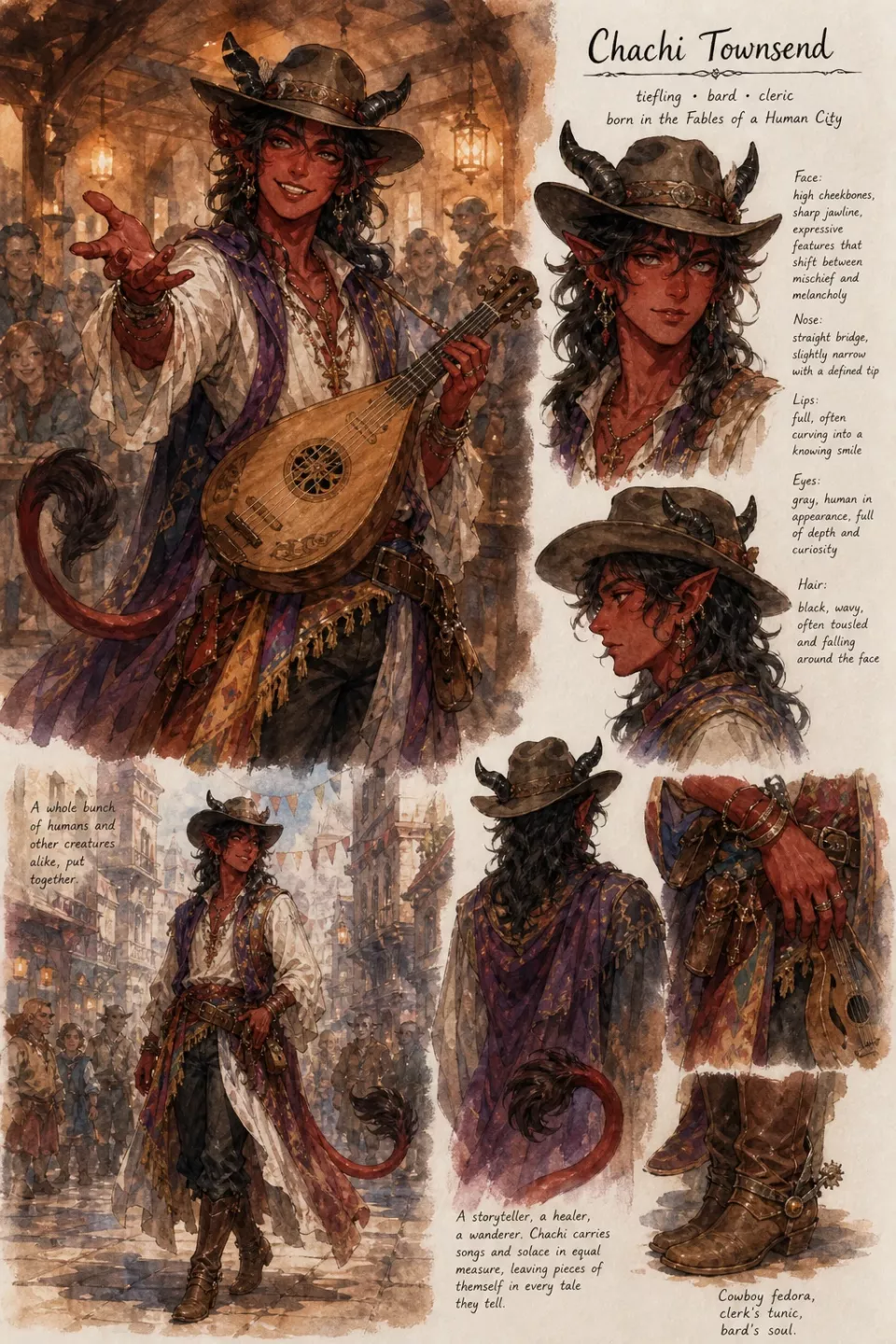
Revak Solmire
Tiefling, Bard, Chaotic Neutral
Description
Revak Solmire carries himself like a performer waiting for his cue, all charcoal skin, copper eyes, close-curled horns, and a narrow tail that flicks whenever a lie enters the room. Smoke clings to his clothes after anger, fear, or a particularly moving song. His blackwood lute bears scorch marks from the night the Red Marigold burned, and he plays it with the easy precision of a man who can turn a tavern’s laughter into a weapon. He grins at danger, bows to insults, and never sits with his back to a door.
Before the fire, Revak was a gifted thief and pickpocket. He lifted wallets from noble courtiers between verses, slid rings from drunken merchants during applause, and once stole a magistrate’s seal without interrupting the man’s conversation. The theater taught him misdirection; his mother taught him to watch the pause before a promise. He still counts purses by the sound of their coins and catches himself reaching for unattended valuables, though he now returns most of what he takes—usually after learning what it is worth. Each stolen trinket reminds him of the people who vanished beneath the Red Marigold’s canvas.
Revak believes the theater was never merely a troupe, but a hidden cause, a vessel for forbidden songs and names powerful people wanted erased. He hunts the missing final verse, the scorched contract seal, and the mother who vanished with the copper ledger. His old talents open locked rooms, empty guarded pockets, and place him close enough to overhear dangerous secrets. Ambition keeps him moving when guilt would make him stop; if the Red Marigold’s last song can expose those who destroyed it, Revak means to perform it before a crowd too large to silence.
Backstory
Revak Solmire was born beneath the canvas roof of the Red Marigold, a traveling theater that crossed the border roads of three kingdoms. His father, Caldris Solmire, belonged to a tiefling bardic bloodline famed for voices that could bend a room toward laughter, grief, or silence. The Solmires carried wine-red skin, swept-back horns, and a talent for binding scraps of magic into melody. Caldris could tune a lute by listening to a heartbeat and had inherited a collection of songs said to have been composed by an archdevil’s court musician.
Revak’s mother, Veyra Kharz, came from a harsher lineage tied to Belial’s old furnace-cities. Her family had once forged infernal contracts and branded oathbreakers, and their heritage showed in ash-gray skin, ember-orange eyes, black claws, and a thin line of heat along the palms. Veyra had no gift for song, but she could read a lie in the pause before a person answered. From her, Revak inherited his pale charcoal complexion, copper irises, and the faint smell of smoke that clung to his clothes after strong emotion. His horns curled close to his temples like ram’s horns, unlike either parent’s, and his tail ended in a narrow, arrow-shaped barb.
The theater welcomed Caldris’s music but never Veyra’s family name. Town guards searched her trunk for contract seals, priests watched Revak during performances, and children threw pebbles at his horns from behind market stalls. Caldris taught him rhythm, stagecraft, and the old Solmire songs; Veyra taught him Infernal script, the value of a precisely chosen promise, and how to sleep with one hand beneath his pillow. Revak learned early that people heard his father’s music and saw his mother’s blood before they listened to his own words.
At seventeen, Revak found a sealed copper ledger hidden beneath the theater’s floorboards. Its pages named performers who had vanished after singing one forbidden Solmire ballad, including Caldris’s older sister. Before he could ask his father about it, the Red Marigold burned during a performance, and Veyra disappeared with the ledger. Revak escaped with his father’s blackwood lute, a scorched contract seal, and half a song whose final verse was missing. He now travels from court to caravan, trading music and mockery for clues, chasing the truth about his family while taking whatever dangerous work pays enough to keep the road beneath his boots.