
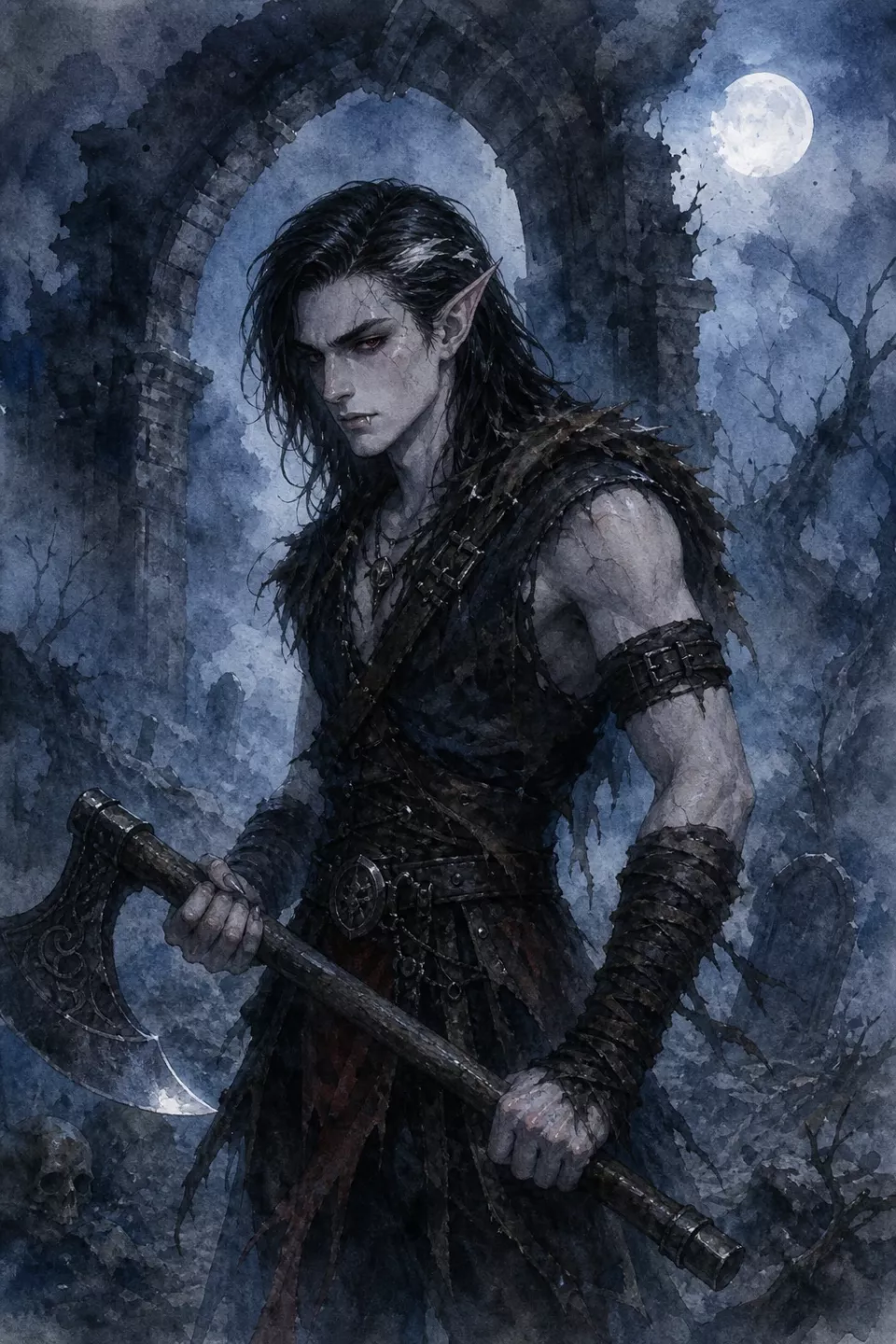
Urge
Dhampir, Barbarian, Chaotic Neutral
Keeps a careful count of every door, window, and living creature in a room.
Refuses food offered by strangers, but accepts fresh blood without hesitation.
Speaks softly enough that others lean closer, then remembers every word they say.
Shows unexpected tenderness toward vermin, strays, and anyone treated as a monster.
Sleeps in unfamiliar places only after checking the shadows beneath the bed.
Treats promises like chains: binding, useful, and dangerous to break.
Can become possessive of people who show repeated kindness.
Smiles at funerals, not from joy, but because the dead no longer have to pretend.
Description
Urge has the lean, unsettling beauty of an elven portrait left too long in a crypt. His skin is pale ash with a faint blue undertone, smooth across the cheeks and brow but stretched thin enough at the temples to reveal delicate veins. Long, tapered ears rise through his hair, their tips dusted with a muted gray. His face is narrow and sharp-featured, with high cheekbones, a slender nose, and a mouth framed by two slightly elongated canines.
His eyes are a deep garnet red, darkening almost to black around the pupils and catching stray light like wet glass. Thick charcoal hair falls to his shoulders in uneven layers, with a single white streak at the right temple; the front is swept back from his face, exposing the pointed ears and the fine, angular shape of his brow. His lashes are black, and his expression often seems still enough to be mistaken for carved stone until his gaze suddenly fixes on someone.
Urge’s body is wiry rather than muscular, built with the quiet strength of a drawn bow and the narrow waist and long limbs of his elven blood. His fingers are slender, ending in hard, faintly pointed nails the color of smoked glass. His hands and throat are cool and nearly bloodless in appearance, while the skin around his mouth darkens to a wine-colored flush after feeding. In certain light, his shadow seems to lag half a heartbeat behind him, and his movements carry a smooth, soundless precision that feels less like grace than hunger held perfectly still.
Backstory
Seventeen years ago — The Name
Urge was born in the village of Bellwether Ford during a thunderstorm that split the old chapel bell. Their mother, Mara Venn, claimed the other parent was a traveling physician named Sable. The villagers knew better. Sable never ate, never cast a reflection in the chapel’s silver basin, and left before dawn with blood on his cuffs.
Mara named the child Urge after the craving that woke them both: the newborn’s first cry came with a hunger for blood rather than milk.
Fifteen years ago — The Locked Room
Mara kept Urge in the attic whenever strangers came to the house. She nailed iron charms above the door and taught them to sleep beneath a wool blanket during daylight. At night, she brought home rabbits from the snare lines and made Urge drink from a clay cup.
She never called them a monster. She also never let them forget what one might do.
Urge learned to read from Mara’s collection of medical ledgers, then learned to lie by watching her tell the neighbors that the child upstairs had a wasting fever.
Eleven years ago — The First Mistake
A boy named Pell climbed through the attic window while Urge was alone. He saw the fangs, screamed, and ran toward the village square. Urge caught him before he reached the stairs. The hunger took control for three heartbeats.
Pell survived, but the marks on his neck became Bellwether Ford’s favorite story. By sunset, villagers had gathered outside the Venn house with torches. Mara drove them away with a hatchet and sent Urge into the woods until morning.
When Urge returned, Mara had packed a coat, three books, and a silver knife.
Ten years ago — The Road North
Mara took Urge to the city of Greyharbor, where no one cared about a pale traveler so long as they paid rent. She found work washing linens at the House of Saint Orra and rented two rooms above a cooper’s shop.
Urge began carrying messages through the city at night. They learned which alleys smelled of lamp oil, which taverns kept blood sausage behind the bar, and which watchmen could be bribed with information. They also learned to smile without showing their teeth.
Seven years ago — Sable Returns
Sable found them in Greyharbor.
He arrived at the House of Saint Orra wearing a physician’s coat and carrying a black wooden case. He spoke to Urge as though no time had passed, then offered Mara a cure: a ritual that would make Urge fully mortal.
Mara refused. She knew Sable’s cures always required a living heart.
Sable left a red mark on the door and promised to return when Urge was old enough to choose.
Four years ago — The Fire at Saint Orra
Sable kept his promise. His servants set fire to the charity house while Mara slept. Urge woke to smoke, splintering doors, and the sound of people trapped below.
Mara pushed Urge through a window and stayed behind to help the patients escape. She never came out.
Urge returned after the flames died. Beneath the rubble, they found Mara’s silver knife and a single page from a medical ledger, scorched around the words: Hunger is not a command.
Two years ago — The Red Ledger
Urge tracked Sable’s servants across Greyharbor, following rumors of missing vagrants and sealed wagons marked with the same black sigil as his case. They discovered a ledger listing dozens of dhampirs, failed cures, and payments from noble houses.
Mara’s name appeared on the final page.
Urge stole the ledger and burned every page except the ones naming Sable’s patrons. Since then, they have sold pieces of the list to families seeking their vanished relatives and kept the last names for themself.
Present Day — The Unfinished Hunt
Urge travels from town to town under borrowed names, carrying Mara’s silver knife and the blackened ledger pages in a waterproof case. They accept night work, avoid temples with polished mirrors, and never sleep in a room without two exits.
They hunt Sable, but revenge is no longer the only reason. Urge wants to find every dhampir named in the ledger before Sable can use them—or convince them that hunger makes them his property.
When the craving rises, Urge repeats Mara’s final lesson aloud: “A hunger is a warning. It is not an order.”
Personality
Speaks softly and stands too close, watching people’s throats when they talk.
Refuses food in public but accepts bitter coffee, salted meat, and anything heavily spiced.
Keeps to the edges of rooms, where exits, shadows, and sleeping bodies are easy to count.
Answers personal questions with a question of their own, then remembers every detail.
Becomes unnervingly polite when angry, using names and titles with careful precision.
Sleeps in short stretches and wakes at the slightest heartbeat that isn’t their own.
Urge speaks softly, stands too close, and watches throats while people talk, but combat strips away every trace of restraint. They meet danger head-on, trusting sharp reflexes, hard-earned endurance, and the instinct that tells them when to bite, duck, or break bone. Rage comes as a sudden red pressure behind the eyes; they do not lose themself in it so much as let the hunger and fury point in the same direction. Afterward, they count their wounds, clean their weapons, and repeat, “A hunger is a warning. It is not an order.”
Carries a distinctive black hatchet at the hip, rolling its haft across their knuckles when restless and gripping it before words when the barbarian’s temper starts to rise.
The black hatchet Mara used at the Venn house did not come from Bellwether Ford. She stole it from Sable’s black wooden case the night he first visited, prying it loose from a velvet-lined slot beside his surgical tools; its head was forged from coffin nails and blackened silver, and its haft bore the same sigil later found on his ledger. Mara used it to break the attic lock when the villagers came with torches, then pressed it into Urge’s hands before sending them into the woods. Years later, Urge found it beneath the ashes of Saint Orra, its edge buried in the door where Mara had held the patients back. They keep it tucked beneath their coat and oil the blade with saltwater. Urge never explains its origin twice. When asked, they turn it over in silence; when using it, they whisper, “A hunger is not an order,” before striking.