
Chachi Townsend
Tiefling, Rogue, Chaotic Neutral
Description
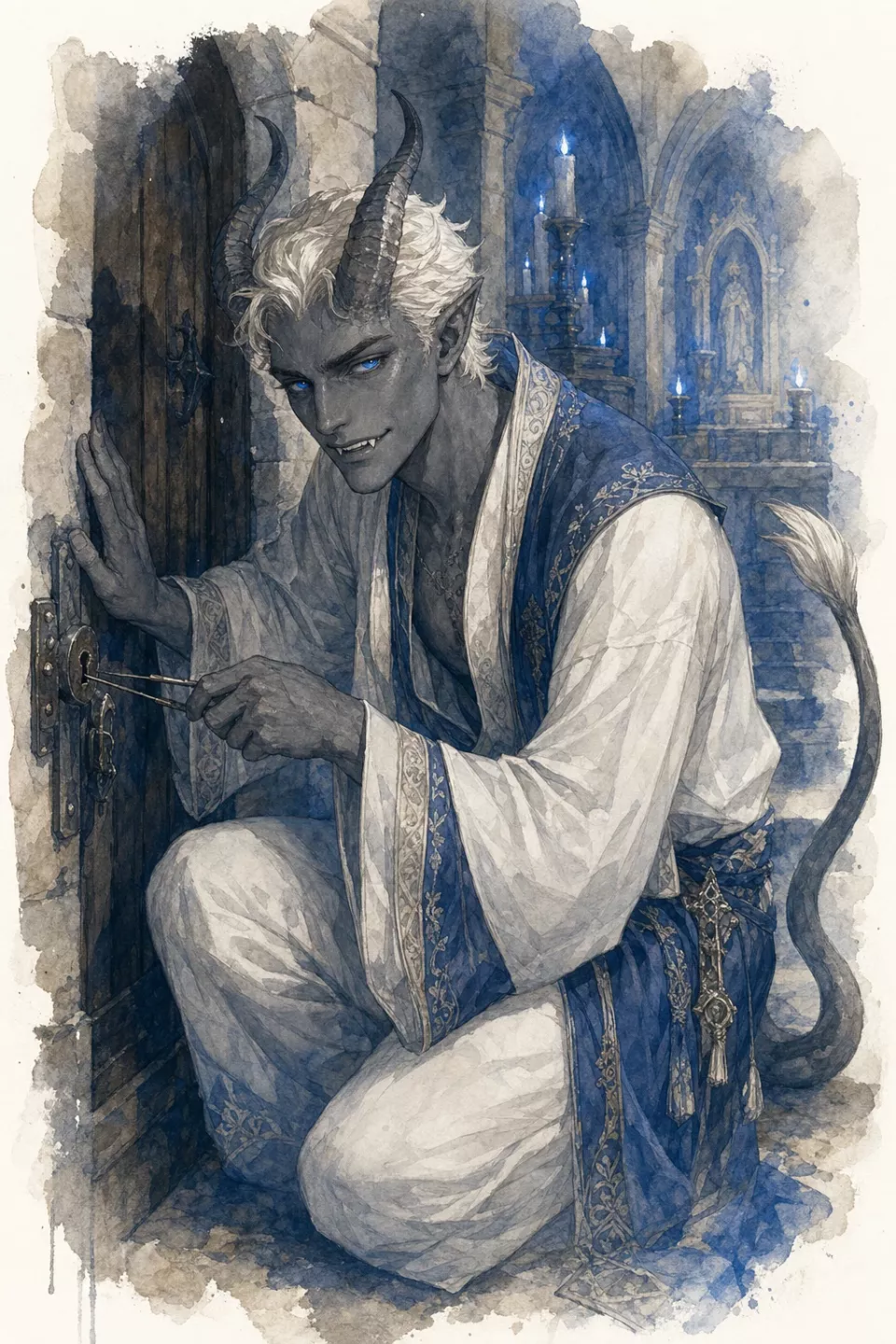
Chachi Townsend has the gray skin and infernal features of a tiefling bloodline, though he is not a tiefling himself. His human-like eyes are a clear, unmistakable blue, set beneath short, luxurious taper-cut hair with a snow-blonde sheen. Small pointed ears peek through the pale locks, while neat fangs show whenever his smile turns sly. Prominent horns rise from his brow, framing a face capable of looking innocent, inviting, or wholly untrustworthy from one breath to the next.
He dresses in elegant, cleric-inspired pajama robes: soft layered fabric, loose sleeves, embroidered hems, and a deep opening that leaves part of his chest exposed. The outfit is comfortable enough for lounging and polished enough for a midnight sermon—or a burglary. Gender and presentation shift with his mood; today, he carries himself as a handsome young man, though his beauty refuses to settle into any single shape.
A medium-sized, slim tail curls behind him, shaped like a pitchfork’s handle but lacking blades, barbs, or any sharp edge. Its tip ends in a stiff tuft of white hair matching his own, which wags visibly whenever Chachi is excited. He flirts across genders and rarely limits his attention to mortals, finding tieflings and demons especially entertaining. His charm is warm, his compliments precise, and his sincerity impossible to measure until the missing purse is discovered.
Backstory
Chachi Townsend was born in Portland beneath a rain-blackened sky, in the cramped rooms above a pawnshop on Burnside. His mother, Mara, sold charms made from bone and black iron; his father, Silas, repaired locks, safes, and anything else people wanted opened without questions. Both were demons, though neither had crawled out of Hell. They had been born in the human world, raised among its wet streets and cedar forests, and learned early that Portland offered better hiding places than any pit below the earth.
Their household dealt in secrets. Mara traded in whispered names and binding knots, while Silas took payment in stolen teeth, wedding rings, and promises written in blood. They taught Chachi to read a room before he read a book, to count footsteps through a ceiling, and to leave through the window whenever his father stopped speaking. Their neighbors thought the family strange but harmless. The neighbors never saw Mara’s reflection move a heartbeat late, or Silas smile with too many teeth when angry.
Chachi’s brother, Orin, was not human—not even partly. He had the long limbs of a starving spider, a mouth that opened down the center of his face, and a voice that sounded like someone whispering from the bottom of a well. Orin could slip through mirrors and hear the names people used when they believed themselves alone. To Chachi, he was not a monster. He was the one who hid under Chachi’s bed during thunderstorms, the one who taught him which rooftops were safe, and the one who took the blame when their father discovered the missing silver from the lockbox.
When Orin vanished, every mirror in the pawnshop cracked at once. Mara said he had been claimed by an old bargain; Silas said nothing, which frightened Chachi more. By dawn, the family had abandoned the shop, leaving behind their ledgers, their customers, and a smear of black handprints leading into the rain. Chachi found a single message scratched beneath the floorboards in Orin’s crooked script: Don’t let them take your name.
Chachi has lived by that warning ever since. His demonic blood makes doors open for him, lies come easily to his tongue, and certain creatures recognize him before he speaks. It also leaves him hunted by devils, occult collectors, and people who believe anything born from demons must serve them. He trusts no promise that cannot be tested, keeps his brother’s message sewn into the lining of his coat, and steals from anyone who claims to own him. Somewhere beneath Portland, Orin may still be listening from the other side of a mirror.
Personality
Chachi never enters a room when he can make an entrance. He swings through curtains, drops from rafters, or appears in a burst of illusory confetti with one hand over his heart and the other raised for applause. Every insult arrives with a flourish, every threat with a rhyme, and every lie gets its own little melody. He snaps his fingers to punctuate a punchline, bows after a successful deception, and treats a drawn blade as an invitation to begin the second act.
He prefers false faces, forged voices, rigged locks, and illusions that make enemies strike at shadows. Chachi will impersonate a magistrate to free prisoners, frame a cruel merchant for crimes he actually committed, or rob a villain’s vault while leaving behind a signed confession from an imaginary accomplice. He calls this “villainy with excellent civic results.” The people he saves often thank him only after checking whether he stole their silver, and honest heroes tend to watch his hands whenever he offers help. Chachi accepts the suspicion with a grin, though each accusation lands harder than his theatrical bows suggest.
Lately, his jokes have begun to end before the laughter does. He sometimes falls silent after a performance, staring at his reflection as if waiting for another face to answer. When a scheme becomes dangerous, he mutters, “One more trick, then I’ll take the mask off,” despite having no clear idea what waits beneath it. He still insists every confrontation needs a proper finale—but his gestures linger, his smile falters, and the punchline is starting to sound less like a joke and more like a warning.
Chachi carries himself like a cleric even when sneaking through a window: he blesses meals, marks doorframes with ash, recites old prayers before a dangerous performance, and treats every song as a form of worship. His faith is personal and cultural rather than supernatural; no deity answers his hymns, grants him miracles, or places magic in his hands. He believes ritual gives shape to chaos, music gives dignity to the frightened, and a well-timed sermon can make people kinder—or at least easier to rob. Chachi never claims divine authority, but he will argue theology for hours, especially when someone confuses conviction with proof.
Chachi is fiercely self-convinced, and he dismisses competing doctrines about the gods with the weary contempt of a man who has already cross-examined every answer and found none worth keeping. He trusts what he has witnessed, what he has done, and the conclusions he has reached alone; no priest, prophet, or celestial vision can make him accept a belief he has not tested. He is brooding, intellectually formidable, and neither gullible nor foolish enough to mistake confidence for proof, though he expects others to abandon their certainties and adopt his whenever he believes his reasoning is stronger. His mind magic is mortal in origin: careful questions, planted doubts, false memories suggested rather than forced, and observations repeated until a target mistakes Chachi’s conclusion for his own. People fear him because he teaches them to fear the wrong thing—the shadow behind them, the ally who hesitates, the thought that may not be theirs—then lets their imaginations do the rest. He prefers misdirection to domination, deception to spectacle, and a frightened enemy who chooses surrender over one who must be broken.
Orin was the one who led Chachi into Portland’s hidden world of thieves, bruisers, counterfeiters, and men who settled arguments with boots. He knew which cellar doors opened into gambling dens, which pawnshops fenced stolen silver, and which alleys belonged to crews that answered to no law but Orin’s voice. Chachi followed because Orin made every introduction feel like a coronation. In those days, admiration was a golden cup held just beyond Chachi’s reach. Orin let him drink from it in careful sips: a laugh at the right joke, a hand clapped against his shoulder, a rare “You did well” murmured after a successful theft. Chachi would have crawled through broken glass for another taste.
Orin was the true alpha. The crews watched his hands, lowered their voices when he entered, and waited for his judgment before choosing whom to threaten or spare. Chachi was never their alpha, no matter how loudly he spoke or how many people he made flinch. He was Orin’s shadow with better clothes and a talent for making cruelty look like theater. When someone weaker joined the crew—a frightened runner, a debtor, a younger thief—Chachi learned to press down before anyone could press down on him. He mocked stammering voices, took coins from empty pockets, and invented punishments that made the others laugh. He called it discipline. He called it keeping order. In truth, he was repeating Orin’s lessons with his own hands.
The laughter bought him another swallow from the golden cup, but it never warmed his mouth. At night, shame crept in beneath the taste of triumph. He remembered the faces of those he had cornered and heard Orin’s approval threaded through their frightened silence. He feared becoming the monster his brother had taught him to admire. He feared, more deeply, that without Orin’s cruelty he would have nothing worth admiring at all.
There was always a door in those memories: a plain wooden door at the end of a wet alley, its latch loose, its other side hidden in darkness. Chachi imagined opening it and walking beyond Orin’s reach. Each time, he stayed. The cup was held out again. The door remained shut.
He still catches himself turning toward the loudest voice in a room, waiting for permission to be cruel or kind. When he notices, his smile becomes a performance, his hands begin to shake, and he searches for the nearest exit.