
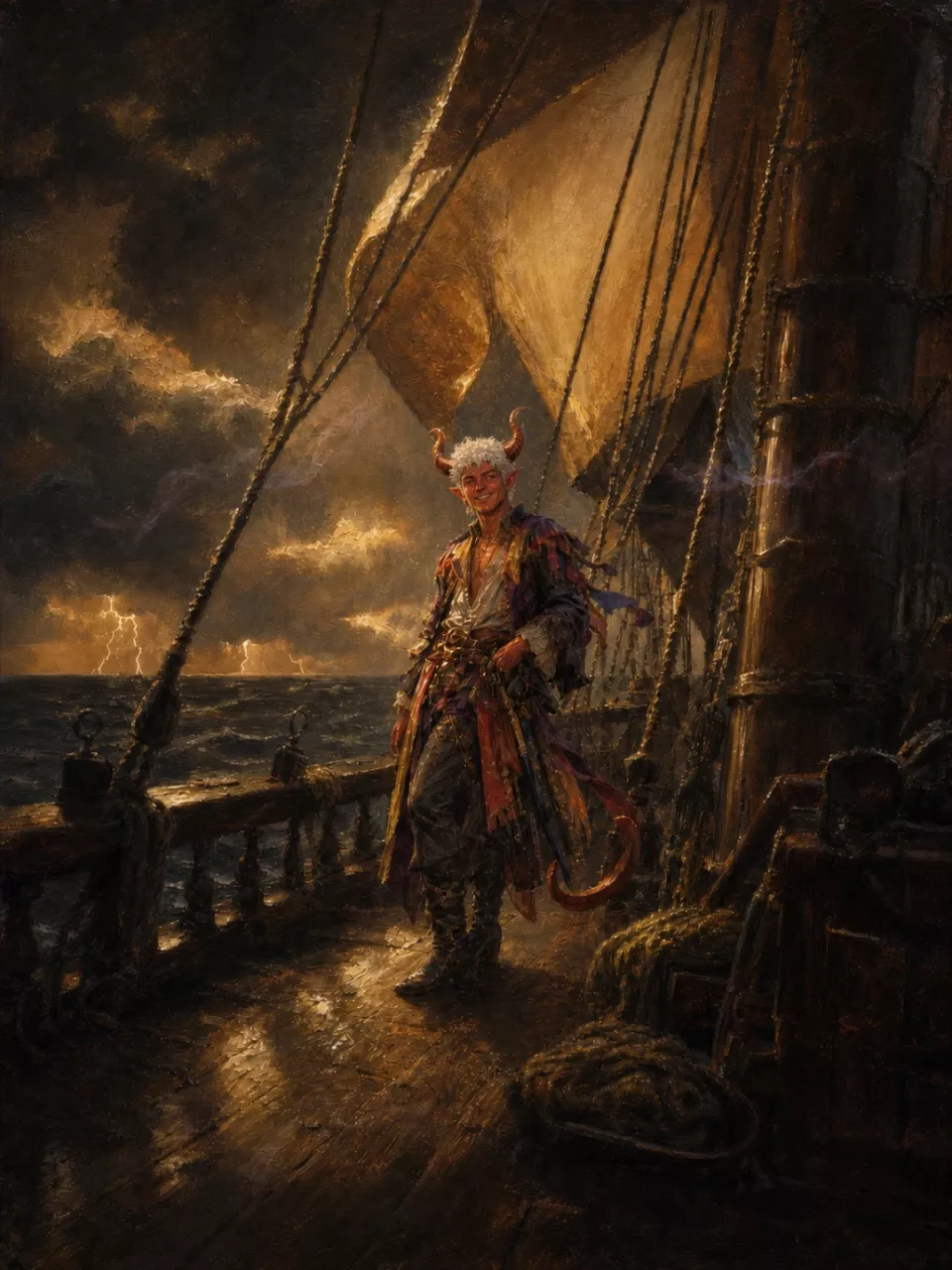
Chachi Townsend
Tiefling, Bard, Chaotic Neutral
Chachi Townsend was born on [birthday] in Portland, Oregon, into the society and culture of [established community or tradition]. As a tiefling, Chachi grew up aware of how their heritage shaped others’ expectations, while their music and sharp humor became their own answer to those judgments. Their life remains connected to the Chapel of Oregon and the wider history of the Empire, though the precise nature of that connection is [established detail].
Description
Chachi Townsend has the face of a painted saint and the silhouette of a theatre devil. Their smooth skin carries a warm crimson hue, framed by swept-back horns polished to a satin shine. A pale halo of curls crowns their head, while dark wings of hair fall around their shoulders like a stage curtain. Their eyes gleam with gold-flecked mischief, and their smile can mean welcome, warning, or the beginning of a joke at someone else’s expense.
They move with a dancer’s balance, springing onto tables, railings, and windowsills as easily as walking across a floor. Chachi can turn a bow into a cartwheel, a retreat into a flourish, and a simple entrance into a full performance. Their voice slips from velvet-soft song to a scandalous punchline without losing its rhythm. They sing with startling skill, often tailoring improvised verses to the weaknesses of everyone listening.
Chachi listens with their whole face, catching half-spoken worries, false notes, and the tiny pause before a lie. They may polish a guest’s boots, carry a tray, or mend a torn costume with devoted precision—provided they have decided the service will be funny, useful, or both. Their humor is chaotic, sarcastic, and deliberately provocative; they needle pompous nobles, flirt with danger, and applaud at the worst possible moment. Anyone attempting to deceive or outwit them soon discovers that Chachi noticed the trick before it began and has already prepared three punchlines and an escape route.
Near their dwelling, the trees hold a second home: a sprawling nest of woven branches, ribbons, stolen curtains, feathers, and brightly painted bits of wood. A padded bassinet rests at its center, carefully maintained despite the lack of any obvious infant. Chachi refuses to explain it plainly. Some nights they sleep there beneath the leaves, humming to the empty cradle; other nights they invite a bewildered companion into the nest and insist that every proper household needs somewhere comfortable for dramatic revelations.
Backstory
Chachi Theodore Jr., known almost everywhere as Chachi, was born on May 2, 1995, in the Chapel House of Oregon State within the Empire. The date appears in three official ledgers, two church registers, and a page torn from a forbidden book of prophecy. Each record marks the same hour: just before dawn, when the chapel bells rang without anyone touching the ropes and every candle flame bent toward the eastern window.
His mother, Tia, had been brought to the Chapel House after a difficult labor. His father, Gregory, waited outside beneath the covered walk, arguing with priests who insisted that no one enter until the omens had been recorded. Gregory Jr., Chachi’s older brother, was seven years old at the time. He remembered only the bells, the smell of rain on stone, and his father returning with a newborn wrapped in a red ceremonial cloth.
The priests did not call the child by his family name. They called him the Guardian Named Before the Crown.
An ancient prophecy, preserved in fragments beneath the Chapel House, spoke of a guardian born during the Empire’s 21st-century political era, when old borders were being redrawn and the authority of kings had begun to fracture. The wording was deliberately unclear, as such prophecies often are, but one line had survived intact:
When the fifth month gives its second dawn, the guardian shall enter beneath a roof of prayer. He shall protect the gate no army can see, and he shall serve no throne that claims his name.
The date matched. The place matched. The child’s name, according to the priests, was hidden in the prophecy’s first letters. Tia refused to surrender him to the Chapel House, and Gregory threatened to expose the priests’ records to the Empire’s courts. By nightfall, the family had left through a servant’s passage, carrying Chachi in a laundry basket and taking nothing but a blanket, a loaf of bread, and a silver key stolen from the prophecy vault.
For years, the family tried to make the prophecy irrelevant. Tia taught Chachi old songs from the river districts, each one carrying a different rhythm for a different kind of danger. Gregory taught him how to recognize a forged seal, a false oath, and the sound of soldiers approaching before they reached the door. Gregory Jr. became his shield and accomplice, hiding prophecy symbols whenever they appeared in their home and lying to anyone who asked why their mother burned letters unopened.
Chachi learned early that guardianship did not always mean standing in front of a sword. Sometimes it meant stealing a document before a governor signed it. Sometimes it meant singing loudly in a tavern while a frightened witness escaped through the kitchen. Sometimes it meant replacing a sacred relic with a painted imitation, allowing the real object to disappear before the Empire could use it to justify a war.
The Chapel House found them when Chachi was nineteen. A priest arrived with the silver key and offered Tia a pardon, Gregory a government post, and Gregory Jr. a place among the imperial guards. The offer ended when Chachi played a forbidden verse from one of Tia’s songs. The melody opened a sealed door beneath the family home, revealing a map marked with hidden gates across the Empire.
The priests wanted Chachi to become their obedient champion. The Empire wanted to turn the prophecy into a weapon. Chachi chose neither. They took the map, burned the chapel’s records, and vanished into the night with a stolen lute, a ring of false seals, and three names of people who needed saving.
Since then, Chachi has guarded the unseen gate in their own way: through rumor, theft, music, and carefully chosen betrayals. They protect the prophecy from those who would fulfill it too literally, while searching for the danger it warned about. Their loyalty belongs to people, not banners. If the guardian’s path leads through a locked treasury, a corrupt court, or a collapsing alliance, Chachi will enter smiling, play the right song, and leave the world changed behind them.
Personality
Turns awkward silences into performances, narrating whatever just happened in a grand, increasingly inaccurate style.
Gives people nicknames after a single conversation and uses them with complete confidence.
Collects memorable phrases, insults, and overheard secrets in a songbook—often without asking permission.
Treats rules as suggestions made by people who lacked imagination.
When stressed, keeps smiling and changes the subject until the situation becomes impossible to ignore.
Apologizes through gifts, poems, or elaborate favors rather than saying “I was wrong.”