
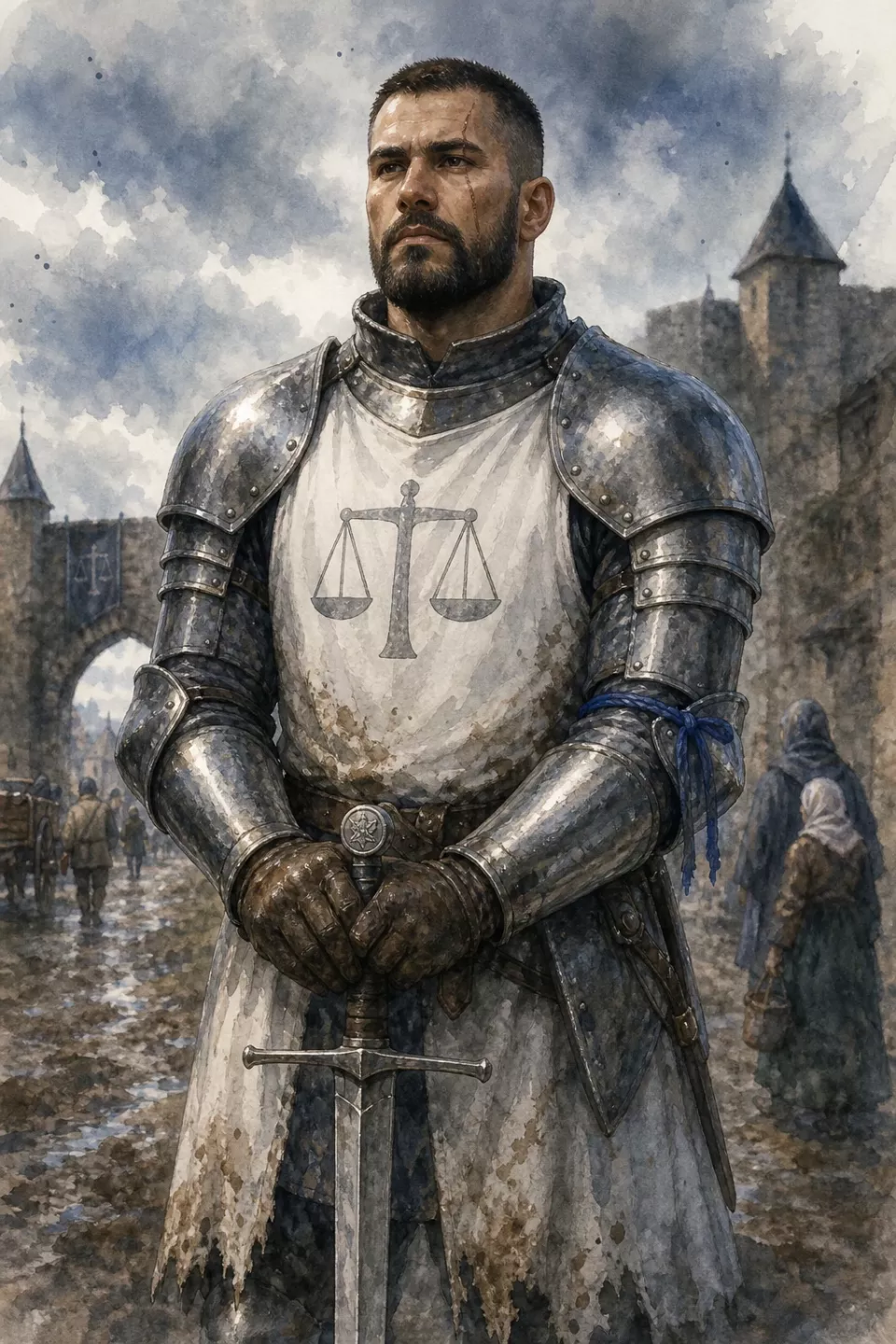
Pallor Pendragon
Human, Paladin, Lawful Good
Description
Pallor Pendragon is a broad-shouldered human man with close-cropped black hair, a square beard, and a pale scar running from his left temple to the corner of his mouth. He wears well-maintained plate armor beneath a white surcoat marked with a simple silver scale, its edges stained by mud and travel rather than neglect. A blue cord binds his right vambrace, a keepsake from the village that raised him. He stands with his back straight and both hands resting over the pommel of his longsword, giving every conversation the weight of a sworn testimony. Pallor speaks in a calm, carrying voice and addresses beggars, nobles, and soldiers by the same respectful title. When danger appears, he steps between it and everyone else without waiting to be asked.
Backstory
Pallor Pendragon was raised in Bellwether, a farming village built around a stone bridge and a shrine to the Lady of Scales. His mother kept the shrine’s ledgers; his father repaired plows, hinges, and the iron rings that held the bridge together. From them, Pallor learned that law was more than the commands of kings. It was the promise that a widow’s claim would be heard, that a hungry child would not be turned from a full granary, and that a strong man would answer for the harm he caused.
At sixteen, Pallor joined the village watch after a band of deserters began extorting food from the surrounding farms. The watch captain, Ser Aldren Voss, taught him to hold a shield line, question witnesses, and wait until anger had finished speaking before passing judgment. Pallor wore a blue cord around his right arm during those years, a gift tied there by the village children on the morning he took his oath.
The deserters returned in winter, this time led by a knight wearing the king’s colors. They demanded Bellwether’s grain and accused the villagers of hiding rebels. When the elders refused, the knight ordered the bridge burned with the watch and half the village still on it. Pallor stood in the way. He remembers the crunch of boots on frozen mud, the smell of pitch, and Ser Aldren shouting for him to run. The knight’s sword opened Pallor’s face from temple to mouth before the village smith drove a hammer into the man’s knee.
Bellwether survived, though three homes burned and Ser Aldren died beneath the collapsing bridge. The knight escaped before dawn. Pallor spent the next year searching for proof that would bring him before a proper court, gathering names, brands, and testimony from every village the company had threatened. His evidence brought the deserters to justice, but the knight had friends in the royal court and vanished behind sealed orders.
A silver-scaled paladin named Dame Meriel heard Pallor give his testimony. She offered him training at her chapterhouse, where he learned to wield divine power without mistaking certainty for righteousness. Pallor swore the Oath of the Silver Scale, pledging to shield the helpless, speak the truth under threat, and place justice above rank.
Now he travels beneath the white surcoat of the order, carrying Bellwether’s blue cord and a list of unanswered names. He seeks the knight who ordered the burning, but he also hunts the official who erased the crime. Pallor will obey lawful authority until it commands cruelty; then he will plant his sword in the ground, stand between victim and executioner, and demand that the law remember what it was made to protect.
Personality
Pallor treats every promise as a bond that must be witnessed, recorded, and kept. He asks who was harmed before asking who broke the law, then listens without interrupting, one thumb rubbing the blue cord around his vambrace. When weighing a decision, he taps two fingers against his sword pommel and repeats the facts aloud, as if daring falsehood to correct him.
He is patient with frightened witnesses, hungry villagers, and clumsy allies, offering practical help before advice. He addresses strangers with formal respect, but watches their hands and remembers every name they give him. Nobles receive the same courtesy as beggars—and the same direct questions when their orders cause suffering.
Pallor’s contradiction unsettles people: he seems built for obedience, yet becomes immovable when authority demands cruelty. He dislikes shouting, threats, and needless punishment, but his calm refusal can feel harder than anger. Among companions, he takes the first watch, repairs damaged straps without comment, and steps between danger and anyone who hesitates. He rarely speaks of his scar unless asked. Accusations of recklessness leave him defensive; beneath his certainty lies the fear that one missed warning, one delayed judgment, will cost another village its dead.