
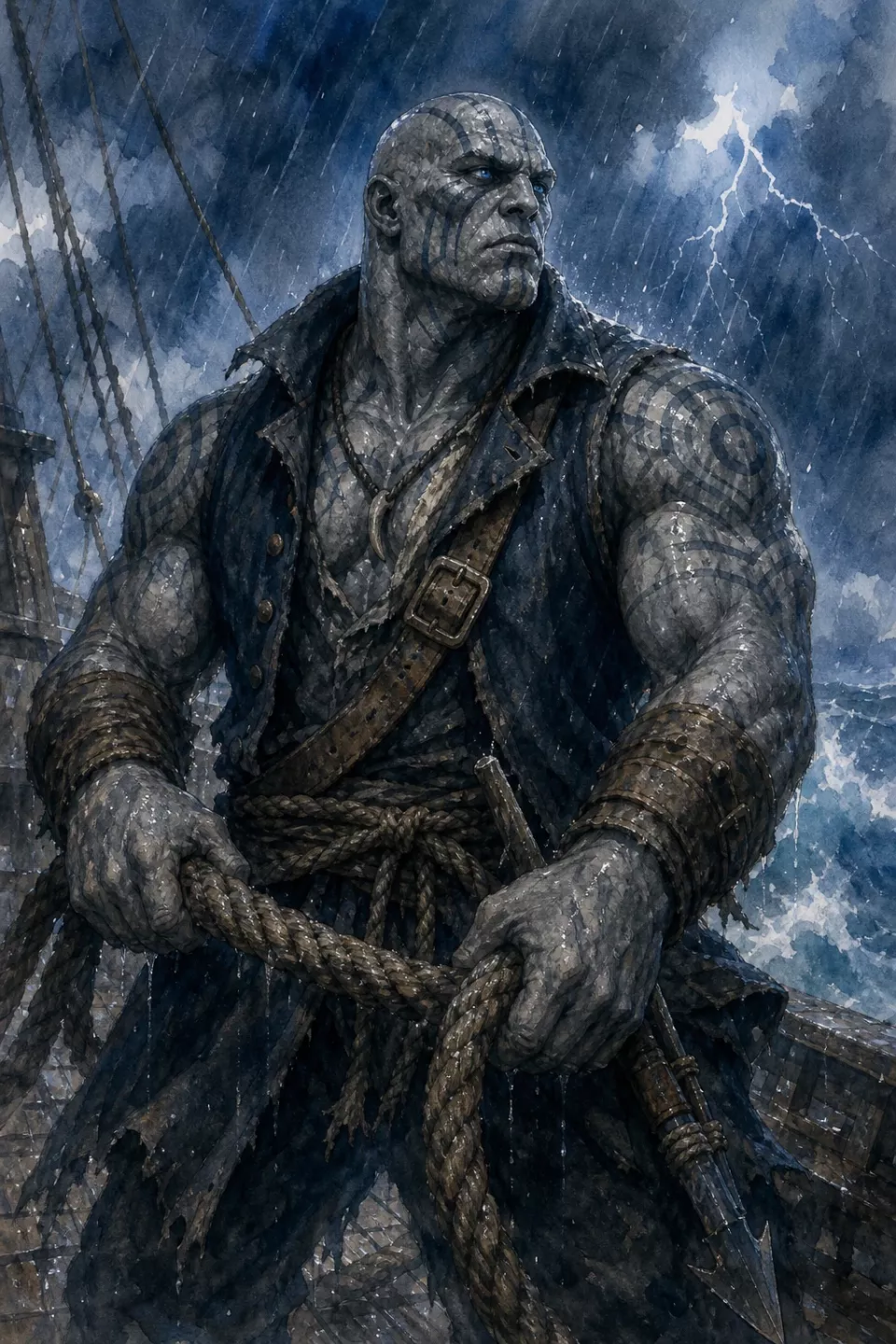
Rusty Shackleford
Goliath, Barbarian, Neutral
Description
A broad-shouldered Goliath sailor and former whaler, built for hauling wet rope, boarding storm-tossed decks, and bringing down creatures larger than a rowboat.
Backstory
Rusty Shackleford spent twenty years at sea, first as a deckhand and later as the strongest harpooner aboard the whaler Salt Widow. He knew every sound a ship could make: rope groaning under strain, timbers knocking in heavy swells, and the deep, hollow breath of a whale beneath the hull. His crew hunted for oil, not sport, and Rusty carried the work’s weight without complaint.
That changed on a fogbound morning when the Salt Widow found a pod of whales drifting in blood-dark water. Something had torn them open from below. Before the crew could turn away, a many-jawed sea monster struck the ship, snapping the mast and dragging three sailors overboard. Rusty drove a harpoon into its eye, but the beast’s thrashing tore him from the deck. He fell through the rigging, caught his leg in a loop of wet rope, and was dragged beneath the waves.
The rope pulled him toward the wreck. Rusty cut himself free with the small gutting knife he wore at his belt, then wedged himself inside the shattered remains of a lifeboat. The monster circled the debris, following the blood from Rusty’s torn shoulder. He stayed motionless in the dark water until the creature finally descended after the sinking wreck. When it vanished, Rusty used the broken boat as a float and kicked toward the nearest reef.
He reached the rocks at dawn, half-frozen and too weak to stand. A lighthouse keeper found him there three days later, alive because he had eaten the last of his emergency salt pork and refused to let go of his harpoon. The Salt Widow’s captain and most of the crew were gone. The surviving owners called the disaster bad luck and sent another ship to the same waters.
Rusty refused to sail. He had learned that some beasts were not quarry to be harvested; they were predators that followed ships, villages, and frightened people wherever they went. He sold his share of the Salt Widow, kept his harpoon, and walked inland for the first time since childhood.
Now Rusty hunts monsters on land. He follows reports of missing travelers, livestock found crushed, and claw marks too high for any wolf. Each hunt is a chance to face the kind of creature that once owned the sea—and to make sure no crew meets it unprepared.
Personality
Rusty treats every road like a deck in bad weather. He checks bridges before crossing, ties down loose gear, and counts his companions whenever the group stops. He speaks in short, practical sentences and uses old sailing commands when startled: “Brace,” “Hold fast,” and “Cut the line.” He shares food with anyone who has worked a night watch, but he has little patience for nobles who have never hauled a rope or cleaned a blade. When danger appears, he steps between it and the least prepared person without announcing why.
Flaws
Rusty cannot ignore a monster report, even when the trail is a trap or the odds are poor. He trusts his instincts more than maps, officials, or anyone who was not there when the Salt Widow sank. Deep water leaves him tense and sleepless, though he hides it by polishing his harpoon until dawn. He also has a habit of treating allies like a ship’s crew, barking orders when frightened and taking disobedience as a personal betrayal.
Motivations
Rusty wants to find the sea monster that destroyed the Salt Widow and finish the hunt he began years ago. Until then, he takes every monster contract he can find, especially those involving isolated settlements or missing sailors. He sends part of every reward to the families of the crew who died, though he never tells them that the money came from him.