Hurley
Human, Cleric, Lawful Neutral
Description
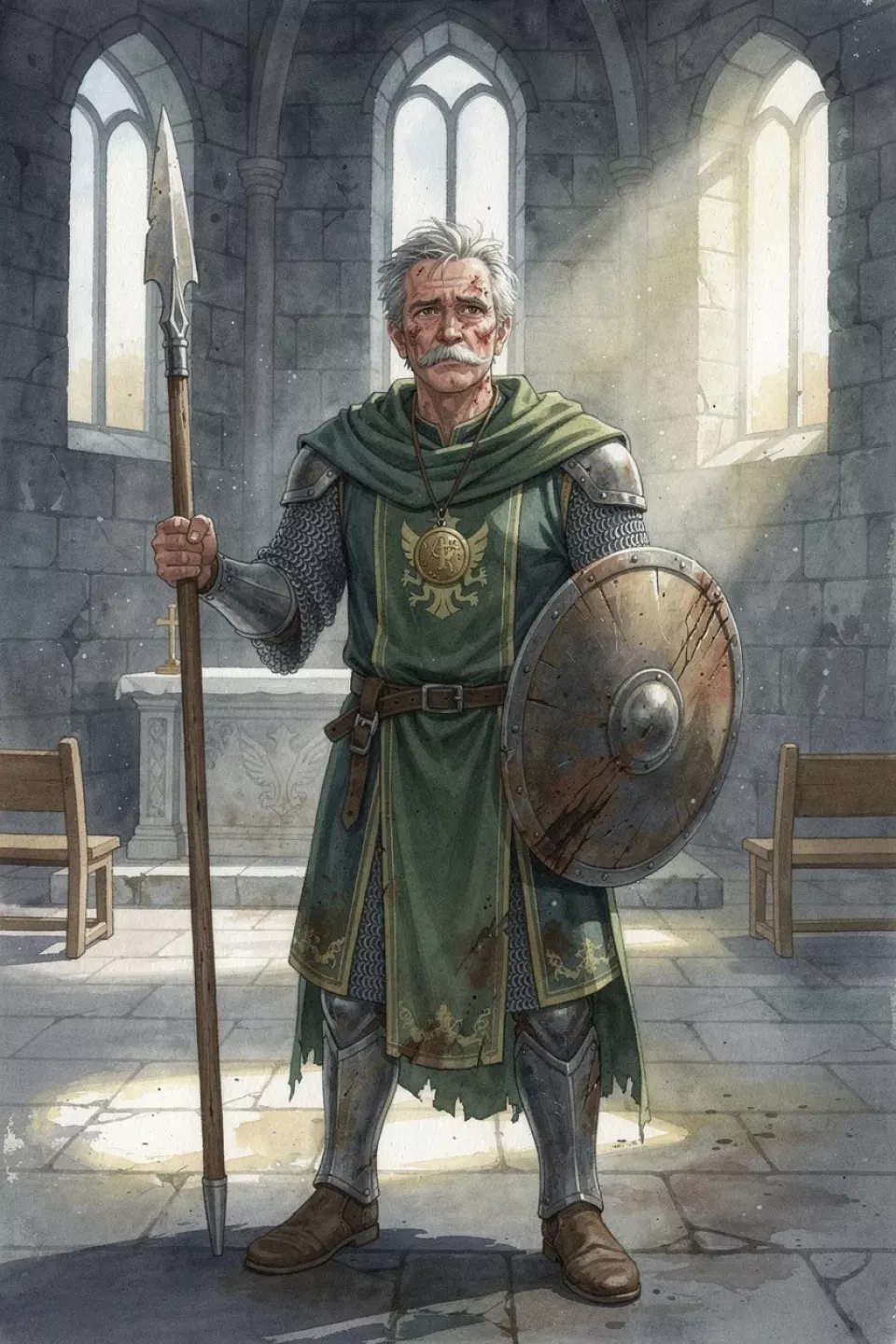
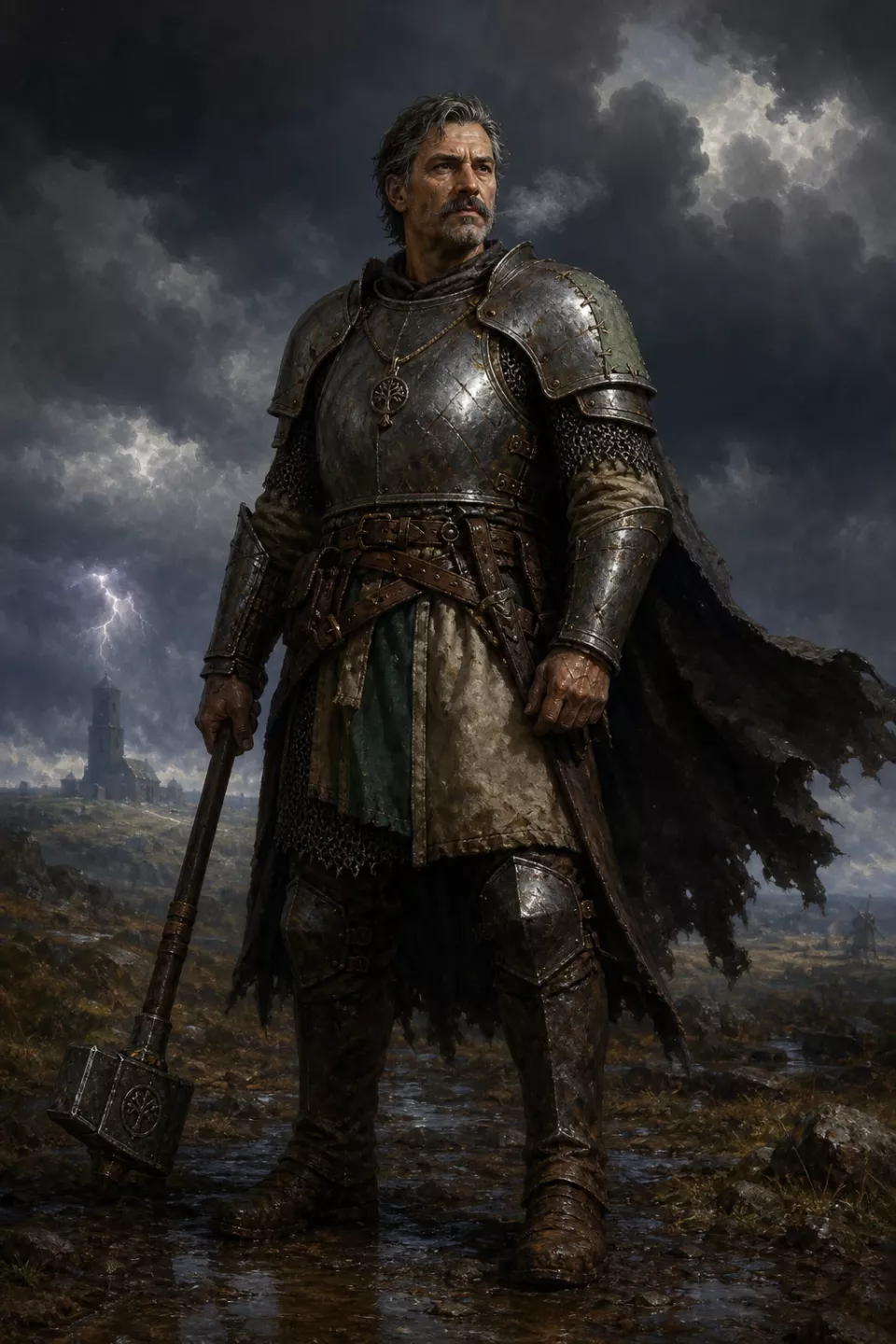
Hurley is a weathered cleric in his middle years, a former soldier whose armor still smells faintly of smoke and wet iron. His hair has turned salt-and-pepper, and the steady set of his mustache never quite relaxes. He keeps old chainmail under battered, half-plate guards—scuffed, scratched, and dented in places that match the scars on his knuckles—gear that still holds fast even when the straps squeak in the wind.
He doesn’t wear loyalist insignia or the dynasty’s colors, though the metal is unmistakably made for a king’s war. Instead, his left shoulder bears a small stitched patch of green thread that looks fresh against the grime, like he’s been sewing it on after battles for years. When he prays, a faint, cool breath seems to move through the air—he can feel it more than he sees it—until the clouds above rattle with distant thunder.
Hurley serves a nature-bound law: weather, soil, and season as rules that must be kept. He keeps his holy symbol on a cord beneath the breastplate, small enough to hide, carved with a winding vine wrapped around a falling raindrop. When he walks, he stamps once at the edge of puddles and damp earth, as if checking for order in the ground itself, then turns his face toward the sky like someone who expects the storm to answer.
Backstory
Hurley spent thirty years as a disciplined Northreach Empire captain, earning decorations through competence in three major campaigns and countless skirmishes. Five years ago, during a brutal winter in the northern territories, he took a poisoned arrow meant for a junior officer. Infection spread fast, and healers gave him three days. On the second night, delirious with fever, Hurley felt divine intervention press against his consciousness, offering him a choice: renewed service or death. He accepted; the fever broke and the wound closed. He finished his service, retired with honors, but the calling never left him. He treats it as a debt—his second chance demands continued duty—so he became a cleric and has spent the past five years learning to channel his divine gift with the same methodical discipline he used in swordwork, viewing it as simply his next posting in an endless career of obligation.
Personality
Hurley is a practical, plainspoken man who communicates with soldier's directness—clear orders preferred over philosophy. Thirty years of command taught him to listen more than speak, a habit that makes his measured words carry weight.
Despite this discomfort, he remains reliable. He honors his obligations without question, deflecting embarrassment with gruffness that closes off commentary. He will fulfill his clerical calling and aid those in need, but with the air of a man enduring an unwelcome posting rather than embracing faith.
Events
Last week, Hurley marched his company through the rain-slick switchbacks outside Greyhook Pass, where the wind howls between stone ribs and every step sounds like a warning. The job was simple—hold the road until the wagons cleared—until the treeline started moving wrong. Not just raiders, not just bandits. Their boots kept landing in the same footprints, as if someone behind the curtain was counting steps.
Opposite him came a knot of “willbreak” cultists: hooded, pale-faced figures with waxy handprints on their shields and lanterns that burned blue without any warmth. They didn’t rush like thieves. They advanced in spaced pairs, halting whenever Hurley’s men raised their weapons, then throwing chalky vials that hissed against steel like hot spit. Between volleys, they called numbers in unison—low, steady—matching their marching cadence to the pass itself.
Hurley didn’t try to out-swarm them. He did what he’d always done in Northreach: take away the enemy’s plan. He had his line form a shallow wedge, then ordered his archers to stop chasing targets and aim only at lantern-glass. “Break the light,” he barked, “not the men.” When the cultists’ blue gleams flickered and guttered, their spacing faltered—just long enough.
Then came the part that made his tactics feel less like prayer and more like drill.
As the cultists hurled their next wave of vials, Hurley stepped forward with the same calm he used to check a formation. He planted his staff butt-first in the mud, one boot braced against the slope, and opened his prayer like a written command—short lines, firm gestures, no theatrics. The air cooled around him. Rain stopped beading on his armor for a heartbeat, as if the storm itself paused to listen. A thin, stubborn ward flared over his forward ranks, turning the cultists’ corrosive hiss into nothing more than steaming stains.
When the first pair finally broke through, they didn’t meet steel—they met inevitability. Hurley drove his shield into the taller one’s chest and didn’t give him space to swing. His chainmail clinked sharp as judgment. He kept his movements economical, then snapped a hand to the wounded soldier beside him, fingers pressing into a flaring bruise blooming black around the ribs. The cultist flinched at the sight, like they’d expected the cleric to be busy “preaching” while they killed the easy targets.
Hurley’s answer was to do both—because he always did. He treated the injury like a problem on a roster: locate it, close it, steady it.
His staff rang once against the ground—one clean sound to mark the rhythm—and a pulse of healing rolled outward, stopping the bleed that had already started to foam under the man’s chin. The soldier blinked, swore, and pulled himself upright. No grand miracle, no glowing choir—just the sudden, practical return of breath.
That steadiness gave the rest of Hurley’s line permission to fight again. The cultists tried to regroup behind their lantern pairs, but Hurley had already switched the order: now his flanks moved, two steps, stop, cross-guard, hold. Every time a cultist tried to cast or throw, one of his men was already in the way. Every time someone slipped—mud, bodies, panic—Hurley was there, swapping positions as if he’d counted the distance years ago.
The memorable moment came when a lantern-bearer got too close—blue flame licking at the wax on his shield. The cultist lifted both hands as if calling a spell from his palms, and Hurley saw the tell: the tremor in the fingers, the breath held too long. He didn’t dodge. He shoved his staff between them like a barrier post, then laid his other hand on the cultist’s wrist. “You’re tired,” Hurley said, voice flat and certain, the way he’d correct a recruit’s grip. “So am I. Stand down.”
The words weren’t smoke or poetry—they were instruction. The ward held, and the flame went wrong: the blue guttered, the lantern glass cracked, and the cultist’s posture collapsed as if the counting numbers had fallen out of his head. Around them, the remaining cultists scattered rather than reform. A few tried to drag lantern shards into their own armor, as if they could stitch their plan back together, but by then the road belonged to Hurley’s men again.
By dawn, Greyhook Pass was washed in rain and trampled mud, the cultists’ lanterns dark and useless. No massacre—Hurley made sure his line took prisoners where they could. He checked his wounded one by one, swore at the worst injuries like he was mad at the universe for being sloppy, and kept his orders tight until everyone stood and ate something warm.
Hurley ended the fight with his mustache still unruffled, old armor creaking as he turned away from the broken lanterns. He didn’t celebrate. He filed it away like another campaign report—efficient, measurable, done. Then, while the others spoke excitedly about “cleric miracles,” he only gave a short nod to his sergeant and said, “We held the road. That’s what matters.” His eyes tracked the treeline anyway, already listening for the next time the enemy tried to count their steps in the dark.